Tuesday, August 21, 2012

I'll Stop The Whirl And Melt With You!

http://www.youtube.com/watch?v=QZw3lxyuhEU
The Same Goes For Religiousity. You Might Hear A Female Say "Wow, He's A Really Religious Guy. His Parents Raised Him Well." But, In Actuality, It Wasn't Entirely His Environment That Shaped His Religious Commitment And Religious Faithfulness. Much Of It Had To Do With His Genes. His Genes Predisposed Him To Be Highly Religious And These Genes Then Interacted With His Environment To Create The Religious Person He Came To Be.

  1. Join CARTA live! Ajit Varki discusses the "Mind Over Reality Transition": The Evolution of Human Mortality Denial
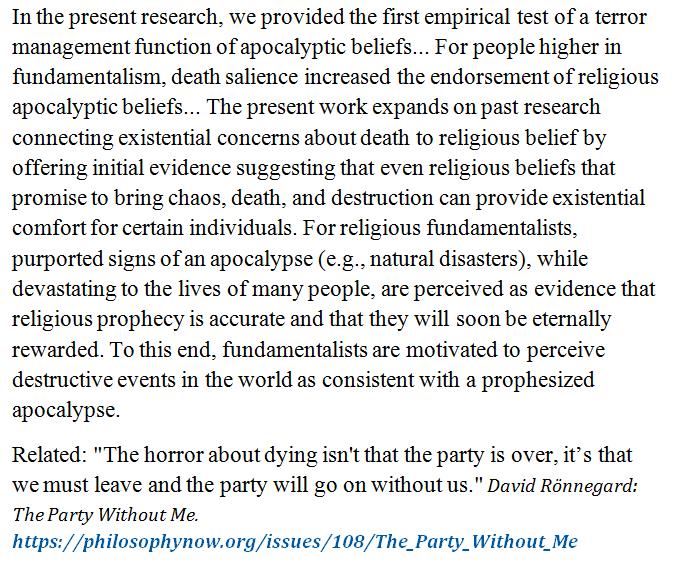
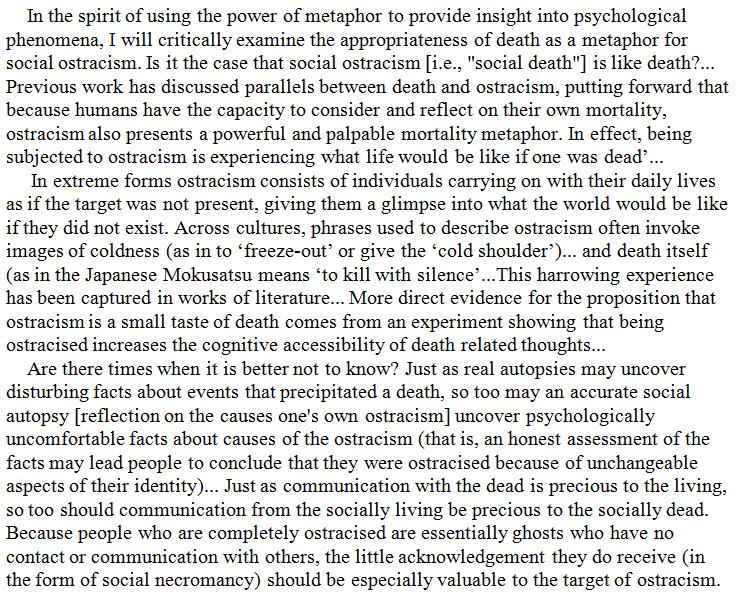
The worst thing about death isn't that the party is over; it’s that we must leave and the party goes on without us.

  1. I don't think that the terrible thing about dying is the expiration of the self. The terrible thing is that WE must leave - and the party goes on without us. Social comparison until the end.


https://www.youtube.com/watch?v=Kyagrj-OHAM
0:45 "There's No Reason To Feel Sorry When It Comes To Death! Cuz In G0D There Is No Death! Jesus Said Any Man Who Believes My Word...Shall NOT See Death!" - Sam


Imagine, for example, a prehistoric hunter making his way home through unfamiliar woods. His mind wanders as he travels, and he is only absently aware of ambient noises of the forest, but when a twig snaps in the underbrush, his mind is instantly, involuntarily focused. This intense mental alertness results from the sudden activation of the amygdala, the ancient limbic watchdog that monitors all incoming sensory information for signs of danger and opportunity. When the amygdala detects the unaccounted-for auditory impulses caused by the sudden noise, it rivets the hunter's mind upon it. Already, the autonomic system has triggered an arousal response, bracing the body for action. In the same split second the hunter first hears the suspicious sound, the cognitive imperative is driving the causal operator to discover what it might mean.

Discovering a cause is the first priority of the causal operator, but as the hunter scans the underbrush, no cause is apparent. Uncertainty at such an urgent moment is intolerable to the causal operator, so it does what it is designed to do in the absence of a specific cause: it proposes one. The proposal arises out of activity in the hippocampus, the limbic structure where past experiences are stored as memories. Rapidly, the mind scours these memory banks, sorting and cross-referencing information as it searches for any pertinent content - images, sounds, or larger chunks of experience - that might shed light on the problem at hand.

The computational task is staggering, but in an instant, all the brain's memory files have been consulted, all irrelevant data has been ignored, and the casual operator presents its best hunch by conjuring in the hunter's mind the idea of a leopard lurking in the trees. For the hunter, who had seen the tracks of a big cat earlier that day, and who had once been chased by a leopard in woods very similar to these, there was no need for further deliberation; the unseen predator was utterly real, the danger was immediate, and his only option was to run.

Later, in a calmer moment, the hunter might reconsider his reaction. After all, he had no way of knowing for sure that the noise was made by a leopard - it's just as likely that the twig was stepped on by a plump wild pig, or by a harmless foraging deer. But the hunter didn't need to know the leopard was real, it was enough that he believed it. The causal operator is designed to promote survival, not necessarily to find the truth, and if there really had been a leopard in the bushes, it was the hunter's ability to think about the potential for danger, as opposed to an antelope that can only react, that would save his life.

But why would he believe so surely in something he didn't know absolutely to be true? We think there was more to the hunter's reaction than simple common sense. We believe he accepted the realness of the unseen leopard because neurological forces allowed him no other choice.

The hunter's process of believing that began as amygdalar function focused the mind's cognitive operations upon the mystery of the noise in the bushes. The causal operator, or, more specifically, the brain structures that support the causal operator, responded by proposing the presence of a leopard. Simultaneously, the binary operator interprets the problem as a conflict of opposites. In a specific sense, this conflict is between the concepts of leopard and not-leopard, but on a deeper and more general level it is a fundamental conflict of life versus death.

In either case, these urgent conflicts must be effectively resolved. The analytical, verbally inclined left brain immediately attacked the problem by making certain logical connections: The hunter realized he was in leopard country, and remembered having seen leopard tracks a few miles back. It was logical to believe that a leopard might have been lurking in the trees.

At the same time, the hunter knew that the tracks he'd seen were at least several days old. He also knew that leopards do not customarily hunt at that time of the day. This led to the logical possibility that something other than a leopard - a deer or a pig, for example - was the source of the startling sound. The hunter now faced a logical dilemma: Fleeing might have cost him an easy kill, but hesitation might have cost him his life.

While the verbal, analytical left brain struggled with this problem, the intuitive, holistic right brain was taking a different approach. Thinking with images and emotions, rather than language and logic, the right brain analyzed how the situation felt. The right brain visualized the easy kill, and the reaction was highly positive. But those positive feelings were heavily outweighed by the vivid visualization of being eaten by a leopard. As the right brain dwelt upon this grisly possibility, a memory sprang to mind of a time when the hunter was chased by a man-eating cat in the woods very similar to these. The right brain remembered the terror and instantly made its decision: There's a leopard in the trees.

This emotional apprehension immediately colored the decision making process of the left brain. The logical idea of the leopard was now charged with emotional substance, and as the intuitive faculties of the right brain came into unified agreement with the logical powers of the left, the ideas in his head gained depth and authority. He not only thought there was a leopard in the bushes, he felt it in his bones.

Now the opposites of leopard versus not-leopard, and of life versus death, had been powerfully and neurologically resolved. A cause had been determined. Ideas had become emotionally charged convictions; a logical possibility had become a visceral belief.

In a sense, the hunter had created a simplistic myth - the myth of the leopard in the bushes. It began, as all myths do, with urgent, unanswerable questions. In this case: What is that noise, and what does it mean? The importance of finding answers compelled the mind, through the drive of the cognitive imperative, to bring the brain's analytical powers to bear. The causal operator found a plausible explanation for the noise. The binary operator framed the problem in terms of opposites. And finally, the holistic agreement of the left and right sides of the brain led to a whole brain unification that turned logical ideas into emotionally felt beliefs. These beliefs resolved all uncertainties and gave the hunter a coherent scenario in which he could react effectively.

Like all effective myths, the story of the leopard in the trees may or may not have been literally true. Yet this simple scenario explains the unexplainable in a way that allowed the hunter to take effective and possibly life-saving action. His belief enhanced his chances of survival, and that is precisely the goal of the cognitive drive.

This process is automatic: uncertainty causes anxiety, and anxiety must be resolved. Sometimes resolutions are obvious and causes are easy to spot. When they are not, the cognitive imperative compels us to find plausible resolutions in the form of a story, like the story of the leopard in the trees. These stories are especially important when the mind confronts our existential fears. We suffer. We die. We feel small and vulnerable in a a dangerous and confusing world. There is no simple way to resolve these enormous uncertainties. In such situations, the explanatory stories that the mind creates take the shape of religious myth.

It would be impossible to trace the endless web of cultural and psychological factors that led to the genesis of a single specific myth, and it would be foolhardy to suggest that anyone could explain for certain how any specific religious myth developed. But if we frame our discussion carefully, we can certainly examine the biological origins of the urge to make myth. We can even speculate upon the neurological origins of a single myth concept. Consider, for example, the following scenario: 
In a close-knit prehistoric clan, one of the tribe has died. His body lies on a bearskin. Others approach and touch him gently. They sense immediately that the man who used to be exists no more. What was once a warm and vital person has suddenly become a cold and lifeless thing.
The clan's chieftain, an introspective man, slumps beside the campfire and broods upon the lifeless form that was once his comrade. What is it that is missing? he wonders. How was it lost and where has it gone? As he watches the crackling fire his stomach tightens with sadness and anxiety. His mind's need for cause will not rest until it finds resolution, but the longer he dwells upon the unnerving puzzle of life and death, the deeper he sinks into existential dread.
"When You Die You Go Into A Comfortable Hole And We Blow You A Kiss G00D Bye!" - KoKo The Gorilla Mastering The Abstract Concept Of Non-Existence!

In neurobiological terms, the grieving chief is in the grip of the same arousal responses that seized the startled hunter. It began in the chieftain's brain when the amygdala noticed frustration in the thought processes of the logical left hemisphere - the effect of the chief's intense, prolonged brooding. Interpreting this frustration as a sign of distress, the amygdala triggered a limbic fear response, and sent off neural signals that activated the arousal system. Now, as the chief continues to ruminate upon his grief and fear, that arousal response intensifies. His pulse quickens, his breath grows shallow and rapid, and his forehead becomes beaded in sweat.
The chief stares vacantly at the fire, turning his troubles around and around in his head. Soon the fire has burned down to embers, and as the last flames sputter and die, an intuition strikes him: The fire was once bright and alive, but now it's gone, and soon there will be nothing but lifeless grey ashes. As the last wisps of smoke rise to the heavens he turns to the body of his fallen friend. It occurs to him that his comrade's life and spirit have vanished completely as the flames. Before he can consciously phrase the thought, he is struck by the image of the very essence of his friend escaping to heavens, like smoke, the rising spirit of the fire.   
This conviction begins as nothing more than an idea, just one more possibility offered up by the intellectual pondering of the brain's left side. At the same time, the brain's right side is proposing holistic, intuitive, nonverbal solutions to the problem. As the intellectual idea of the ascension of the spirits enters the chief's consciousness, it becomes "matched" with one of these emotional right-brain solutions. Suddenly, the agreement of both sides of the brain causes a neurobiological resonance that sends positive neural discharges racing through the limbic system, to stimulate pleasure centers in the hyopthalamus. Because the hypothalamus regulates the autonomic nervous system, these strong pleasure impulses trigger a response from the quiescent system, which the chief experiences as a powerful surge of calmness and peace.

All this happens in the wink of an eye, too fast for the arousal response that triggered the chief's anxiety to subside. For a remarkable moment, both the quiescent and arousal systems are simultaneously active, immersing the chief in a blend of fear and rapture, a state of intensely pleasurable agitation that some neurologists call the Eureka Response, which the chief experiences as a rush of ecstasy and awe.

In this transforming flash of insight, the chief is suddenly freed from his grief and despair; in a deeper sense, he feels that he has been freed from the bonds of death.

The insight strikes him with the force of revelation. The experience feels vividly, palpably real. In that moment, the opposites of life and death are no longer locked in conflict; they have been mythically resolved. Now he sees clearly the absolute truth of things - that the spirits of the dead live on.

He feels that he has discovered a primal truth. It is more than an idea, it is a belief he has experienced in the deepest reaches of his mind. Like the story of the leopard in the bushes, the chief's intuition about the ultimate destiny of the soul may or may not be true. What matters is the notion that it is based on something deeper than imagination or wishful thinking. We believe that all lasting myths gain their power through neurologically endorsed flashes of insight, like the one that struck the chief. These insights might take many forms, and can be triggered by many different ideas. For example, the chieftain might have seen fog rising up a mountain slope in the moonlight, and concluded that like the eerie mist, the spirits of the dead go off to dwell in the holy hills. Any idea might trigger a myth if it can truly unify logic and intuition, and lead to a state of left-brain/right-brain agreement. In this state of whole-brain harmony, neurological uncertainties are powerfully alleviated as existential opposites are reconciled and the problem of cause is resolved. To the anxious mind, the resonant whole-brain agreement feels like a glimpse of ultimate truth. The mind seems to live this truth, not merely comprehend it, and it is this quality of visceral experience that turns ideas into myths.

That personal myth becomes a communal myth when it is shared with others who find meaning and power in the resolutions it provides. There is no guarantee that this will happen. The chief's clan mates, for example, will not accept his insights unless, as they listen to him share his story, they experience within themselves the same neurological ring of truth that seized the chief during his moment of penetrating vision. Their reactions, in hearing the story, will not necessarily be as intense as the chief's, but if they feel even a small degree of neurologically experienced emotion, the chief's passionate testimony will gain credence. They will believe him not because they think he is right, but because they feel it. The chief may become considered a seer, and a system of mythology may rise from his beliefs.   

Why God Won't Go Away: Brain Science and The Biology of Belief. Newberg, D'Aquili, Rause, p. 67-73.
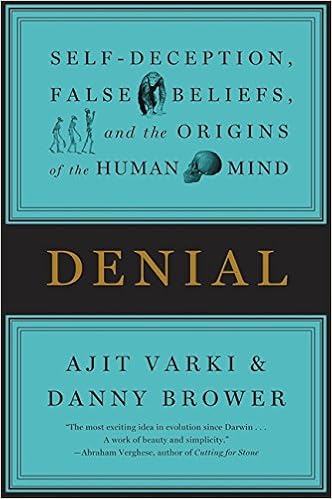

The Premise Of Ajit's Book Seems To Be Based On The Premise Of This Book
Which Is Based On The Hypothesis That Belief In G0D And The Afterlife Occurred Once Homo Sapiens Evolved The Capacity For Denial (Denying Reality)! Read Both Books To See If What I'm Saying Is Accurate! 

"HE IS I AND I AM HIM, SLIM WIT THE TILTED BRIM!" - NIGGA DOGGY DOGG!

At the heart of all the mystic's descriptions, however, is the compelling conviction that they have risen above material existence, and have spiritually united with the absolute. The primordial longing for this absolute union, and the transcendent experiences to which it might lead, are the common threads that run through the mystical traditions of East and West, of ancient centuries, and of the present. And while the mystics of different times and traditions have used many techniques to attain this lofty union, from the pious self-denial of medieval Christian saints to the ritual sexuality of some tantric Buddhists, the mystical states they describe sound very much the same. For example, here is the Sufi master Hallaj Husain ibn Mansur, a resident of medieval Iraq, describing the intimate intermingling of the mystic and his Lord:
I am He Whom I love, and He whom I love is I:
We are two spirits dwelling in one body.
If thou seest me, thou seest Him,
And if thou seest Him, thou seest us both.
The medieval Catholic sage Meister Eckhart, writing from the cooler climes of Germany, had similar words to say on the very same subject:
How then am I to love the Godhead? Thou shalt not love him as he is: not as a God, not as a spirit, not as a Person, not as an image, but as sheer, pure One. And into this One we are to sink from nothing to nothing, so help us God.
The theme of unity echoes in the Taoist wisdom of Lao-tzu...
Ordinary men hate solitude 
But the Master makes use of it, 
embracing his aloneness, realizing
he is one with the whole universe  
...Christian mystics relied upon intense contemplative prayer, fasting, silence, and various forms of mortification to free their minds from mundane matters and focus more intently upon God. These disciplines emerged independently, but all are based on a common insight; The first step in attaining mystical union is to quiet the conscious mind and free the spirit from the limiting passions and delusions of the ego.

"The separate self dissolves in the sea of pure consciousness, infinite, and immortal," says Hindu scripture. "Separateness arises from identifying the Self with the body, which is made up of the elements; when this physical identification dissolves, there can be no more separate self. This is what I want to tell you, beloved."

 ...In her book A History of God, religion scholar Karen Armstrong explains that the goal of Greek mysticism was to gain "a freedom from distraction and multiplicity, and the loss of ego - an experience that is clearly akin to that produced by contemplatives in nontheistic religions like Buddhism. By systematically weaning their minds away from their 'passions' - such as pride, greed, sadness, or anger which tied them to the ego - hesychiasts would transcend themselves and become deified like Jesus on Mt. Tabo, transfigured by the divine 'energies.'"

Armstrong finds similar ideas among the Islamic mystics, called Sufis, who developed the concept of 'fana, or annihilation, which was brought about by a combination of fasting, sleepless vigils, chanting, and contemplation, all intended to induce altered states. These behaviors often resulted in actions that seemed bizarre and uncontrolled, which, according to Armstrong, earned those mystics who practiced such techniques the nickname of the "drunken" Sufis. The first drunken Sufi was Abu Yizad Bistami who lived in the ninth century, and whose introspective disciplines, Armstrong says, carried him beyond any personalized conceptions of God.

"As he approached the core of his identity," she writes, "he felt that nothing stood between God and himself; indeed, everything that he understood as 'self' seemed to have melted away:  
I gazed upon [Allah] with the eye of truth and said to Him: "Who is this?" He said, "This is neither I nor other than I. There is no God but I." Then he changed me out of my identity into His Selfhood...Then I communed with him with the tongue of his Face saying: "How fares it with me with Thee?" He said, "I am through Thee, there is no god but Thou."
Bistami had united with God, Armstrong says, had become a part of God, beyond his self. In Armstrong's words, "This was no external deity 'out there,' aline to mankind: God was discovered to be mysteriously identified with the inmost self. The systematic destruction of the ego led to a sense of absorption in a larger ineffable reality."

"THERE IS NO OTHER THAN ME. A PROPHET, A MAC MESSIAH! TURN WATER TO HENNESSEY!" - MAC ALLAH

Ramachandran, the Temporal Lobes and God - Part 1

 TELL IT, MY INDIAN BROTHERS, TELL IT.  

 In their follow-up study Johnstone and colleagues found that, as before, patients with damage to their right parietal lobe (as measured by their ability to judge the orientation of lines and ability to identify the fingers on their left hand) were more spiritual. In particular, they tended to score higher on measures of forgiveness (so they were less ‘self-oriented’) as well on measures of spiritual transcendence (tending to agree with statements like “I feel the presence of a higher power”).

In contrast, patients with damage to their frontal lobe (measured using a kind of ‘connect the letters and numbers’ puzzle) tended to be less likely to engage in private religious practices and go to church. There was also some evidence that they tended to be less spiritual.

Johnstone et al suspect that the link between the right parietal lobe and spirituality comes about because damage to this part of the brain makes it harder to locate yourself in 3D space. So there is a tendency to feel that you are somehow merged or blurred in with your environment – hence the sensations of spiritual transcendence.

They don’t speculate on the link between better frontal lobe function and religious activities per se (focussing instead on the spirituality link) but I find this result intriguing. The frontal lobe is involved in classic ‘figuring stuff out’ actions, as well as social functioning. So it seems likely that good frontal lobe function could be important to this aspect of religiosity.

Read more: http://www.patheos.com/blogs/epiphenom/2012/07/different-parts-of-the-brain-linked-to.html#ixzz3NtuXCFVe
Ramachandran, the Temporal Lobes and God - Part 2

https://www.youtube.com/watch?v=hxDSOh66oWk
9:23 The BRAIN Has Evolved Neural Wiring That CreateS The Sensations, Thoughts, And Beliefs That, For Centuries, WERE Attributed To GOD's Presence Or GOD's Connection With You. So When You're Deep In Prayer Or Singing A Hymn In Church With The Rest Of The Congregation And You Feel That Closeness To GOD (That Transcendence) The Neurons In The GOD Region Of Your Brain Are Just Firing! (Those Parts Of Your Brain That Are Responsible For Belief In God, The Feeling Of The Presence Of God, Religious Out Of Body Experiences, Etc. Are Triggered By Neurochemicals, Electrical Signals, Etc. In The Brain Resulting In The Heightened Mental State Of Arousal That You Experience! In Other Words, The Concept Of God And The Sense That God Is With You Or You're With God, Are All A Product Of The Genetic And Biological Functioning Of The Brain!)


During brain scans of those involved in various types of meditation and prayer, Newberg noticed increased activity in the limbic system, which regulates emotion. He also noted decreased activity in the parietal lobe, the part of the brain responsible for orienting oneself in space and time.
“When this happens, you lose your sense of self,” he says. “You have a notion of a great interconnectedness of things. It could be a sense where the self dissolves into nothingness, or dissolves into God or the universe.”
Such “mystical”, self-blurring experiences are central to almost all religions – from the unio mystica experienced by Carmelite nuns during prayer, when they claim their soul has mingled with the godhead, to Buddhists striving for unity with the universe through focusing on sacred objects. But if Newberg and his colleagues are correct, such experiences are not proof of being touched by a supreme being, but mere blips in brain chemistry.
“It seems that the brain is built in such a way that allows us as human beings to have transcendent experiences extremely easily, furthering our belief in a greater power,” Newberg says. This would explain why some type of religion exists in every culture, arguably making spirituality one of the defining characteristics of our species.
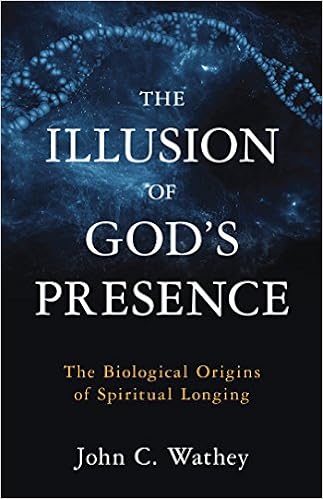
https://www.amazon.com/Illusion-Gods-Presence-Biological-Spiritual/dp/1633880745
http://www.patheos.com/blogs/daylightatheism/2016/01/book-review-the-illusion-of-gods-presence/

"It's An Illusion" -Cellskini
They found that people of different religious persuasions and beliefs, as well as atheists, all tended to use the same electrical circuits in the brain to solve a perceived moral conundrum – and the same circuits were used when religiously-inclined people dealt with issues related to God.

The study found that several areas of the brain are involved in religious belief, one within the frontal lobes of the cortex – which are unique to humans – and another in the more evolutionary-ancient regions deeper inside the brain, which humans share with apes and other primates, Professor Grafman said.

"There is nothing unique about religious belief in these brain structures. Religion doesn't have a 'God spot' as such, instead it's embedded in a whole range of other belief systems in the brain that we use everyday," Professor Grafman said.

The search for the God spot has in the past led scientists to many different regions of the brain. An early contender was the brain's temporal lobe, a large section of the brain that sits over each ear, because temporal-lobe epileptics suffering seizures in these regions frequently report having intense religious experiences. One of the principal exponents of this idea was Vilayanur Ramachandran, from the University of California, San Diego, who asked several of his patients with temporal-lobe epilepsy to listen to a mixture of religious, sexual and neutral words while measuring their levels of arousal and emotional reactions. Religious words elicited an unusually high response in these patients.

This work was followed by a study where scientists tried to stimulate the temporal lobes with a rotating magnetic field produced by a "God helmet". Michael Persinger, from Laurentian University in Ontario, found that he could artificially create the experience of religious feelings – the helmet's wearer reports being in the presence of a spirit or having a profound feeling of cosmic bliss.

RELIGIOUS REID!

The universality of religious behavior suggests that, as with language, it is mediated by specialized structures in the brain. Language is known to be supported by neural circuitry in certain regions of the brain because, if these regions are damaged even minutely, specific defects appear in a patient's linguistic abilities. No such dedicated regions have yet been identified with certainty for the neural circuitry that may underlie religious behavior. Excessive religiosity is a well-know symptom of temporal lobe epilepsy and could reflect the activation of neural circuits associated with religious behavior. But there is no agreement on this point, and the search for such circuitry in people who don't suffer from epilepsy is "suggestive but not conclusive," according to the neurologist Steven Schachter. It could be that religious behavior itself does not require a dedicated brain region large enough to be detectable by present methods.

The fact that religious behavior is universal strongly suggests that it is an adaptation, meaning a trait shaped by natural selection. If it is an adaptation, it must have a genetic basis, such as a suite of genes that are activated during development and wire up the neural circuits needed to induce the behavior. Identification of such genes would be the best possible proof that religious behavior has an evolutionary basis. The lack of any progress in this direction so far is not particularly surprising: the genes that underlie complex diseases have started to be identified only recently and funds to support such expensive efforts are not available for studying nonmedical complex traits.

An indirect approach to the genetic basis of religious behavior is through psychological studies of adopted children and of twins. Such studies pick up traits that vary in the population, such as height, and estimate how much of the variation is due to environmental factors and how much to genetics. But the studies cannot pick up the presence of genes that do not vary; genes for learning language, for example, are apparently so essential that there is almost no variation in the population, since everyone can learn language. If religious behavior is equally necessary for survival, then the genes that underlie it will be the same in everyone, and no variation will be detectable. 

Religious behavior itself is hard to quantify, but studies of religiosity - the intensity with which the capacity for religious behavior is implemented - have shown that it is moderately heritable, meaning that genes contributed somewhat, along with environmental factors, to the extent of the trait's variation in the population. "Religious attitudes and practices are moderately influenced by genetic factors," a large recent study concludes. Another survey finds that "the heritability of religiousness increases from adolescence to adulthood," presumably because the influence of environmental factors decreases in adulthood (when you leave home you go to church if you want to, not because your parents say so). The aspects of religiosity that psychologists measure include factors like frequency of church attendance and the importance assigned to religious values. Their studies show that there are genetic influences at work on the intensity of religious behavior, but do not yet reach to the heart of the issue, that of probing the neural circuitry for learning and practicing the religion of one's community.

In the absence of direct evidence about the genes underlying religious behavior, its evolutionary basis can be assessed only indirectly. The effect of cultural learning in religion is clear enough, as shown by the rich variety of religions around the world. It's the strong commonalities beneath the variation that are the fingerprints of an innate learning mechanism. The common features seem very unlikely to have persisted in all societies for the 2,000 generations that have elapsed during the 50,000 years since the ancestral human population dispersed from its African homeland, unless they have a genetic basis. This is particularly true given the complexity of religious behavior, and its rootedness in the emotional levels of the brain.

To no less an observer than Darwin himself it seemed that religion was like an instinctive behavior, one that the mind is genetically primed to learn as indelibly as the fear of heights or the horror of incests. His two great books on evolution, Origin of Species and Descent of Man, have nothing directly to say about religion but in his autobiography, written in his old age, he was more explicit about this controversial topic. He wrote, "Nor must we overlook the probability of the constant inculcation in a belief in God on the minds of children producing so strong and perhaps an inherited effect on their brains not yet fully developed, that it would be as difficult for them to throw off their belief in God, as for a monkey to throw off its instinctive fear and hatred of a snake.        

...

The neural circuitry that predisposed hunters and gatherers to learn the religion of their community remained the basis of religious behavior.

The Faith Instinct. Wade, p. 43-45, 133.


http://www.newscientist.com/article/dn7147-genes-contribute-to-religious-inclination.html#.VDwwJXbg5gU
In Other Words, We're Genetically Wired To Be Religious (To Learn And Practice The Religion Of Our Community) Just Like We're Genetically Wired To Learn And Speak The Language Of Our Culture (Whether That Culture's Korean Or Russian Or Portuguese Or What Have You).  
http://www.psychologytoday.com/blog/out-the-darkness/201309/can-neuroscience-explain-human-experience


I'LL ADD A PASSAGE FROM THIS BOOK: 
WHY GOD WON'T GO AWAY

Saturday, June 23, 2012

Shock The Monkey (Monkey Man)

Pinned Tweet
WHEN I COME BACK I'M GOING TO EXPLAIN TO YOU WHY PEOPLE DON'T LIKE BEING MADE AWARE OF THE FACT THAT THEY'RE CLOSELY RELATED TO CHIMPANZEES AND THAT MUCH OF THEIR BEHAVIOR IS FOUND AMONG CHIMPANZEES! I'M NOT BACK, YET, BUT I'LL TELL YOU ANYWAY! IT'S BECAUSE IT MAKES THEM REALIZE THAT THEY'RE NO DIFFERENT THAN OTHER ANIMALS, PARTICULARLY OTHER PRIMATES! IT MAKES THEM REALIZE THAT THEIR THOUGHTS AND BEHAVIOR ARE DRIVEN BY THE SAME MOTIVES IN LIFE (SURVIVAL AND REPRODUCTION) THAT MOTIVATE OTHER ANIMALS, PARTICULARLY OTHER PRIMATES! AND IT MAKES THEM REALIZE THAT THEIR LIFE AND ESPECIALLY THEIR DEATH ARE INSIGNIFICANT. YOU EITHER PASS ON YOUR GENES OR YOU DON'T JUST LIKE ALL OTHER ANIMALS AND THAT'S THE END OF IT. THERE'S NO AFTERLIFE FOR HUMANS JUST AS THERE'S NO AFTERLIFE FOR ANY OTHER ANIMAL! 


We (Humans) Share Over 98% Of Our DNA (Genes) With Our Genetically Closest Hominid Cousin, The Chimpanzee, Since We're Both Descended From The Same Hominid Ancestor Who Lived About 6-7 Million Years Ago (An Ancestor That Lived Around The Time Of Sahelanthropus tchadensis's Existence). So It's Only Natural (Since We Possess So Many Of The Same Genes In Common) That We Would Share Many Of The Same Physical Traits, Psychological Traits, Behavioral Traits, Etc. With Our Chimpanzee Cousin. In Fact, Some Of Our More Complex Human Psychology, Behavior, And Culture (Self-Awareness, Consciousness (Theory Of Mind), Morality, Altruism, Deceptiveness, Hierarchical Society, Religion, Etc.) Are Found In Their Rudimentary Form Among Our Chimpanzee Cousin (Chimpanzees Can Often Be Seen Engaging In The Vestigial Forms Of  Our More Sophisticated Human Thought And Behavior As Demonstrated In The Photos Below).

I'm Talking To Tha Mandingo In The Mirror!

"I'm A Tree Top Nigga! I'm A Tree Top Nigga!" - Y.G. Foe Hunted
Classifying Cultures: Grade v. Clade

"
TREE GANG!" - DJ Q U I K

"I COULD BE PART OF YOUR FAMILY TREE!" - RUBIX CUBE

"...the genetic connection between humans and chimpanzees is closer than between dolphins and salmon..." - Paul Bloom 

On hearing, one June afternoon in 1860, the suggestion that mankind was descended from the apes, the wife of the Bishop of Worcester is said to have exclaimed, ‘My dear, descended from the apes! Let us hope it is not true, but if it is, let us pray that it will not become generally known.’ As it turns out, she need not have been quite so worried: we are not descended from the apes, though we do share a common ancestor with them. Even though the distinction may have been too subtle to offer her much comfort, it is nevertheless important.

 "Monkey Shit Is Not Alloooooowed! So Getcho Monkey Ass From Aroooooound Me!" - Ralo Da Piiiiiimp


MAYBE I'M WRONG ABOUT CHIMPANZEES AND HUMANS SHARING SIMILAR BEHAVIORAL TRAITS AND EMOTIONS BECAUSE OF THEIR SIMILAR ANCESTRY. IT MAY BE BECAUSE WE EVOLVED IN SIMILAR SOCIAL SETTINGS. READ HERE:

Did I learn something from the book? Well, there are anecdotes about chimp compassion and altruism that are new to me, but I had already accepted the proposition that humans evolved an innate set of moral “rules” and emotions based on our millions of years of living in small groups of hunter-gatherers. It’s not at all hard to believe that natural selection would mold not just behaviors, but emotions (which of course underlie many such behaviors) that would impel us to take care of others, and to be better to those who behave better, while punishing “free-riders” and miscreants. And it’s not news to me that other primate groups have “proto-morality,” though it might be to others who haven’t read de Waal’s other books.

I disagree, though, that the behaviors and genes that make chimps and humans compassionate to “in-group” members are homologous–that they are genes inherited from our common ancestors. As I learned at a recent meeting in Oakland University, primate “morality” does not map neatly onto primate phylogeny. Orangutans, for instance, don’t show the sense of equity demonstrated by capuchin monkeys, even though orangs are more closely related to us than are capuchins.

It seems likely, at least to me, that natural selection independently molds behaviors based on how a species lives: orangs are solitary, capuchins gregarious. And other species, distant from us, show behaviors that look altruistic (whales, dolphins, dogs, and so on). So if we’re innately solicitous to members of our in-group, as I think we are, this may have evolved in our own lineage after we separated from the chimp lineage, and chimp and human behaviors are convergent, not homologous. This is supported by the very different forms of altruism and caring shown by bonobos vs. chimps, who diverged only about 1-2 million years ago, versus the 5-6 million years ago that our lineage diverged from that of both species of chimps. Social behavior is evolutionarily malleable. We may be able to learn about the evolution of altruism and cooperation in chimps by studying them, but not necessarily learn much about the evolutionary basis of morality in our own species. Remember that we did not descend from modern chimps or bonobos, but from common ancestors whose social system may have differed from all of ours.


Photos Taken From The Following Books: 

Evolution: The Human Story

The Complete World Of Human Evolution

Do You Mind If I Hang From Your Chandeliers?

AT EASE OFFICER!
UH TENNNNNN SHUN! 

You know them. You've seen them, perhaps in zoos, perhaps in the movies or on television. You've looked deep into their dark, soulful eyes, pondered their hairy faces, and recognized a mind behind those eyes. A mind like a child's perhaps, but a mind akin to your own. You've seen their sinewy arms, their long fingers clasping something - a twig to use as a tool? Or perhaps a Raggedy-Ann doll?

And you know about those resemblances. That chimpanzees, says the narrator, is more than 98% genetically identical to us. That similarity he says, blunts the line between us. We are chimpanzees, and they are us.

But take another look. Those deep eyes - without whites, which those chimpanzee eyes really do lack - they look more like a dog's dark eyes than like your own, don't they? And those sinewy arms are rather hairy, aren't they? They aren't human arms at all - they are like human arms. The chimpanzees themselves could not really be confused with people. Their heads are smaller. Their eyeteeth are bigger. They have neither noses nor foreheads to speak of. Their legs are short, their ears are huge, and they use their hands in walking. They have thumbs on their feet. They have knees pointing ridiculously far outward. 

Listen to them. You hear no speech; rather, a series of grunts and hoots. Sounds, meaningful sounds, but hardly human sounds. 

They don't gossip, pray, sing, praise, or insult. They don't decorate their bodies or cover them up. Their sexuality is stimulated by colorful swelling of the female genitalia. In fact, the chimpanzees do hardly anything you might recognize as being human. When they do, after all, it's newsworthy.

And not only that, but sometimes, the adults kill and eat the chimpanzee babies.

All of which is certainly not to deny that chimpanzees are closely related to us. In the panoply of nature, chimpanzees are very similar to us. Our species give birth  to live young and nurses them, like chimpanzees and other mammals and unlike salamanders and pigeons. Among the mammals, our species has grasping hands, toenails, and only one pair of nipples - a combination again like chimpanzees, but unlike cows or dogs or dolphins. And among the primates, our species has a very mobile shoulder and no tail - once again like chimpanzees, but unlike the awfully cute lorises and vervet monkeys of Africa.

The great apes ae indeed physically similar to us, and they indeed are our closest living relatives. Particularly the African great apes: the familiar common chimpanzee (Pan troglodytes), found across Central and West Africa; the bonobo (Pan paniscus), a very similar and rare species with a distinctive black face and a head with long hair parted in the center; and the large gorilla (Gorilla gorilla), rare in the Viruga mountains but more common in the lowlands of West Africa. None is plentiful in nature; all are restricted to patchy and often discontinuous ranges of land in a quite restricted part of the world. Their cousin, Homo sapiens, is by contrasting exceedingly plentiful. Too plentiful, many would argue.

We are slightly more distantly related to the red-haired orangutan of Borneo and Sumatra. Like the chimpanzees and gorillas, the Asian orangutan is also a "great ape," in contrast to the small , long-armed and exceedingly graceful gibbons of southeast Asia, the "lesser apes." We're still similar enough to the orangutans, though, that the very name "orangutan" means "man of the woods" in Malay. The indigenous peoples didn't need science to tell them of that creature's general similarities to them.  

 "Really A Gaiili[?]! For Those That Don't Know That Mean Gorilla In Swahili!" - Mr. Newton

You See Human Males, Particularly Blacc Ones Behaving The Same Way When They Perceive To Be Insulted Or When Their Status Is Challenged By A Rival Male(s) Or When They're Among A Group Of Males And Are Trying To Establish Dominance Or Their Position In The Pecking Order (Establish Their Status Among Male Acquaintances, Male Rivals, Or Male Strangers).

The general estimate, which there is no good reason to doubt at present, is that about seven million years ago Homo, Pan, and Gorilla all comprised a single species. That species lived in Africa (which is, after all, where its descendants live), and probably resembled the chimpanzee. One group evolved a larger body size and ultimately became gorillas, and another group began to walk upright and ultimately became humans. And it is certainly possible that there were several other branches of that family tree that flourished, say, three million years ago, but whose remains have not yet been unearthed.

Obviously, a lot can happen in seven million years - a creature resembling a chimpanzee can evolve into a creature resembling a human being, for example. But it is also paradoxically little more than a flash in biological time. It all depends upon one's perspective. The average species of clam, for example, remains largely unchanged for as much a ten million years.

Fifteen million years ago, there were many diverse species of apes, thriving in the pristine and abundant woodlands of Africa, Asia, and Europe. The Miocene epoch, which lasted from about twenty-five to five million years ago, encompasses the florescence of the apes. They ranged in size from the diminutive Micropithecus to the aptly named Gigantopithecus, whose jaw dwarfs that of a modern gorilla. All looked diagnosably different from modern apes, but all would be recognized as apes; non would be readily mistaken for a raccoon or a billy goat.

Modern apes thus constitute in the present day but a miniscule relic of the ecological space once occupied buy their mighty group. And this shift from diverse and prolific to nearly extinct, from masters of the primate world to is tattered and pathetic remnants, has occurred with an evolutionary filament of the billions of years of life on earth, the single thread that subsumes the emergence and development of the human line from that ape radiation.   

Seven million years ago, toward the end of the Miocene, the ancestors of living humans, gorillas and chimps wet their separate evolutionary ways.  Possibly the proto-chimpanzees were spread widely over Central Africa, the proto-gorillas occupied West Africa, where we find modern gorillas, and the proto-humans occupied East Africa, where we find the earliest humanlike fossils.

The human fossils are more more copious than late ape fossils because, like modern apes, the ancestral apes lived generally in forested areas whose soil doesn't preserve fossils well. The human hallmark, bipedalism, took our ancestor to open savannas, where the complex geological processes of fossilization could more readily occur. The resulting abundance of proto-human fossils and near absence of later ape (chimp/gorilla) fossils makes it unlikely that the fossil record will tell us much  about the actual historical divergence of humans and living apes from one another.   

What It Means To Be 98% Chimpanzee: Apes, People and Their Genes. Marks, p. 8-10. (THIS IS ONE OF THE WORST BOOKS ON THE EVOLUTION OF HUMANS THAT I'VE EVER READ. THE AUTHOR IS OBVIOUSLY A DISCIPLE OF THE Stephen Jay Gould & Richard Lewontin SCHOOL OF HUMAN EVOLUTION AND GENETICS AND, THUS, A RACE DENIER. FURTHERMORE, THE TITLE OF THIS BOOK IS MISLEADING. YOU'D THINK IT'D HAVE SOMETHING TO DO WITH THE EVOLUTIONARY AND GENETIC HISTORY OF HUMANS AND THEIR RELATION TO CHIMPANZEES AND OTHER HOMINIDS, BUT IT REALLY DOESN'T. IT'S MOSTLY A HISTORY OF THE ACADEMIC STUDY OF HUMAN EVOLUTION AND HUMAN GENETICS (THE WHO'S WHO AND THE WHAT'S WHAT OF HUMAN GENETICS AND EVOLUTIONARY STUDIES). (DON'T BUY THIS BOOK OR EVEN READ THIS BOOK. THE PASSAGE THAT I JUST COPIED IS THE BEST THING IN IT AND SOME OF IT IS INCORRECT (THE PART ABOUT ORANGUTANS BEING MORE DISTANTLY RELATED TO HUMANS).)  


"MADD GORILLAS AND ORANGUTANS" - T NUTTZ

"A SAVAGE GO RILLA" - Parkside Piru (Cillie Cider)

"CAIN'T HANG WIT US GORILLAS MANE YOU JUST AN ORANGUTAN" -  Sum Dum Nigger Whose Name I Don't Have Time Searching Fore!

The Fore!
Climb That Socioeconomic Ladder!
EVERYBODY'S A WINNER!

Photos Taken From The Following Books:

Our Inner Ape: A Leading Primatologist Explains Why We Are Who We Are

The Bonobo and the Atheist: In Search of Humanism Among the Primates


The Ape And The Sushi Master Reflections Of A Primatologist

 
⧬
The Negroid's Default Language Is Chimp (Eww Eww Ahh Ahh Eww Eww Ahh Ahh Eww Eww Eww Eww Ahh Ahh Ahh Ahh ). If The Negroid Is Not Taught A Human Language At Birth It Will Revert To This Primal Form Of Communication. The Negroid Is Genetically Hardwired To Do So (To Speak Chimp), Since The Chimp Is Its Next Closest Relative. The Negroid Toddler Above Is Only Doing What Comes Naturally To It Which Is Speak Chimp. (I'm Referring To Teen Mom's Daughter http://instagram.com/d0llywood I Believe Teen Mom Removed The Video Above, But You Can Still Detect Chimp Like Vocalizations And Vernacular In The Other Videos That Feature Her Daughter.)


Pay Close Attention To The Gorilla Like Dominance Display. Notice How Naturally And Instinctively It Comes To The Negroid? (Do You Also Notice How The Negroid Female Is Attracted To This Display?) This Innate Behavior Is Further Evidence Of The Close Genetic Relationship The Negroid Has With His Hominin Cousins (The Chimpanzee, The Bonobo, The Gorilla, Etc). The Negroid Is One Step And One Call Away From His More Primitive, Jungle Living Cousins. (Niggers Have Superhuman Strength. No Other Human SubSpecies (Race) Has The Muscular Strength Of The Negroid. You Have To Look Outside Of The Human Species To Find Any Approximate Equivalent. And When You Look Outside You Find Their Closest Equivalent In The Chimpanzee. And, Sure Enough, When You Look At The Genes Of The Chimpanzee That Control Muscular Development You Find These Same Genes And Similar Variants Among The Negroid (The Nigger). If That Isn't A Smoking Gun I Don't Know What Is.)

A MISSIONARY

1:05 Mr. Mane Meant Chimpanzee Nuts Not Monkey Nuts ("Cuz They Knew I Had Them 20s And Chimpanzee Nuttz!"). Chimpanzee Testicles, Relative To Body Size, Are The Largest Found Among Primates. Why Are They Larger Than Monkeys? Because Chimpanzee Females Are More Promiscuous, So To Compete For Reproductive Success, Chimpanzee Males Had To Evolve Large Testicles That Could Create, Store, And Propel Huge Amounts Of Sperm Into Females (Chimpanzee Males Needed To Evolve Huge Testicles So They That Could Ejaculate Huge Amounts Of Sperm To Block Their Competitor's Sperm And Have A Better Chance Of Impregnating A Female, Hence Their Huge Testicles! This Was The Selection Pressure Placed On Them By Their Promiscuous Female Chimpanzee Counterparts!).

"THEY TRYNA TEST YO TESTICLEZ!" - SUGA

"Imma Let Mines Hang...My Nuttz Need Room...My Nuttz Gotta Breath!" - Ike Dola The Hoe Controlla
"Filled Up Wit Embalming Fluid So I Still Got Hard Nuttz" - Alpha Beta Bossalini
"If I Die Bury Me, Hang My Ballz On A Tree On F I G...If They Fall Take A Bite, I Bet You They Taste Like UH Hundred And 9th!" - B-Braze A Dazy!
"I Charge A Hoe Like Ladanian! Got BIG Nuttz Like Macadamian!" - W H YB "The Paper Boy"! (N/0)
"Ax Y They Hate Cuz They Got The Nutts The Size Of Grapes!" - Grape Fruit South Street Park Mexican!
"Bitchez On The Tracc Cuz I Got BIG Fuckin' Nuttz!" - Ralo Da Piiiiiimp!
"Cuz I Got BIG Nuttz...Yeah, I Got BIG Nuttz Ya Girl She Tryna Lyft 'Em Up!" - ConRad From The Ave
https://x.com/robkhenderson/status/1838602260084908325
"They Say 'Spider Where You Get Ya Gall?' And I Respond 'I Was Born Wit 2 BIG Ol' Ballz!'" - Spider (Monkey) Loc
"No Nuttz, No Glory!" - Nigga Doggy Dogg
"No Nuttz, No Glory!" - B's Friend From The Denva Lane Gang
Nige & Battle Locco - My Testacles Like Vegetables

AGAIN, WHAT WE'RE SEEING HERE WITH THESE NIGG UH EXCUSE ME BLACC MALES IS AN ANCIENT, PRIMAL IMPULSE TO ADVERTISE THEIR TESTICLE SIZE TO PROMISCUOUS BLACC FEMALES BECAUSE IT WAS THE PROMISCUOUS, ANCESTRAL BLACC FEMALE THAT DROVE THEIR TESTICLE SIZE TO INCREASE JUST AS IT WAS THE PROMISCUOUS ANCESTRAL, CHIMPANZEE FEMALE THAT SELECTED FOR LARGE, MALE CHIMPANZEE NUTTZ!

https://x.com/robkhenderson/status/1693033515116343675

AS G00D AS ADVERTISED!
Variation in testes size across ethnic groups. Testes size is used as an indicator of the intensity of sperm competition (males competing to inseminate a female) within a population.

More Proof That Niggers Are More Closely Related To Our Primate Relatives, Particularly Our Chimpanzee Cousins. How Is It Proof? because Chimpanzees Have The Largest Testicles Relative To Body Size Just As Niggers Have The Largest Testicle Size Among Humans (Large Testicle Size Indicating A Promiscuous Mating System, Which Niggers Have Just Like Chimpanzees)! 

Testis size and sperm warfare in primates


Scientists previously proposed that chimps have large testicles because several males mate with a single female, and so have to produce more sperm in order to compete.
...
The researchers claim that these findings also support theories that sperm production relates directly to reproductive competition and mating behaviour. 

Previous studies proposed that testes are smaller in polygynous species such as gorillas where one alpha male monopolises mating with multiple females.

In promiscuous species such as chimps however, there is greater competition between males as several copulate with one female.

This competition is thought to be the driving factor for sperm production and larger testes are thought to produce more sperm.

Replying to
That 25 is looking real chimpy
http://instagram.com/p/kj6kE3RDCR/
BIG BALLZ (MUCHO COJONEZ)

 https://thehumanevolutionblog.com/2017/02/27/the-body-language-of-bonobos-and-the-evolution-of-human-language/
physical-differences-990

SIPPIN'

Origin Of The Tear Shedding Nigger After He's Inducted Into The Hall Of Fame!

MUG ON MEAN!

Dee Brown NO LOOK Dunk (The Origin Of The DAB; A lil DAB'll Do Ya!)

Look ME In The I! All From The I! Daniele Watts Hangin' From The Moonroof. Hang 10.

...it turns out that we are closer genetically to chimpanzees and bonobos...than they are to gorillas and orangutans. Indeed, Jared Diamond was spot-on in saying that, from a strictly genetic perspective, we are nothing more than a "third chimpanzee." (Denial. Ajit Varki.)

Chimps And Bonobos Have More Genes In Common With Humans Than They Do With Gorillas And Orangutans. So How Could You Say Humans Are Not Animals (Primates) Who Didn't Evolve From An Ancestor That They Shared In Common With Chimpanzees? YOU CAN'T.

Yes, Shock That God Damn Monkey. Humans Are Just Apes Who've Evolved A Little More Intelligence, A Little More Consciousness, A Little More Culture (A More Sophisticated Culture), And Look A Little Differently Than Our Ape Cousins (Chimpanzees, Bonobos, Gorillas Have More Body Hair And Primitive Physical Features). Other Than This, We're Essentially The Same As Them. We're Driven By The Same Things (Sex And Survival) And We Try To Solve Problems Related To Sex And Survival In A Similar Manner, Namely By Creating A Hierarchical Society Which Helps To Create Order, Organization, And Obedience in Society.

Gimme Monies! I Needs Monies! $5 Dolla!

NIGGERS Create Coalitions And Alliances With Other NIGGERS To Exploit Resources (Accumulate Wealth), Attain Status, And Dominate Females (Just Like Chimpanzees). Rappers And Their Crews Epitomize This Male Human Behavior. In Fact, Rappers Epitomize All Human Male Behavior, But In An Exaggerated Manner. They Conspicuously Consume, Display Forms Of Dominance, Lek, And Engage In All Other Forms Of Intrasexual Selection, But Too A Far Greater Degree Than Most People.
MONKEY MACCIN'
Hi Five!
"We're All Perverts": The Prehistoric Origins of Modern Sexuality with Author Christopher Ryan
You Don't Want To Give Them To ME Paul? OK, I'll Try To Remember What I Wrote And Repeat It. Here Goes. So, Paul, You're Saying That We're Not Animals, We're Not A Part Of The Animal Kingdom, And We're Not At The Mercy Of The Dictates Of The Animal Kingdom (Survive, Attain Status And Resources, And Reproduce)? You're Saying That We're Unique, Soul Filled Beings, Created Separately From The Animal Kingdom, And Living Separately From The Animal Kingdom? Well Then Why Do We Share So Many Physical, Physiological, Psychological, Behavioral, And Social Traits With Animals, Particularly Primates? If We Aren't Animals, Why Are So Many Of The Traits That We Have Found In Rudimentary Form In Other Animals, Especially Primates?

Paul, Let's Take, For Instance, Consciousness, Altruism, Empathy, And Cooperation. The Precursors To These Psychological And Behavioral Traits Can Be Found In Our Non-Human Primate Cousins, The Great Apes (You See Glimpses Of This Behavior Among Chimpanzees, Bonobos, Etc). In Fact, The Precursors To Just About All Of Our Emotions, Drives, Gestures, And Behaviors Can Be Found In Nearly All Of Our Animal Ancestors, Which Makes Sense Since Humans Share The Same Organs And Organ Systems (Cardiovascular, Skeletal, Nervous, Etc.), Including The Components Of The Brain With Most Animals. The Difference, However, Paul, Is That Evolution, Specifically In The Form Of Sexual Selection And Group Selection, Has Taken Humans Down Such A Divergent Path From Other Animals That It's Made Humans Look And Act As If They Have No Genetic Or Biological Connection To Other Animals. We Can Think, Believe, Behave, And Live In Ways That Seem So Contrary To Animals, So Unique, And Unprecedented In The Animal Kingdom That, To The Untrained Eye, It's Easy To Believe That We're Not Animals And Thus Have No Genetic Or Biological Relation To Them. But This Is Just An Illusion Created By Evolution, Since All Of Our Mental And Physical Adaptations (Traits) Can Trace Their Origin To More Rudimentary Forms In Other Animals, Especially Primates. 

That Was Mr. Paul Harvey Rite There!

 "Africans Remained More Primitive (More Similar To Our Hominid Ancestors) While Populations, Particularly Eurasian Races, Evolving Outside Of Africa In Higher Latitudes Retained Fewer Of These Primitive, Ancestral African Traits." - Peter Dagampat Ph.D. 

https://x.com/shi_huang5/status/1785125019376636221
That African DNA is the closest to chimpanzees is an open secret among a small circle of experts. No one (dare) discusses its significance, so it is unknown to most. There are many papers on this. The one with the most complete data is (Extended Fig 5).
https://x.com/TruePhilocalist/status/1790067701693465006
Africans the last to become modern homo based on 3 open secrets. 1. More similar to chimpanzees in DNA than others do. 2. Highest genetic diversity but becoming higher species is associated with lower GD. 3. Largest # of protein truncating variants.
https://x.com/shi_huang5/status/1958027349066412281
The first modern people at ~50-200 kya should have more fixed differences from chimpanzees than other contemporaneous people, which is partly why they were modern. They have more derived alleles (non-chimp) and less ancestral/primitive alleles and hence have more modern traits.


In Other Words, Niggers Are More Animal Like (Combative, Aggressive, Insolent, Insubordinate, Obstinate, Etc.) Because Their African Ancestors Evolved In An Environment (sub-Saharan Africa) That Didn't Place Much Of A Selective Pressure On Them To Evolve Psychological Traits That Were Different Than Their Chimpanzee, Gorilla, And Ancestral Hominid Relatives. (Chimpanzees Establish Dominance Hierarchies, Form Coalitions, And Gang Attack* Members To Eliminate Rivals And Gain Status; Niggers Are No Different.)

Not Only Do Africans And Blacks Bear A Stronger Physical Resemblance To Our Hominid Cousins (Bonobos, Chimpanzees, Gorillas) And Hominid Ancestors Than Do Any Other Races, But They Also Share Many Of The Same Mental And Behavioral Traits As Our Hominid Relatives.

Genetically, Africans And Their Descendants (Black Americans, Black British, West Indians, Etc.) Are The Most Closely Related Populations (Races) To Our Ape Relatives And Ancestors. Africans And Blacks Share Gene Variants (Alleles) With Our Ape Relatives And Ancestors That Non-African Populations Don't Possess. So, Blacks May Not Be Chimps Or Gorillas, But They're More Closely Related To Chimps And Gorillas Than Any Other Race (Other Races Don't Have These Non-Human Ape Alleles)."

https://x.com/shi_huang5/status/1785125019376636221
That African DNA is the closest to chimpanzees is an open secret among a small circle of experts. No one (dare) discusses its significance, so it is unknown to most. There are many papers on this. The one with the most complete data is (Extended Fig 5).
https://x.com/TruePhilocalist/status/1790067701693465006
Africans the last to become modern homo based on 3 open secrets. 1. More similar to chimpanzees in DNA than others do. 2. Highest genetic diversity but becoming higher species is associated with lower GD. 3. Largest # of protein truncating variants.
https://x.com/shi_huang5/status/1958027349066412281
The first modern people at ~50-200 kya should have more fixed differences from chimpanzees than other contemporaneous people, which is partly why they were modern. They have more derived alleles (non-chimp) and less ancestral/primitive alleles and hence have more modern traits.


Retweeted
Replying to

Good researchers hope to understand human diversity, not the mistaken idea that some living people are closer to our common ancestors.

"Runnin' Off Bustas!" - Lincoln Park Piru
"Chasin' Niggas Off They Own Block!" - Skyline Piru
"Pull Up On You In YO Hood And Chase YO Ass 'Round The Block" - B0
CHEW HIS ASS OUT...BITE HIS ASS...CHASE HIS ASS OFF!
(IN THAT ORDER!)


What did the researchers do? They combined a ton of data from various field studies—that’s why there are so many authors—and compiled every instance of either known or suspected chimpanzee murder (18 chimp and 4 bonobo communities were studied). They found 152 murders: 58 were observed directly, 41 were inferred from forensic data like bite marks) and 53 “suspected” killings were enumerated by observing disappearance of healthy chimps or suspected deaths after known attacks). All of these were in chimps; only one bonobo was murdered by another, and although fewer bonobos were watched than chimps, that probably reflects bonobo’s general and well-known peacefulness.


The authors then considered two hypothesis for these murders—both of the hypotheses could, of course, operate together.

1. Chimp murder is “adaptive.” That is, it is an evolved trait that increases the reproductive success of the killers in some way. To test that, they looked at three predictions: members of the “eastern” clade should kill members of the “western” clade of chimps more often (presumably because of xenophobia); number of adult males in a group should correlate with more murders (the more males the more murders, since presumably it is the males who murder for reproductive advantage); and higher density of a group, which is said to reflect competition for resources and number of interactions, should also be associated with more murders.

It’s a shame that these aren’t great surrogates for what we want to know: do the killers have more offspring than non-killers? But that would be impossible to know, since the killers are males and you’d have to do paternity analysis on every chimp to see who the father was.  Still, I’m not happy with these surrogates for adaptation. I suppose they’re the best the researchers could do given the data, but it makes the paper’s conclusions weaker.

2. Chimp murder is an artifact of human impact.  The authors used three measures of disturbance as well: size of protected area covered by a group (the assumption is that smaller protected areas experience greater human impact);  whether or not a group was artificially fed by humans; and “disturbance” (an amalgam of five variables including habitat disturbance, human harassment of chimps, hunting, habituation to humans, and elimination of predators [a sign of human impact]).

The results favored hypothesis #1: murder is adaptive. There was little support for the notion that human impact played any role. The authors note this (my emphasis):

Of the 16 models we considered (Table 3), four of the five models in the resulting 95% confidence set included combinations of the adaptive variables; the fifth model included the three human impact variables. The best model included only males and density, and was supported 6.8 times more strongly than the human impact model (evidence ratio = wi/wj = 0.40/0.059 = 6.8). Considering model-averaged parameter estimates22, increases in males and density increased the number of killings; for all other parameter estimates, the 95% confidence intervals included zero (Table 3 and Fig. 2). Excluding one community (Ngogo) that had both an unusually high killing rate and unusually many males resulted in similar values for model-averaged parameters, but only the estimate for density excluded zero from the 95% confidence interval (Extended Data Table 5b; n = 17).
Opposite to predictions from the human impact hypothesis (Table 2), provisioned and disturbance both had negative effects [i.e. reduced killing]; the estimates for these parameters included zero in the 95% confidence intervals (Table 3 and Extended Data Fig. 2b). The highest rate of killing occurred at a relatively undisturbed and never-provisioned site (Ngogo); chimpanzees at the least disturbed site (Goualougo) were suspected of one killing and inferred to have suffered an intercommunity killing; and no killings occurred at the site most intensely modified by humans (Bossou).
Some other fun facts about chimpanzee murder:
  • 92% of the killer chimps were male.
  • The chimps most likely to be killed were other males and infants (killing someone else’s infant can be adaptive if you subsequently inseminate the mother of the victim
  • Victims were usually members of other communities and hence unlikely to be related to the killers
  • In killings observed, attackers outnumbered defenders by, on average, 8 to 1. Chimps attack in groups.
The conclusion:
We conclude that patterns of lethal aggression in Pan show little correlation with human impacts, but are instead better explained by the adaptive hypothesis that killing is a means to eliminate rivals when the costs of killing are low.
The implicit conclusion, I think, is that humans are innately warlike as well; that’s the reason why the paper got so much attention.

While I think it’s a good effort, there are problems with measuring disturbance and adaptiveness, though there’s no doubt that chimps kill each other in the wild, and they do it in relatively undisturbed areas. That tells us that chimps probably do murder in natural circumstances, but whether that’s adaptive or not is hard to gauge. (I’m not willing to say it’s adaptive just because it occurs.)


https://twitter.com/robkhenderson/status/1256962406569345030
"male chimps compete for access to small numbers of females, so they have an incentive to kill each other. But rival groups sometimes attack them, so they also have a reason to keep their fellow males around for support. It is a trade-off."
http://articles.latimes.com/2010/jun/22/science/la-sci-chimps-20100622

"male chimps compete for access to small numbers of females, so they have an incentive to kill each other. But rival groups sometimes attack them, so they also have a reason to keep their fellow males around for support. It is a trade-off."

The 0:03 Second Mark Of This Video. Multiple Black Nigga Males From The Same Neighborhood (Territory) Gang Attacking Another Black Nigga Male (A Rival) From A Different Neighborhood (Territory). This In No Different Than What We See When Chimpanzees Go On The Hunt And Attack A Lone Chimpanzee From A Different (Set) Territory. See Video Below.
https://www.youtube.com/watch?v=CPznMbNcfO8
The 3:10 Mark. Although Human Gang Attacks And Chimpanzee Gang Attacks May Appear To Be The Result Of Differing Motives (Respect And Status For Humans, Territory And Resources For Chimps) The Unconscious, Underlying Reason For These Attacks Is The Same: SEX (Acquisition Of Females In Their Reproductive Prime). The Nigger Wants Nubile Nubian Queens To Fuck And Have Kids With Just Like The Chimp Wants Fertile And Fecund Females To Reproduce With!
https://www.youtube.com/watch?v=a7XuXi3mqYM
Listen To David Attenborough. He Could Just As Well Be Talking About Black Nigga Youths In The Inner City. If This Video Consisted Of Audio Alone Without Any Footage, You Could Have Just As Easily Assumed That David Were Describing The Gang Activity Of Black Nigga Males From South Central Los Angeles Going On The Hunt For Rival Males From A Different Gang/Territory. Listen To David Describe The Nigg Uh Excuse ME Chimps!

http://www.unl.edu/rhames/courses/war/Wrangham-coalitionaryx.pdf


One night during a brutal fight, they wounded Luit mortally - even going so far, in a gratuitous bit of Darwinian symbolism, as to rip out his testicles.

"Where His Balls Hangin'!" - Grape Street Watts Crip Gang Member
every human behavior is often a product of subterranean forces - rational forces perhaps, but not consciously rational.


Perhaps chimp culture assigns males the 'role' of chimpiside?
https://twitter.com/SteveStuWill/status/1021350296239292422

 One Troop Of Chimps Excuse ME One Group Of Niggers Stalking (Hunting Down) And Attacking Another Group Of Niggers Leaving One Nigger Shoeless (A Rival Nigger Took His Shoes). HA HA HA!
"Take That Monkey Shit Off You Embarrassing Yourself" - Pimpsy Ph.D.
"Them White Folkz Is Laughin' At You!"-  Pimpsy Ph.D.

https://www.youtube.com/watch?v=a7XuXi3mqYM&feature=youtu.be
"NIGGERS ARE NO DIFFERENT" -Sihk The Shocker!


WHY DO I QUOTE ALL OF THESE NIGGER RAPPERS? BECAUSE THEY ALL MAKE REFERENCE TO THEIR NEXT OF KIN IN THEIR SONGZ (THEY ALL RAP ABOUT THEIR PRIMATE COUSINS; GORILLAS, CHIMPANZEES, ORANGUTANS, ETC.). THIS IS FURTHER PROOF THAT THEY'RE MORE CLOSELY RELATED TO THESE GREAT APE COUSINS THAN ANY OTHER HUMAN RACE. I MEAN, THEY'RE UNCONSCIOUSLY INFLUENCED TO GIVE THEM "SHOUT OUTS" IN THEIR SONGZ BECAUSE THEY FEEL A GREATER FILIAL CONNECTION TO THESE BEASTS! ISN'T THAT OBVIOUS? THE CLOSE GENETIC AND CULTURAL AFFILIATION THEY HAVE WITH THESE CREATURES?

And my only book with full frontal nudity on the cover...okay in America because here most people believe we have no relation to those creatures.


Back to Darwin, ’s ‘Why Darwin Matters’ focuses on the narrower issue of the still (shamefully) raging arguments against evolution; and in particular where such thinking infringes policy and curriculums. A great account of some pivotal trials on the subject.