Tuesday, November 6, 2012

ROCK In The Cats Paw, ROCK In The Cats Paw...Charleeeeeene Don't Like IT...You Make ME Feel Audacious...ROCK In The Cats Paw, ROCK In The Cats Paw


VOTING IS A FORM OF COSTLY SIGNALING AND IT GIVES VOTERS A CHANCE TO DISPLAY THEIR PERSONALITY TRAITS. FROM AN EARLY AGE WERE TOLD TO EXERCISE OUR RIGHT TO VOTE BECAUSE IT'S THE SOCIALLY CONSCIOUS, COMMUNITY ORIENTED THING TO DO AND IT'S IMPLIED THAT NOT VOTING IS SOCIALLY IRRESPONSIBLE OR EVEN MORALLY REPREHENSIBLE. SO, TO AVOID LOOKING LIKE YOU'RE UNCONCERNED WITH THE WELFARE OF THE COMMUNITY AND NOT PLAYING YOUR PART IN ITS MAINTENANCE AND PROGRESSION YOU VOTE. BY DOING SO, YOU'RE SIGNALING TO OTHER MEMBERS OF THE COMMUNITY THAT YOU'RE AS MUCH APART OF THE COMMUNITY AS THEM. YOU'RE DEMONSTRATING TO THEM THAT YOU'RE INTERESTED AND INVESTED IN THE COMMUNITY JUST AS MUCH AS THEY AND YOU'RE PLAYING A ROLE IN SHAPING ITS OUTCOME. "HEY, I TOOK THE TIME TO STUDY THE ISSUES AND LEARN ABOUT THE CANDIDATES AND NOW I'VE TAKEN TIME OUT OF MY DAY (POTENTIALLY LOSING MONEY) TO INTERACT WITH MEMBERS OF THE COMMUNITY AND VOTE. I'M AS CONCERNED ABOUT THE WELL BEING OF THE COMMUNITY AS THE REST OF YOU. DON'T THINK POORLY OF ME OR SPEAK BADLY ABOUT ME OR SHUN ME OR PUNISH ME IN ANY OTHER WAY BECAUSE I'VE CONFORMED TO THE COMMUNITY  DEMANDS*." WHICH, ALSO DEMONSTRATES YOUR CONSCIENTIOUSNESS AND AGREEABLENESS (PERSONALITY TRAITS THAT ARE FAVORED BOTH SEXUALLY AND SOCIALLY IN MOST COMMUNITIES). LOOK AT ALL OF THE PEOPLE ON TWITTER TELLING EVERYONE THEY'VE VOTED OR SHOWING PEOPLE THEIR BALLOTS. WHY ARE THEY DOING THAT?
  1. Economists: 'People vote their pocketbooks' People: 'Yep' Sociologists: 'People vote their identities' People: 'Yep' Evolutionary psychologists: 'Also, people sometimes vote for their perceived reproductive & genetic interests' People: WHAT KIND OF CYNICAL MONSTERS ARE YOU?
*APPLY THIS TO ALL OF THE NIGGERS, BEANERS, SPICS, AND OTHER ETHNIC MINORITIES THAT VOTED FOR OBAMA. THEY'VE CONFORMED TO THE URBAN, ETHNIC MINORITY, HIP HOP AND BLACK CULTURE INFLUENCED COMMUNITY STANDARDS FOR ACCEPTABILITY. "HEY, I VOTED FOR BARACK. I'M DOWN WITH THE REST OF YOU ALL (THE REST OF YOU NIGGERS, BEANERS, SPICS, AND OTHER ETHNIC MINORITIES). FUCK CONSERVATIVE WHITEY AND FUCK CAPITALIST AMERICA. NOW, DON'T EXCLUDE ME FROM THE ETHNIC MINORITY COMMUNITY." 

Image result for don't vote

Within the economics departments at certain universities, there is a famous but probably apocryphal story about two world-class economists who run into each other at the voting booth.

"What are you doing here?" one asks.
"My wife made me come," the other says.
The first economist gives a confirming nod. "The same."

After a mutually sheepish moment, one of them hatches a plan: "If you promise never to tell anyone you saw me here, I'll never tell anyone I saw you." They shake hands, finish their polling business and scurry off.
Why would an economist be embarrassed to be seen at the voting booth? Because voting exacts a cost - in time, effort, lost productivity - with no discernible payoff except perhaps some vague sense of having done your "civic duty." As the economists Patricia Funk wrote in a recent paper, "A rational individual should abstain from voting."

The odds that your vote will actually effect the outcome of a given election are very, very, very slim. This was documented by the economists Casey Mulligan and Charles Hunter, who analyzed more than 56,000 Congressional and state-legislative elections since 1898. For all the attention paid in the media to close elections, it turns out that they are exceedingly rare. The median margin of victory in the congressional elections was 22 percent; in the state-legislature elections, it was 25 percent. Even in the closest elections, it is almost never the case that a single vote is pivotal. Of the more than 40,000 elections for state legislature that Mulligan and Hunter analyzed, comprising nearly 1 billion votes, only 7 elections were decided by a single vote, with 2 others tied. Of the more than 16,000 Congressional elections, in which many more people vote, only one election in the past 100 years - a 1910 race in Buffalo - was decided by a single vote.

But there is a more important point: the closer the election is, the more likely that its outcome will be taken out of the voters'  hands - most vividly exemplified, of course, by the 2000 presidential race. It is true that the outcome of that election came down to a handful of voters; but their names were Kennedy, O'Connor, Rehnquist, Scalia and Thomas. And it was only the votes they cast while wearing their robes that mattered, not the ones they may have cast in their home precincts.

Still people do continue to vote, in the millions. Why? Here are three possibilities:

1. Perhaps we are just not very bright and therefore wrongly believe that our votes will affect the outcome.

2. Perhaps we vote in the same spirit in which we buy lottery tickets. After all, your chances of winning a lottery and of affecting an election are pretty similar. From a financial perspective, playing the lottery is a bad investment. But it's fun and relatively cheap: for the price of a ticket you buy the right to fantasize how you'd spend the winnings - much as you get to fantasize that your vote will have some impact on policy.

3. Perhaps we have been socialized into the voting-as-civic-duty idea, believing that it's a good thing for society if people vote even if it's not particularly good for the individual. And thus we feel guilty for not voting.

But wait a minute, you say. If everyone thought about voting the way economists do, we might have no elections at all. No voter goes to the polls actually believing that her single vote will affect the outcome, does she? And isn't it cruel to even suggest that her vote is not worth casting?

This is indeed a slippery slope - the seemingly meaningless behavior of an individual, which, in aggregate, becomes quite meaningful. Here's a similar example in reverse. Imagine that you and your 8-year-old daughter are taking a walk through a botanical garden when she suddenly pulls a bright blossom off a tree.

"You shouldn't do that," you find yourself saying.
Why not?" she asks.
"Well," you reason, "because if everyone picked one, there wouldn't be any flowers left at all."
"Yeah, but everybody isn't picking them." she says with a look. "Only me."

In the old days, there were more pragmatic incentives to vote. Political parties regularly paid voters $5 to $10 to cast the proper ballot; sometimes payment came in the form of a keg of whiskey, a barrel of flour or, in the case of an 1890 New Hampshire Congressional race, a live pig.

Now as then, many people worry about low voter turnout - only slightly more than half of the eligible voters participated in the last presidential election - but it might be more worthwhile to stand this problem on its head and instead ask a different question: considering that an individual's vote almost never matters, why do so many people bother to vote at all?

The answer may lie in Switzerland. That's where Patricia Funk discovered a wonderful natural experiment that allowed her to take an acute measure of voter behavior.

The Swiss love to vote - on parliamentary elections, on plebiscites, on whatever may arise. But voter participation had begun to slip over the years...so a new option was introduced: the mail-in ballot. Whereas each voter in the U.S. must register, that isn't the case in Switzerland. Every eligible Swiss citizen began to automatically receive a ballot in the mail, which could then be completed and returned by mail.

From a social scientist's perspective, there was beauty in the setup of this postal voting scheme: because it was introduced in different cantons (the 16 state-like districts that make up Switzerland) in different years, it allowed for a sophisticated measurement of its effects over time.

Never again would any Swiss voter have to tromp to the polls during a rainstorm: the cost of casting a ballot had been lowered significantly. An economic model would therefore predict voter turnout to increase substantially. Is that what happened?

Not at all. In fact, voter turnout often decreased, especially in smaller cantons and in the smaller communities within cantons. 
 
The finding may have serious implications for advocates of Internet voting - which, it has long been argued, would make voting easier and therefore increase turnout. But the Swiss model indicates that the exact opposite might hold true.

But why is this the case? Why on Earth would fewer people vote when the cost of doing so is lowered?

It goes back to the incentives behind voting. If a given citizen doesn't stand a chance of having her vote affect the outcome, why does she bother vote? In Switzerland, as in the U.S., "there exists a fairly strong social norm that a good citizen should go to the polls," Funk writes. "As long as poll-voting was the only option, there was an incentive (or pressure) to go to the polls only to be seen handing in the vote. The motivation could be hope for social esteem, benefits from being perceived as a cooperator or just the avoidance of informal sanctions. Since in small communities, people know each other better and gossip about who fulfills civic duties and who doesn't, the benefits of norm adherence were particularly high in this type of community." 

In other words, we do vote out of self-interest - a conclusion that will satisfy economists - but not necessarily the same self-interest as indicated by our actual ballot choice. For all of the talk of how people "vote their pocketbooks," the Swiss study suggests that we may be driven to vote less by financial incentive than a social one. It may be that the most valuable payoff of voting is simply being seen at the polling place by your friends or co-workers.

Unless, of course, you happen to be an economist.  


The Central Six also predict social, political, and religious attitudes fairly well. Liberals are only a little brighter than conservatives on average, but they tend to show significantly higher openness (more interest in novelty and diversity), lower conscientiousness (less adherence to conventional social norms), and high agreeableness (more widespread empathy and "bleeding hearts"). Conservatives show lower openness (more traditionalism and xenophobia), higher conscientiousness (family-values moralism, sense of duty, civic mindedness), and lower agreeableness (more hard-headed, hard-hearted support for their self-interests and national interests). However, since the traditional left-right political spectrum has only one dimension, and the Central Six has six dimensions, it is more accurate to describe the complete range of human political attitudes using the Central Six. For example, the 1960s New Left was basically more open (freethinking) than the 1930s Old Left. Fascists can be seen as basically lower-intelligence conservatives with lower stability (more fear, distress, anxiety, and neuroticism) and even lower agreeableness (more aggressive interests in warfare, torture, and genocide). Libertarians can be viewed as basically higher-intelligence liberals with slightly higher conscientiousness (faith in social reciprocity and work ethic), lower agreeableness (distaste for conspicuous sympathy displays), and an extra dollop of extraversion (self-reliant surgency).


Spent: Sex, Evolution, and Consumer Behavior. Miller, p.169


Does vulnerability to parasites also predict differences in openness, extraversion, and individualism across individuals, even within the same culture? To put a finer point on it: do U.S. Republicans and U.K. Conservatives hold the values that they do, not as a function of rational political convictions, but because they unconsciously assess that they have weaker immune systems? Some recent studies suggest so. The evolutionary researchers Dan Fessler, David Navarette, and Mark Schaller have found that "perceived vulnerability to disease" - an individuals self-rated susceptibility to getting colds, infections, and communicable diseases - does predict  that individual's xenophobia. Also, looking at photographs of parasites and disease symptoms has been shown to make people more xenophobic, at least temporarily. A final piece of evidence relies on the fact that women's immune systems grow adaptively weaker during first-trimester pregnancy, so that their bodies don't reject the fetus as an alien parasite. Women in the first trimester also show higher xenophobia, as if they unconsciously realize that their weaker immune systems will have more trouble fighting off new infections from outsiders; this xenophobia becomes weaker as their immune systems become stronger in the second trimester. More generally, people's openness, extraversion, and individualism tend to peak in young adulthood when their immune systems are strongest, and tend to decline throughout middle age as their health declines.

All this research suggests that there are surprisingly strong connections between parasite loads, immune systems, personality traits, and political attitudes - connections that have profound implications for understanding the nature of openness, the reasons why it varies across people and cultures, and the way that consumers try to unconsciously display their levels of openness. These connections also have surprising implications for economic and political policy. For instance, the best way to promote democracy, science, secularism, peace, ethnic harmony, free trade, and tourism in developing nations may be to reduce their parasite load through better medicine and sanitation. As foreign policy tools, immunizations and mosquito nets may be stronger than diplomacy, trade agreements, economic sanctions, loans, warfare, or propaganda, because these simpler measures increase openness, extraversion, and individualism more effectively, and reduce xenophobia and ethnocentrism more quickly. Medecins sans Frontiers and Bill and Melinda Gates Foundation may be promoting the cultural liberalization of developing nations more effectively than the UN, WTO, and World Bank combined. Indeed, Randy Thornhill has argued that this liberalization-through-parasite-reduction is exactly what happened in the United States and Europe during the twentieth century. The baby boomers, for example, were not only the first generation in the United States to grow up benefiting from broad-spectrum childhood immunizations, but were also the first generation to show a sudden massive increase in interracial tolerance, internationalism, openness, and individualism, as manifest in the civil rights movement, the peace movement, the New Left, the psychedelic revolution, the sexual revolution, and the "Me" generation. The conservative backlash benefited from the disco-era genital herpes epidemic and especially from the 1980s AIDS crisis, which increased everyone's perceived vulnerability to communicable disease. 


Spent: Sex, Evolution, and Consumer Behavior. Miller, p. 212-213.

personality big five  | Repinned by Melissa K. Nicholson, LMSW http://www.mkntherapy.com
I Score Low On Extraversion, Low On Agreeableness, Medium On Conscientiousness, Medium To High On Neuroticism, And High On Openness. I Like My Steaks Medium-Rare!

Young adults of both sexes often devote massive amounts of time, money, and energy to signaling their agreeableness through their ideologies. For example, at Columbia University in 1986 there was a sudden upsurge of conspicuous agreeableness one spring.  Hundreds of college students took over the campus administration building and demanded that the university sell off all of its stocks in companies that do business in South Africa.  (This was in the days of apartheid, when Nelson Mandela was still in jail and blacks could not vote.) The spontaneity, ardor, and near-unanimity of the student demands for divestment seemed puzzling. Why would mostly white, mostly middle-class North Americans miss classes, risk jail, and occupy a drab office building for two weeks in support of political freedom for poor black strangers living in a country eight thousand miles away? The campus conservative newspaper ran a cartoon depicting the protest as an annual springtime mating ritual, with Dionysian revels punctuated by political sloganeering about this year's arbitrary cause. The cartoon seemed patronizing at first, but later it seemed to contain a grain of  truth. Although the protests achieved their political aims, only inefficiently and indirectly, they did promote very efficient mating among young men and women who claimed to share similar political ideologies. Everyone seemed to be dating someone they'd met at the sit-in. In many cases, the ideological commitment was paper-thin, and the protest ended just in time for the students to study for semester exams. Yet the sexual relationships facilitated by the protest lasted for years in some cases. 

It seems cynical and dangerous to suggest that loud public displays of one's political ideology function as some sort of courtship ritual designed to attract sexual mates, for it risks trivializing political discourse, just as the conservative cartoon did when lampooning the Columbia antiapartheid protests. The best way to avoid this pitfall is not to ignore the costly signaling logic of human political behavior, but to analyze it seriously and respectfully as a dramatic example of personality display.

Humans are ideological animals. We show strong motivations and capacities to learn, create, recombine, and disseminate value-laden idea systems, often with a righteous contempt for any empirical evidence that would undermine them. Yet it has always seemed hard to envision a survival payoff for conspicuous ideologies that scoff at empirical reality. Fortunately, costly signaling theory does not demand survival payoffs, only social and reproductive payoffs. If a conspicuously displayed ideology correlates reliably with a certain set of personality traits that are socially and sexually desired, then the ideology's empirical truth is irrelevant. Indeed, the most empirically misleading and self-handicapping ideologies might often make the most reliable personality indicators. 

The vast majority of people in modern societies have little political power, yet they do have strong political convictions that they broadcast insistently, frequently, and loudly when social conditions are right (political protests, dinner parties, second dates). This behavior is puzzling to economists, who regard any ideological behavior - even voting - as an expenditure of time and energy that has little political benefit for the individual. But if we view the individual benefits of expressing political ideology as usually not political at all, but rather as social and sexual, we can shed light on a number of old puzzles in political psychology. Why do hundreds of questionnaires show that men are, on average, more conservative, more authoritarian, more rights oriented, and less empathy oriented than women? Why do people usually become more conservative as they move from young adulthood to middle age? Why do more men than women run for political office? Why are most ideological revolutions initiated by young single men?
LISTEN FROM 10:50 - 15:30 THEN FROM 28:15 - 32:56!

None of these phenomena make sense if political ideology is interpreted as a rational reflection of political self-interest. In political, economic, evolutionary, and psychological terms, everyone has equally strong self-interests, so everyone should engage in equal amounts of ideological behavior, if that behavior functions to advance political self-interest. However, we know from sexual selection theory that not everyone has equally strong reproductive interests. Males have much more to gain from many acts of intercourse with multiple partners than do females, because males can potentially produce offspring by hundreds of thousands of different women, but women can bear only about a dozen offspring in a lifetime. Young males should consequently be especially risk seeking in their reproductive behavior, because they have the most to win and the least to lose from risky courtship behavior (such as becoming a political revolutionary). These predictions are obvious to any sexual selection theorist; less obvious are the ways in which political ideology is used to advertise different aspects of one's personality across the life span.    

Adults, especially when young, tend to treat one another's political orientations as proxies for personality traits. Conservatism is read as indicating an ambitious, self-interested personality that will excel at protecting and provisioning a sexual partner. Liberalism is read as indicating a caring, empathetic personality that will excel at child care and relationship building. Given the well-documented, cross-culturally universal sex differences in human mate choice criteria, with men favoring younger, fertile women, and women favoring older, higher-status, richer men, the expression of more-liberal ideologies by women and more conservative ideologies by men is not surprising. Men use political conservatism to (unconsciously) advertise their likely social and economic dominance; women use political liberalism to advertise their nurturing abilities. The shift from liberal youth to conservative middle age reflects a mating-relevant increase in social dominance and earning power, not just a rational shift in one's self-interest.

More subtly, because mating is a social game in which the attractiveness of a behavior depends on how many other people are already producing that behavior, political ideology evolves under the unstable dynamics of social imitation and strategizing, not just as a process of simple optimization, given a particular set of self-interests. This explains why an entire student body at an American university can suddenly act as if it cared deeply about the political fate of a country that it virtually ignored the year before. The consensually accepted way to display agreeableness simply shifted, capriciously and quickly, from one political issue to another. Once a sufficient number of students decided that attitudes toward apartheid were the acid test for whether one's heart was in the right place, it became impossible for anyone else to be apathetic about apartheid.

What can we do to improve society if most people treat political ideas as courtship displays that reveal their advocates' personality traits, rather than as rational suggestions for improving the world? The pragmatic, not to say cynical, solution is to work with the evolved grain of the human mind by recognizing that people respond to policy ideas not just as concerned citizens in a modern polity, but also as hypersocial, status-seeking primates. This view will not surprise political marketers (pollsters, spin doctors, speechwriters), who make their living by exploiting out lust for ideology, but it may surprise social scientists who take a more rationalistic view of human nature. Nonetheless, to understand a great deal of consumer behavior, we have to acknowledge the fundamentally ideological nature of many purchasing decisions, and the way that everyone uses products, in various ways, to advertise his or her personality traits.

Spent: Sex, Evolution, and Consumer Behavior. Miller, p. 246-250.

Voting for McCain and…r-valuep-value
Extraversion.10.50
Agreeableness.28.05
Conscientiousness.41.00
Neuroticism(.17).23
Openness(.46).00

THIS EXCERPT FROM A BLOG SUMMARIZES GEOFFREY MILLER'S CHAPTER FROM SPENT ON OPENNESS PERFECTLY. SO READ IT. READ IT ALL.

Why is Openness negative at its extreme? (Miller has remarked before this in Spent that despite what one might think, one of the other 6 psychological traits he covers, IQ, essentially has no bad amount to have - you have to be in the top percentile before IQ starts being a potential negative, and much marketing is covertly appealing to people's desires to look smart.)  On the potential biological negatives of novelty-seeking:

Each person's lymphocytes learn to fight off the particular varieties of parasites that are common within his own local group, which gives him an immunological memory of the parasites he has already encountered. (Immunization is simply the process of teaching the lymphocytes about a new kind of pathogen by exposing them to safer, deactivated forms of the pathogen.) However, the immune system's learned parasite resistance is highly localized, People from other kin groups, clans, tribes, ethnic groups, or races-even if they live just a few miles away-may host other varieties of parasites that evolved slightly different ways of being transmitted to hosts, infecting them, and making them sick.
Thus, any interaction with outsiders brings a high risk of acquiring a new kind of parasite that may be especially hard for one's locally adapted immune system to fight off. The higher the parasite load the greater the number, variety. and severity of parasites surrounding one's local group the higher that risk is and the more cautious people should be about strangers. They should develop a more proactive "psychological immune system" to avoid getting their mouths, noses, genitals, or skin anywhere close to potential sources of infection. They should be much more averse to contact with other groups, including not just their human members, but also their food, clothing, shelters, animals, social customs, hygiene practices, and purification rituals-anything associated with possible parasite transmission. In other words, people in high-parasite regions will benefit from becoming more xenophobic (fearful of out-groups) and ethnocentric (focused on their own in-group).
Recent research shows something very curious: group Openness inversely correlates with parasite load, even after controlling for all the obvious confounds like health and longevity. (I haven't looked up this research yet; he attributes it to "Corey Fincher and Randy Thornhill at University of New Mexico, and Mark Schaller and Damian Murray at University of British Columbia".)

For example, in a 2008 paper. Schaller and Murray suggested that openness and extraversion would be lower in territories where people suffer from higher parasite loads. They gathered data on average Big Five Five personality scores from three previous studies that had each analyzed thirty,three, fifty, or fifty-six of the ninety-eight territories for which the parasite loads were known. Across the seventy' one territories for which had both parasite-load data and personality data, they that people from territories with the highest parasite load indeed had substantially lower openness and extraversion scores on average.
For the twenty-three territories where Big Five scores could be averaged across all three previous studies (yielding the most accurate estimates), the correlations were guite strong: -.6 between parasite load and openness, and about the same for extraversion. These correlations remained substantial even after controlling for differences across territories in average annual temperature, distance from the equator (absolute latitude), life expectancy, GDP per capita, or political attitudes (individualism versus collectivism).
Collectivists make stronger distinctions between in-group and out-group, are warier of contact with strangers and foreigners, and highly value tradition and conformity. Relatively "collectivist" cultures include China, India. and countries in the Middle East and Africa; relatively "individualist" cultures include the United States and the nations of western Europe, especially Scandinavia. The researchers gathered data on average individualism/collectivism scores from four previous studies that had each analyzed sixty, eight, fifty, eight, fifty-seven, or seventy territories for which parasite loads were known. Across the ninety-eight territories, the various measures of collectivism correlated strongly with current parasite load (correlations ranging from .44 to 59), and even mare strongly with historical parasite load from about a century ago (correlations ranging from .63 to .73).... Even controlling for the four variables known from previous research to predict collectivism across cultures--life expectancy, population density,  GDP per capita, and the Gini index of economic inequality-parasite load still predicted collectivism quite strongly.

The evolutionary researchers Dan Fessler, David Navarette, and Mark Schaller have found that "perceived vulnerability to disease" - an individual's self-rated susceptibility to getting colds, infections, and communicable diseases--does predict that individual's xenophobia. Also, looking at photographs of parasites and disease symptoms has been shown to make people more xenophobic, at least temporarily. A final piece of evidence relies on the fact that women's immune systems grow adaptively weaker during first-trimester pregnancy, so that their bodies don't reject the fetus as an alien parasite. Women in the first trimester also show higher xenophobia, as if they unconsciously realize that their weaker immune systems will have more trouble fighting off new infections from outsiders; this xenophobia becomes weaker as their immune systems become stronger in the second trimester. More generally, people's openness, extraversion, and individualism tend to peak in young adulthood when their immune systems are strongest, and tend to decline throughout middle age as their health declines.
Incidentally, a good deal of LW's userbase could be described as 'young adults'; and it does seem relatively rare for old people to become transhumanists, as opposed to young or very young people. The next step, some anthropological observations which certainly look as if they are costly signalling something:

 Especially in areas with high parasite loads [eg. Papua New Guinea?], many tribal people open their skin to infection when they arc young adults, through scarification or tattooing or forced genital mutilation, to show that their immune systems are strong enough to survive the wounds. (The 5,300-year·old body of "Otzi the iceman," discovered in the Italian Alps in 1991, had fifty-seven tattoos.) If you are a healthy, energetic young male or woman covered in well-healed self-inflicted scars, despite living in a high·parasite area, you have credibly demonstrated that your health is very strong. Potential mates and friends may not consciously understand the connections between costly signaling theory, microscopic parasites, scarification using unsterilized tools, and individual differences in the number and efficiency of the lymphocytes that constitute the adaptive immune system. However, they can unconsciously assess that you would not be looking healthy or energetic after having endured so many cuts if you were weak and sickly. Biologists such as W. D. Hamilton and Anders Moeller have argued that in many other animal species, sexual ornaments have evolved as indicators of parasite resistance.
The final step - applying this idea to us:

In developed countries, we have less to fear from infectious parasites, but much more to fear from infectious memes. So, instead of opening our bodies to ambient germs, we open our minds to ambient culture, to determine if we can stay sane throughout the onslaught.  When you see teenagers and young adults posting their interests in music, books, and film on their MySpace websites, consider the costly signaling principles at work. If they have exposed themselves to a lot  of death metal, Chuck Palahniuk, and David Lynch, and they are  still sane enough to sustain a reasonable conversation through email  or instant messaging, they have credibly proven their openness and psychosis-resistance....Certain extreme ideas may present minimal danger to those with  strong antipsychosis defenses, who can therefore afford to act highly open. But those same ideas may present genuine dangers to those with weaker defenses, who must minimize their openness. If these outlandish speculations have any merit, then people who are low in openness prefer to associate with One another in part to protect their sanity. They seek out communities, jobs, lifestyles, malls, friends, and products that will not challenge their antipsychosis defenses. They prefer the familiar to the novel, the conventional to the radical the predictable to the challenging. They prefer goods and services that are heavy on matter and habit, and light on cognition and imagination.They move to comfortably anti-intellectual communities: rural towns or ethnically homogeneous suburbs around provincial cities, such as Indianapolis, Indiana. or Augsburg, Germany; large, progressive, multicultural cities are just too threatening. In this way, the less-open can thrive for years in meme .. excluding bubbles. avoiding as much as possible disturbing thoughts and social encounters. For them the unexamined life is ... the easiest way to avoid psychosis.

Why Was Che Guevara, Like Most Social Activists And Politicians Who Hold RadiCal, Unconventional, Eccentric Views And Ideologies, Sexually Attractive To The Opposite Sex? Why Did These Social Activists And Politicians Acquire And Espouse These Radical, Unconventional, Eccentric Views And Ideologies In The First Place? Start Reading From "He's A Rebel, But In A Good Way."
"The Rebel" - Cellskini
"Was I Born A Killer, A Rebel From The Ghetto?!" - Lil C.S. Lewis
"Born Rebel...Rebel Devil" - Grape Fruit Street South Park!


"I'm Different, I'm Different...Look Back At It, Look Back At It" - 2 Chain
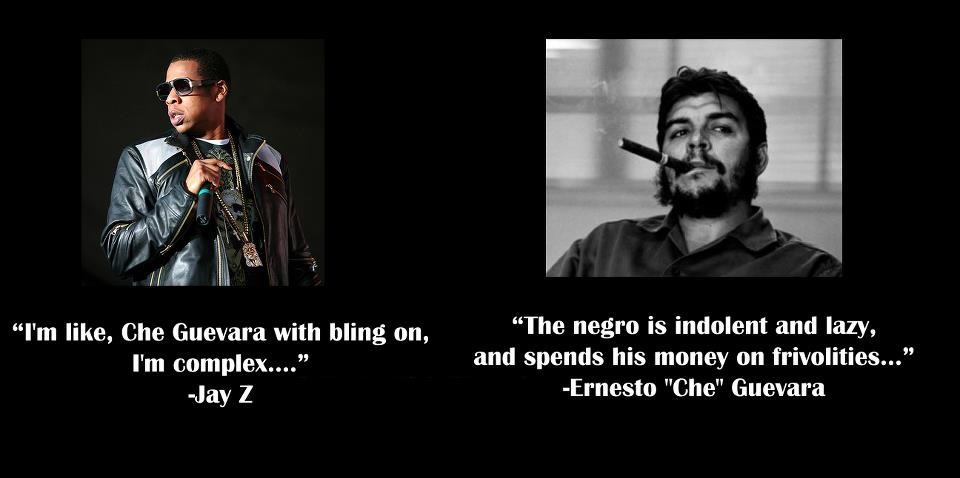
Good quote
TELL 'EM CHE!

Monday, November 5, 2012

The Sweetest Taboo

The human form has undergone extraordinary changes since its lineage split from that of chimpanzees some 5 to 6 million years ago. Our brain tripled in size, our body hair was shed, we downsized our teeth, shriveled our gut and gained a fine facial appendage for conserving moisture in dry climates - the nose.

Equally radical and transformative, though less well appreciated, have been the changes in human social behavior. In the societies of our apelike forbearers, coordination was achieved relatively simply, through a strict hierarchy dominated by the alpha male. Hunter gatherer societies are organized on a very different principle - they are completely egalitarian. It was during the transition from male dominance to egalitarianism that religious behavior emerged.

Many other social innovations developed in the human lineage as this new species, driven by the increasing intellectual capacity of its individuals, experimented with one novel mechanism after another for communicating among members of a group and governing the interactions among them. The surprising gift of music appeared in the repertoire of human faculties. Even more remarkable was language, a wholly novel system for conveying precise thoughts from one individual's mind to that of another. Humans developed or enhanced a skill know to psychologists as theory of mind - the ability to infer what someone else knows or intends. Groups possessing these news skills in various strengths competed furiously with each other in the struggle to survive. All these new faculties were doubtless drawn upon as natural selection searched for an effective solution to the most pressing of all problems for a social species - how to make selfish individuals place society's needs above their own. This departure from self-interest required not just moral self-restraint and social cohesiveness, but an emotional commitment to the group so fierce and transcendent that men would quite readily sacrifice their lives in its defense.

The solution that evolved was religious behavior. It was those who learned to bond to each other through ritual song and dance who developed the most cohesive communities. It was those who believed that the gods or their dead ancestors were seeing into their hearts who hewed closest to their society's rules. It was those who most feared supernatural retribution who built the most moral societies with the strongest social fabric and the resilience to outlast others.  

 The Faith Instinct: How Religion Evolved And Why It Endures. Wade, p. 38-39.


CAN YOU SEE HOW THIS POLYNESIAN CULTURE OF RELIGION IS STILL PRESENT AMONG POLYNESIANS TODAY AND HOW THE SELECTION PRESSURE IT PLACED ON THEM OVER HUNDREDS OF GENERATIONS LED TO THEIR HIGH RELIGIOSITY? I'LL HIGHLIGHT THE SIMILARITIES BETWEEN POLYNESIAN RELIGIOUS RITUALS AND CUSTOMS OF PAST RELIGIONS AND THOSE OF TODAY. (READ BELOW. CAN YOU SEE THE SIMILARITIES?)  


Beginning more than three millennia ago, the Polynesian islands were populated by a chain of migration that issued from Southeast Asia. Individual islands then carried their common cultural heritage in diverse directions. Polynesia is thus testament to the restlessness that cultural evolution shares with biological evolution, the persistent creation and selective retention of new traits. Just as Darwin noticed subtly different physiology among finches that lived on different Galapagos islands, anthropologists have been struck by the cultural variation among the Polynesian islands.

Consider the god Tangaroa - or Tangaloa, or Ta'aroa, depending on what island you were on. He was widely considered to have played a major role in creation, but what role exactly? In some places he was credited with having lifted up the skies, in others with having dredged up the islands. In Samoa it seemed that Tangaloa had created humanity, and perhaps even matter itself; he thus dwelt exaltedly in the skies, a preeminent deity. In the Marquesas islands, Tangaroa lived ignominiously under the feet of Atanua (goddess of the dawn), having lost a battle to her husband Atea (god of light).

But if the various Polynesian peoples disagreed about specific gods, they agreed about gods in general. For example, everyone believed there were lots of them. In the Society islands - the cluster anchored by Tahiti - there were gods of the sea (who used hurricanes and tempests). There were gods of fishermen, of navigators, of netmakers, and more than a dozen gods of agriculture. There was a god of carpenters (not to be confused with the gods of house thatchers), several doctor gods (some specializing in fractures and dislocations), gods of actors and singers, and a god of "hairdressers and combers."

Some anthropologists call these kinds of gods "departmental gods," and one reason there were so many of them in Polynesia is that there were so many departments. Whereas everyone in a hunter-gatherer society is a hunter and/or gatherer, the evolution of chiefdoms meant real division of labor, and gods multiplied to fill the new vocational niches.

The Polynesian gods closely supervised the economy, a fact much on  the minds of their subjects. The anthropologist E.S. Craighill Handy wrote in his 1927 book Polynesian Religion, "All serious enterprise was regarded as consecrated activity by the Polynesians."

No business was more serious than fishing. A boat, maybe a double canoe holding twenty men, would shove off and disappear from view and then return with scads of bonito and other huge fish - or would return empty, or even fail to return. The stakes were high and success meant playing by the gods' rules from the beginning.

And that meant the very beginning. "The building of a canoe was an affair of religion," wrote the nineteenth-century Hawaiian David Malo of his homeland's indigenous culture. When a man found a tree that seemed structurally suitable, he would tell the master canoe builder, who would sleep on the matter, lying before a shrine. If he dreamed of a naked man or woman, "covering their shame with the hand," it meant that the tree was unworthy, Malo reports. Attractive, well-dressed characters, in contrast, were a green light.

The night before felling the tree, artisans camped near it, prayed, and offered the gods coconuts, fish, and pig. The next morning, in an oven built near the tree's base, they cooked the pig and - the gods now having ingested its spiritual nutrients - ate the flesh. Next they prayed to six gods and two goddesses, including deities of the forest, of the canoe, and of the ax. Then they took their stone axes to the tree. After it fell, the master canoe builder donned ceremonial garb, stood over the tree near its bottom with an ax in hand, yelled, "Strike with the ax and hollow it! Grant us a canoe!" and then struck the wood. He repeated those words, struck again, repeated the words, struck again, and so on, moving from the bottom of the tree to the top. Then he wreathed the tree with a flowering vine, said a prayer about cutting off its top, and cut off its top. The completion of the canoe could have taken many days and involved repeated appeals to gods, not to mention another round of pig, fish, and coconuts. Making just the lashings for the outrigger was a matter of "utmost solemnity," Malo wrote.

Once finished, the canoe moved down the divine conveyor belt, to the supervision of new gods. The patron god of fishing, Kuula was worshipped at small stone shrines named after him. But there were other gods of fishing - "various and numerous," Malo wrote - and each fisherman adopted "the god of his choice." The choice had consequences. The god of one fisherman, for example, had strong opinions about the color black, so no family member wore black, and all black was banished from the house.

A ceremony marked the onset of the season for each kind of fishing. When it was tie to catch aku (bonito), a nobleman ate an aku's eye along with the eye of a sacrificed human. (This was good news for aku lovers, because it ended the period during which eating aku was punished by death.) The night before the season's inaugural expedition, fisherman gathered at a fishing shrine, where they would spend the night together, removed from the lure of sex with their wives, which could incur divine wrath. They brought sacrificial food, worshipped the fishing god, and before retiring for the evening did a responsive reading during which a priest said, "Save us from nightmare, from bad-luck dreams, from omens of ill."

From the standpoint of a modern boatbuilder or commercial fisherman, much of the above might seem like nonessential preparation for work.  And it is indeed hard to argue that removing all black from the home is, in and of itself, time well spent for the ambitious angler. Still, the combined effect of all these rituals was to cloak the business of canoe building and fishing in an air of solemnity that presumably encouraged exacting and conscientious performance.

In any event, we'll return to the question of what good was done by the religious dimension of the Polynesian economy. For now the point is just that the religious dimension was considerable.

Undergirding the islands' economic life were two key religious principles, and they undergirded much of Polynesian life in general. One was tapu,  from which comes the English word "taboo." Tapu referred to things set apart or forbidden. Thus, all the forbidden behaviors noted in the preceding paragraphs were tapu: eating aku before the aku season, wearing black if your god had forbidden it, having sex with your wife right before a key fishing expedition. These things weren't just frowned on and punished with social disapproval, the way wearing black to a regatta might be nowadays. Tapu violations were punished by the gods themselves, in the form of a fishless expedition, an illness, even death. Tapu put starch in the ritual fabric of Polynesia.

The second key concept was mana. Scholars disagree on what mana meant - in part, no doubt, because its meaning varied subtly from chiefdom to chiefdom. Some say mana was a magical or divine power, a kind of supernatural electricity. Others say mana  was more mundane; it was basically just efficacy, success in getting what you want. Regardless of how mana is defined, it was a religious thing, for mana was delivered to Polynesian society by the gods. It was the carrot part of the Polynesian incentive structure. Just as violations of tapu would bring misfortune, respect for tapu could shore up mana.

Chiefs possessed mana in spectacular proportions. They were conduits through which mana entered society and then trickled down the social scale to lesser folk. This role of divine spigot was a natural extension of the logic of shamanism: elevate your importance by claiming special access to the supernatural. (That doesn't mean the chiefs didn't themselves believe in mana. One senses an air of authentic desperation in the way a newly installed chief on the Solomon Islands implored the soul of his dead predecessor to "crawl to the gods for some mana for me." Groveling before the departed former chief, he declared, "I eat ten times your excrement.") 

If mana made the chief special, tapu formalized his specialness. One of the things most consistently tabooed in Polynesia was casual contact with the chief. When a Tongan chief walked around, Captain Cook noticed, people not only cleared a path for him, but sat down until he passed. The one allowed encounter was to bow down and gingerly touch his foot.  On some islands, commoners couldn't even hear a chief speak; a spokesman - a "talking chief" - conveyed his pronouncements. There was no chance for familiarity to breed contempt.

As if all this weren't enough, chiefs were often descended from gods - and upon death might well become gods themselves, assuming they weren't already considered divine.  On some islands the chief was also the head priest, and on islands where he wasn't, chief and priest typically worked hand in glove. This meant the chief could help decide what was and wasn't tapu - no trivial power in a society where breaches of tapu were intensely eschewed.

In sum, Polynesian political leaders were drenched in authority that emanated from the divine. Thus were a Tongan chief's not-infrequent harangues absorbed as Captain Cook described: "The most profound silence and attention is observed during the harangue, even to a much greater degree than is practised amongst us, on the most interesting and serious deliberations of our most respectable assemblies."

...

In Polynesia the chief used his divine authority for typical chiefly endeavors: organizing feasts, organizing armies, maintaining roads and irrigation systems - and amassing the requisite resources. Of course, modern politicians manage to do the same thing - spend and tax - without being thought even remotely sacred. But they have an advantage over chiefs: written laws, often resting on a hallowed constitution, and backed by courts that not only enforce compliance but lend legitimacy. Chiefs, lacking the secular sanctity these things confer, relied on the old-fashioned kind of sanctity.

In Hawaii, when it was time to collect foods for the annual makahiki festival, the chief (or "king" as westerners sometimes called him, so large and elaborate were the Hawaiian polities) would place all the land under tapu, confining everyone to  their homesteads. Priests, bearing a figure of the god Lono, then joined tax collectors in touring the chiefdom, lifting the tapu in their wake, liberating the people district by district. If unhappy with the contribution made by a district, they would curse its people in Lono's name.

Gods weren't the only coercive force. Chiefs had armed retainers who could administer beatings and enforce banishment. But for any ruler, the less of what you have to do, the better. And when force must be exercised, the less mundane it seems, the better; belief that the laws were being broken were gods' commands, not just chiefs' whims, may help explain why beatings, by some accounts, were absorbed without protest.

Moreover, in chiefdoms, there are limits on the scope of government coercion, and here arose an opportunity for religion to play a second role in ordering society. One difference between a chiefdom and a state is that a state government typically has a monopoly on the legitimate use of force: no matter what your neighbor does to you or your family - robbery, assault, even murder - you can't retaliate; the government handles punishment. But in chiefdoms, as in hunter-gatherer societies, grievances can be vented by violent retaliation. This doesn't mean these societies are lawless; the punishment for a given crime may be a matter of consensus, and may have the chief's blessing. It's just that inflicting the punishment is the job of the victims or their kin.

This sort of laissez-faire law enforcement is a shakier source of social order in chiefdoms than in hunter-gatherer societies. In a small hunter-gatherer village, you know everyone and see them often and may someday need their help. So the costs of getting on someone's bad side are high and the temptation to offend them commensurately. In a chiefdom, containing thousands or even tens of thousands of people, some of your neighbors are more remote, hence more inviting targets of exploitation.

And there's more to exploit. Whereas in hunter-gatherer society there is little private property, in chiefdoms families own things like fruit trees and gardens, an open invitation to theft. And as crime grows more tempting, it grows more explosive. So long as its punishment is left to the victims, the prospect of family-versus-family feuds loom. And since in chiefdoms these "families" may be big clans that amount to a small village, "feud" may be an understatement.

In this phase of cultural evolution - with personal policing having lost its charm but with government not yet taking up the slack - a supplementary force of social control was called for. Religion seems to have responded to the call. Whereas religion in hunter-gatherer societies didn't have much of a moral dimension, religion in the Polynesian chiefdoms did: it systematically discouraged antisocial behavior.

You might not notice this on casual inspection of Polynesian gods. In many ways they are reminiscent of hunter-gatherer gods, complete with a lack of consistent virtue. Robert Williamson, who in the early twentieth century heroically compressed centuries of reports on central Polynesia into a few classic volumes on its religion, wrote that the Society Islands gods "ate and drank, married and indulged in sexual gratifications, and quarreled and fought among themselves." In other words, "people imagined them to be such as they were themselves, only endowed with greater powers." So the key was to give them things, such as food and respect. Prayers and sacrifices sent to gods of the air could stave off storms - or bring them on, in the event that a fleet of invaders was approaching. And if you were the aggressor, and your enemy had retreated to a fortress, you could buy off the enemy's gods, placing offerings near the fort to encourage divine desertion.

Similarly, anticipation of the afterlife, which today is a moral carrot or stick for so many people, retained in the Polynesian chiefdoms the heavily amoral flavor it had in hunter-gatherer societies; your life in the hereafter was shaped mainly by things other than how you treated people here. In the Society Islands, if you died at sea, your spirit would enter a shark, and if you died in battle, you would haunt the battlefield. In the long run most Polynesian souls migrated to a distant place sometimes described as a dark underworld, sometimes a faraway island. There might be a more luxurious alternative in the sky - an "abode of light and joy," as a westerner described one island's version - but if you were an ordinary Joe, living an upright life wouldn't get you there; this paradise was reserved for the ruling class and perhaps a few other elites. (In the Society Islands it was open to showpeople - singers, actors, dancers - though not for free; they had to have any babies born to them killed, or else face expulsion from the entertainers' guild that was the gateway to paradise.) In general, Handy observed, "Prestige, rites, and circumstances affecting death determine destiny in after-life."

Yet if Polynesian religion lacked the moral incentives of some modern religions - a role-model god who hands out afterlife assignments according to your conduct grade -  it had other moral guidance built into it.

For starters, though Polynesians didn't fret about punishment that might await them in the afterlife, there was an edifying fear of punishment that could originate there, via ghosts that frowned on their behavior. In a Hawaiian legend, the spirit of a dead man haunts his murderer until the murderer makes amends by building three houses, one for the dead man's kin, one for their servants, and one for the dead man's bones.

Believing that anyone you mistreat might haunt you from the grave could turn you into a pretty nice person. The incentive - fear of ghosts - is also found in some hunter-gatherer or horticultural religions, but in the Polynesian chiefdoms it had acquired the added power of divine supervision: the same gods who wouldn't punish you in the next life punished you in this one. Tongan gods, for example, punished theft with shark attack. ("In consequence," the anthropologist H. Ian Hogbin observed, "thieves hesitated to swim during the season when sharks were at their worst.") And these Tongan gods gave out rewards as well as punishment; mana was granted not just for ritual correctness but for moral goodness - eschewing theft and other antisocial acts. A boost in mana was no mere abstraction; it meant more pigs and yams, here and now.

Still, the standard divine sanction in Polynesia was a stick, not a carrot. In Samoa, a nineteenth-century missionary reported, "calamities are traced to sins of the individual or his parents, or some other near relative." Theft, for example, might bring "ulcerous sores, dropsy, and inflammation of the abdomen."

Even family life was subject to supernatural sanction. In the Society Islands, a fisherman who argued with his wife before an expedition would have bad luck.  A woman who cheated on her husband while he was out at sea could bring worse luck, including his drowning. And on many Polynesian islands, hostility toward kin could be punished with illness. In a society where extended families live together and form the basic unit of society, this alone could do wonders for social harmony.
 

When you add up all the little ways Polynesian religion encouraged self-restraint, you wind up with a fair amount of encouragement - enough, perhaps, to compensate for the absence of a centralized legal system. And religion in chiefdoms was doing more than fill in for the not-yet-invented secular laws; its was paving the way for secular laws.

For example, the Polynesian chiefdoms featured land ownership, something generally lacking in hunter-gatherer societies. In this modern world, poverty markers are secular things; you may respect fenceposts or surveyors' pins, but you don't revere them. To judge by Polynesian chiefdoms, property markers started out as something more awe-inspiring. On many islands, a family could (sometimes with a priest's help) place a taboo on its fruit trees and vegetable gardens, leaving it for the gods to prosecute thieves or trespassers  via illness or death. These property taboos were advertised with signs made of leaves, sticks, and other handy materials. In Samoa, the signs conveniently signaled the kind of misfortune awaiting the thief. Coconut fiber molded in the shape of a shark meant shark attack; a spear stuck in the ground foretold facial neuralgia. (The system wasn't perfect. If Tongan natives could get some visiting westerner to remove the sign, and hence the taboo, they would happily eat fruit from a previously forbidden tree.)

Samoa, unlike most Polynesian chiefdoms, had the rudiments of a jury system. If a grievance wasn't settled by retaliation, a body of locals called a fono would hear testimony.  And here, too, law was intertwined with the supernatural. Sometimes the accused had to drink a substance that, if it caused illness or death, signified guilt. And always the accused had to swear their innocence to some god. Of course, even today a defendant may swear by God to tell the truth, but in Samoa the oath was less perfunctory: fear of the god's vengeance could bring a dramatic confession.

...But how thankful should the Polynesians have been? Was their social system a just one? Did religion, in upholding it, uphold the public good? Or were gods just a tool of oppression, devoutly sustained by a ruling class that wanted to keep living in the manner to which it had become accustomed?

Polynesia certainly gives support to the latter view. Chiefs, for example, got lots of wives, as befits the quasi-divine. And the ruling class in general got lots of good food. In Hawaii, precious sources of protein - pigs, chickens, fish - wound up disproportionately on elite dining tables, whereas vegetables were more widely accessible. In the Society Islands, commoners couldn't enter the temple grounds, site of big sacrifices to the gods, but priests could, and they ate the part of the food the gods left behind - the physical part. Polynesian priests also profited from that hallowed shamanic service, fee-based communion with the supernatural. One of their jobs was to cure illness by diving what offense had caused it. A nineteenth-century Methodist missionary described a Samoan priest entering a diagnostic trance via "preliminary yawnings and coughings," then passing through contortions and convulsions, until finally the god possessing him prescribed the restorative atonement, such as for "gifts to be given to the priest."

Elites also got lavish medical care. When a Tongan commoner was sick, priests might prescribe a curative sacrifice: cutting off the finger joint of a relative even lower in the social hierarchy. But for a chief's illness, sometimes the only cure was to strangle a child.

Equality before the law wasn't a bedrock Polynesian principle. In Tonga, murder was usually punished one way or another, but not if it was the murder of a commoner by a chief. In Samoa, adultery could bring a broad range of informal punishments unless committed with a chief's wife, in which case the punishment was formal and ranged only from death by drowning to death by beating. Human sacrifice seems also to have had an upper-class bias. In the Society Islands, one anthropologist noted, candidates for sacrifice fell into several categories, including prisoner of war, blasphemer, and "person obnoxious to the chief or priest."

In the face of facts like this, what could a functionalist possibly say in defense of the claim that religion benefits society a whole? More than you think.

Consider human sacrifice, as appraised in the clinical terms of functionalism. Even Captain Cook, who deemed it a "waste of the human race," noted that many of the adults sacrificed were criminals. And many others were "common low fellows, who stroll about  from place to place and from island to island, without having any fixed abode, or any visible way of getting an honest livelihood."  

Now, we might today consider death excessive punishment for many crimes, and certainly for transience and indigence. But well after cook wrote, his native England would be locking up poor people in debtors' prison. And, in any event, the removal from society of people who take from it less than they give isn't, in cold economic terms, a "waste." It may well have made the chiefdom stronger and more efficient, and thus have been socially "functional," whatever you think of its morality. (Supernatural belief has other ways of weeding out poor performers. In various societies, including some hunter-gatherer ones, people accused of sorcery or witchcraft and punished by banishment or death tend to be notoriously uncooperative or otherwise antisocial characters.) More generally, Polynesian religion seems to have kept the machine humming. Under the severe gaze of gods, canoes got made, fish got caught, pigs and yams got raised.

...

Indeed, maybe we should marvel not at the chief's exploitation of his power, but at the limits of the exploitation - at the social services he performed and the sacrifices he made. You would think that someone of divine lineage, shrouded in a haze of ritual sanctity, could have gotten away with less of both. Why didn't he?

One reason is that people aren't dupes. Our brains were designed by natural selection to guard us against danger, including exploitation. They are, owing to quirks of evolutionary history, susceptible to religious ideas and feelings, but they aren't easily blinded by them. Tahitians had a phrase for chiefs who "eat the power of the government too much." And avoiding this appellation was in the interests of chiefs; In Polynesia broadly, as the archaeologist Patrick Kirch noted in The Evolution of the Polynesian Chiefdoms," an overly bloated chieftainship might raise the spectre of rebellion." Or the specter of a bloodless coup. In Tahiti, priests and other elites would approach a persistently despotic chief and offer this guidance: "Go and eat the leg of pork seasoned with dung! Thy royalty is taken from thee, thou art put down to tread the sand, to walk like common men."

Another thing that kept chiefs honest is competition with other chiefdoms. War was common in Polynesia, and among chiefdoms generally. War puts a premium on social efficiency. Ruling classes that are egregiously parasitic, so thoroughly monopolizing the fruits of common labor as to leave little incentive for it, tend to wind up in the dustbin of history. In contrast, a religion that boosts social cohesion and productivity may not only survive but prevail, spreading to weaker societies via conquest. For that matter, it may replicate peacefully. Just as people emulate successful peers, societies emulate potent societies.

This dynamic - the fundamentalist drift of competition among societies - offers at least speculative explanations for otherwise puzzling facts. Why would chiefs sacrifice their own children to the gods? (Because religions that called for no vivid sacrifices by elites had trouble preserving the allegiance of commoners, and thus couldn't sustain the social vigor necessary to prevail in intersocietal competition?) Why were those Society Islands showpeople, the ones destined for a paradise that commoners could only dream of, allowed to mock the chief in public performances? (Because satiric social commentary can help check chiefs self-aggrandizing tendencies before they render a society self-destructively top-heavy?)

The pattern on display in the Polynesian chiefdoms extends beyond them, to other chiefdoms and even to other kinds of societies. On the one hand, the ruling class, consisting as it does of human beings, will try, consciously or unconsciously, to steer culture, including religious belief, toward its selfish ends. But this effort will meet two countervailing forces, one internal and one external. The internal check is popular resistance to exploitation; less powerful but more numerous common folk will, consciously or unconsciously, defend their interests. This may mean rebellion, and it may just mean resisting uncongenial religious ideas. (In Tonga, elites felt sure that commoners have no afterlife; some commoners begged to differ.) The external check on the ruling class's power grab is competition with alternative social systems - that is, neighboring societies. 

Hence an ongoing dialectic: elites use their power to gather more power, but this self-aggrandizement will meet ongoing grassroots resistance and occasionally encounter negative feedback in the form of revolution, military defeat, or economic eclipse. Societies forged by these forces provide plenty of supporting anecdotes for both "Marxists" and functionalists, and so fully vindicate neither.

This evolutionary process doesn't pay much attention to the mythic or cosmological details of a religion. Whether you call a god Tangaloa or Tangaroa doesn't greatly affect societal efficiency, nor does your view on whether this god aided creation by raising the sky or fishing up the islands. But the kinds of behaviors your gods punish and reward does matter. Productivity and social harmony are assets in intersocietal competition, and so are favored by the endless winnowing of cultural evolution. It's no surprise that, while the biographies of gods differ greatly from one Polynesian chiefdom to the next, a product of essentially random drift, more pragmatic themes are more stable. Across Polynesia broadly, religion encouraged exacting work and discouraged theft and other antisocial acts.

Of course, by our standards, the Polynesian religions may seem far from optimally efficient. So much pointless superstition, so much emphasis on sheer ritual correctness! Wouldn't a more potent religion have reallocated time from making sacrifices to building canoes? Wouldn't it have focused more intensely on encouraging honesty, generosity, and other aids to social harmony? Wouldn't its carrots and sticks have been more potent? Sure, the threat of illness or death packs a punch. But why not throw in more ammunition - like heaven and hell?

One answer is that cultural evolution takes time. You can't expect a blind, blundering process to work magic overnight, especially during the age of chiefdoms. Back then cultural innovation didn't arise and spread in a sea of millions electronically interlinked brains. There were just thousands of brains in a society, and communication among them depended on Stone Age technology: walking and talking. And contact among societies was even more arduous.

Even so, Polynesian religion developed some pretty sophisticated features. Mana, the very principle that rendered chiefs so powerful and helped justify their sanctity, could also usher in their demise. Just as a chief's naturally massive mana allowed effective governance, manifestly bad governance signified waning mana. So if a chief lost a few battles, he might be usurped by some noble warrior whose battlefield triumphs were thought to evince high mana. This feedback mechanism, a way of dumping inept chiefs before their missteps reached disastrous proportions, may have been favored by cultural evolution, as chiefdoms lacking such a mechanism tended to be overrun by those possessing it.

At the same time, this doctrine also gets a boost from simple logic. If indeed chiefs favored by the gods succeeded, then a chief's consistent failure suggests that he's lost the favor of the gods. Indeed failure just about has to mean that, if belief in religion is to endure the ups and downs of life. Every religion, to survive elementary logical scrutiny, has to have its explanatory loopholes. With Polynesian chiefs...one loophole is the assumption that waning earthly powers signify a loss of the divine touch. And this loophole laces a limit on how much exploitation even a divinely ordained leader can get away with.      

The Evolution of God. Wright, p. 49-66.

https://ojs.lib.byu.edu/spc/index.php/PacificStudies/article/viewFile/9338/8987


Thursday, November 1, 2012

Like A Moth To Flame Burned By The Fire....My LOVE Is BlInd

Are You Reading It Meek Mill? Do You Have The Intelligence To Understand It? Oh, You Do? Great. Now, The More Important Question Is Do You Have The Openness To Accept It As Fact And Come To The Realization That Your Belief In God Is Absurd And That Your Praying And Practicing Of A Religion (Christianity In Your Case) Is LUDACRiS! I Hope So My Nigga, Because I Don't Want You To Live In Fantasy Land Any Longer. You've Been There Too Long. I Want You To Join The Rest Of US Intelligent Brothas In Reality. (I'm Black, Meek.)


RELIGION AS A BY-PRODUCT OF SOMETHING ELSE

In any case, I want now to set aside group selection and turn to my own view of the Darwinian survival value of religion. I am one of an increasing number of biologists who see religion as a by-product of something else. More generally, I believe that we who speculate about Darwinian survival value need to 'think by-product'. When we ask about the survival value of anything, we may be asking the wrong question. We need to rewrite the question in a more helpful way. Perhaps the feature we are interested in (religion in this case) doesn't have a direct survival value of its own, but is a by-product of something else that does. I find it helpful to introduce the byproduct idea with an analogy from my own field of animal behaviour.

Moths fly into the candle flame, and it doesn't look like an accident. They go out of their way to make a burnt offering of themselves. We could label it 'self-immolation behaviour' and, under that provocative name, wonder how on earth natural selection could favour it. My point is that we must rewrite the question before we can even attempt an intelligent answer. It isn't suicide. Apparent suicide emerges as an inadvertent side-effect or by-product of something else. A by-product of . . . what? Well, here's one possibility, which will serve to make the point.

Artificial light is a recent arrival on the night scene. Until recently, the only night lights on view were the moon and the stars. They are at optical infinity, so rays coming from them are parallel. This fits them for use as compasses. Insects are known to use celestial objects such as the sun and the moon to steer accurately in a straight line, and they can use the same compass, with reversed sign, for returning home after a foray. The insect nervous system is adept at setting up a temporary rule of thumb of this kind: 'Steer a course such that the light rays hit your eye at an angle of 30 degrees.' Since insects have compound eyes (with straight tubes or light guides radiating out from the centre of the eye like the spines of a hedgehog), this might amount in practice to something as simple as keeping the light in one particular tube or ommatidium. But the light compass relies critically on the celestial object being at optical infinity. If it isn't, the rays are not parallel but diverge like the spokes of a wheel. A nervous system applying a 30-degree (or any acute angle) rule of thumb to a nearby candle, as though it were the moon at optical infinity, will steer the moth, via a spiral trajectory, into the flame. Draw it out for yourself, using some particular acute angle such as 30 degrees, and you'll produce an elegant logarithmic spiral into the candle.

Though fatal in this particular circumstance, the moth's rule of thumb is still, on average, a good one because, for a moth, sightings of candles are rare compared with sightings of the moon. We don't notice the hundreds of moths that are silently and effectively steering by the moon or a bright star, or even the glow from a distant city. We see only moths wheeling into our candle, and we ask the wrong question: Why are all these moths committing suicide? Instead, we should ask why they have nervous systems that steer by maintaining a fixed angle to light rays, a tactic that we notice only where it goes wrong. When the question is rephrased, the mystery evaporates. It never was right to call it suicide. It is a misfiring byproduct of a normally useful compass.

Now, apply the by-product lesson to religious behaviour in humans. We observe large numbers of people - in many areas it amounts to 100 per cent - who hold beliefs that flatly contradict demonstrable scientific facts as well as rival religions followed by others. People not only hold these beliefs with passionate certitude, but devote time and resources to costly activities that flow from holding them. They die for them, or kill for them. We marvel at this, just as we marvelled at the 'self-immolation behaviour' of the moths. Baffled, we ask why. But my point is that we may be asking the wrong question. The religious behaviour may be a misfiring, an unfortunate by-product of an underlying psychological propensity which in other circumstances is, or once was, useful. On this view, the propensity that was naturally selected in our ancestors was not religion per se; it had some other benefit, and it only incidentally manifests itself as religious behaviour. We shall understand religious behaviour only after we have renamed it.

If, then, religion is a by-product of something else, what is that something else? What is the counterpart to the moth habit of navigating by celestial light compasses? What is the primitively advantageous trait that sometimes misfires to generate religion?
I shall offer one suggestion by way of illustration, but I must stress that it is only an example of the kind of thing I mean, and I shall come on to parallel suggestions made by others. I am much more wedded to the general principle that the question should be properly put, and if necessary rewritten, than I am to any particular answer.

My specific hypothesis is about children. More than any other species, we survive by the accumulated experience of previous generations, and that experience needs to be passed on to children for their protection and well-being. Theoretically, children might learn from personal experience not to go too near a cliff edge, not to eat untried red berries, not to swim in crocodile-infested waters. But, to say the least, there will be a selective advantage to child brains that possess the rule of thumb: believe, without question, whatever your grown-ups tell you. Obey your parents; obey the tribal elders, especially when they adopt a solemn, minatory tone. Trust your elders without question. This is a generally valuable rule for a child. But, as with the moths, it can go wrong.

I have never forgotten a horrifying sermon, preached in my school chapel when I was little. Horrifying in retrospect, that is: at the time, my child brain accepted it in the spirit intended by the preacher. He told us a story of a squad of soldiers, drilling beside a railway line. At a critical moment the drill sergeant's attention was distracted, and he failed to give the order to halt. The soldiers were so well schooled to obey orders without question that they carried on marching, right into the path of an oncoming train. Now, of course, I don't believe the story and I hope the preacher didn't either. But I believed it when I was nine, because I heard it from an adult in authority over me. And whether he believed it or not, the preacher wished us children to admire and model ourselves on the soldiers' slavish and unquestioning obedience to an order, however preposterous, from an authority figure. Speaking for myself, I think we did admire it. As an adult I find it almost impossible to credit that my childhood self wondered whether I would have had the courage to do my duty by marching under the train. But that, for what it is worth, is how I remember my feelings. The sermon obviously made a deep impression on me, for I have remembered it and passed it on to you.


Does This Child Preacher Understand the Words He's Yelling? | The Oprah Winfrey Show | OWN

To be fair, I don't think the preacher thought he was serving up a religious message. It was probably more military than religious, in the spirit of Tennyson's 'Charge of the Light Brigade', which he may well have quoted:

'Forward the Light Brigade!'
Was there a man dismayed?
Not though the soldiers knew
Some one had blundered:
Theirs not to make reply,
Theirs not to reason why,
Theirs but to do and die:
Into the valley of Death
Rode the six hundred.

(One of the earliest and scratchiest recordings of the human voice ever made is of Lord Tennyson himself reading this poem, and the impression of hollow declaiming down a long, dark tunnel from the depths of the past seems eerily appropriate.) From the high command's point of view it would be madness to allow each individual soldier discretion over whether or not to obey orders. Nations whose infantrymen act on their own initiative rather than following orders will tend to lose wars. From the nation's point of view, this remains a good rule of thumb even if it sometimes leads to individual disasters. Soldiers are drilled to become as much like automata, or computers, as possible.

Computers do what they are told. They slavishly obey any instructions given in their own programming language. This is how they do useful things like word processing and spreadsheet calculations. But, as an inevitable by-product, they are equally robotic in obeying bad instructions. They have no way of telling whether an instruction will have a good effect or a bad. They simply obey, as soldiers are supposed to. It is their unquestioning obedience that makes computers useful, and exactly the same thing makes them inescapably vulnerable to infection by software viruses and worms. A maliciously designed program that says, 'Copy me and send me to every address that you find on this hard disk' will simply be obeyed, and then obeyed again by the other computers down the line to which it is sent, in exponential expansion. It is difficult, perhaps impossible, to design a computer which is usefully obedient and at the same time immune to infection.

If I have done my softening-up work well, you will already have completed my argument about child brains and religion. Natural selection builds child brains with a tendency to believe whatever their parents and tribal elders tell them. Such trusting obedience is valuable for survival: the analogue of steering by the moon for a moth. But the flip side of trusting obedience is slavish gullibility. The inevitable by-product is vulnerability to infection by mind viruses. For excellent reasons related to Darwinian survival, child brains need to trust parents, and elders whom parents tell them to trust. An automatic consequence is that the truster has no way of distinguishing good advice from bad. The child cannot know that 'Don't paddle in the crocodile-infested Limpopo' is good advice but 'You must sacrifice a goat at the time of the full moon, otherwise the rains will fail' is at best a waste of time and goats. Both admonitions sound equally trustworthy. Both come from a respected source and are delivered with a solemn earnestness that commands respect and demands obedience. The same goes for propositions about the world, about the cosmos, about morality and about human nature. And, very likely, when the child grows up and has children of her own, she will naturally pass the whole lot on to her own children - nonsense as well as sense - using the same infectious gravitas of manner.


On this model we should expect that, in different geographical regions, different arbitrary beliefs, none of which have any factual basis, will be handed down, to be believed with the same conviction as useful pieces of traditional wisdom such as the belief that manure is good for the crops. We should also expect that superstitions and other non-factual beliefs will locally evolve - change over generations - either by random drift or by some sort of analogue of Darwinian selection, eventually showing a pattern of significant divergence from common ancestry. Languages drift apart from a common progenitor given sufficient time in geographical separation (I shall return to this point in a moment). The same seems to be true of baseless and arbitrary beliefs and injunctions, handed down the generations - beliefs that were perhaps given a fair wind by the useful programmability of the child brain.

Religious leaders are well aware of the vulnerability of the child brain, and the importance of getting the indoctrination in early. The Jesuit boast, 'Give me the child for his first seven years, and I'll give you the man,' is no less accurate (or sinister) for being hackneyed. In more recent times, James Dobson, founder of today's infamous 'Focus on the Family' movement,* is equally acquainted with the principle: 'Those who control what young people are taught, and what they experience - what they see, hear, think, and believe - will determine the future course for the nation.

But remember, my specific suggestion about the useful gullibility of the child mind is only an example of the kind of thing that might be the analogue of moths navigating by the moon or the stars. The ethologist Robert Hinde, in Why Gods Persist, and the anthropologists Pascal Boyer, in Religion Explained, and Scott Atran, in In Gods We Trust, have independently promoted the general idea of religion as a by-product of normal psychological dispositions - many by-products, I should say, for the anthropologists especially are concerned to emphasize the diversity of the world's religions as well as what they have in common. The findings of anthropologist seem weird to us only because they are unfamiliar. All religious beliefs seem weird to those not brought up in them. Boyer did research on the Fang people of Cameroon, who believe . . .


. . . that witches have an extra internal animal-like organ
that flies away at night and ruins other people's crops or
poisons their blood. It is also said that these witches sometimes
assemble for huge banquets, where they devour
their victims and plan future attacks. Many will tell you
that a friend of a friend actually saw witches flying over
the village at night, sitting on a banana leaf and throwing
magical darts at various unsuspecting victims.
Boyer continues with a personal anecdote:

I was mentioning these and other exotica over dinner in a
Cambridge college when one of our guests, a prominent
Cambridge theologian, turned to me and said: 'That is
what makes anthropology so fascinating and so difficult
too. You have to explain how people can believe such
nonsense.'' Which left me dumbfounded. The conversation
had moved on before I could find a pertinent response -
to do with kettles and pots.

Assuming that the Cambridge theologian was a mainstream Christian, he probably believed some combination of the following:

• In the time of the ancestors, a man was born to a virgin
mother with no biological father being involved.

• The same fatherless man called out to a friend called Lazarus,
who had been dead long enough to stink, and Lazarus
promptly came back to life.

• The fatherless man himself came alive after being dead and
buried three days.

• Forty days later, the fatherless man went up to the top of a hill
and then disappeared bodily into the sky.

• If you murmur thoughts privately in your head, the fatherless
man, and his 'father' (who is also himself) will hear your
thoughts and may act upon them. He is simultaneously able to
hear the thoughts of everybody else in the world.

• If you do something bad, or something good, the same
fatherless man sees all, even if nobody else does. You may be
rewarded or punished accordingly, including after your death.

• The fatherless man's virgin mother never died but 'ascended'
bodily into heaven.

• Bread and wine, if blessed by a priest (who must have
testicles), 'become' the body and blood of the fatherless man.

What would an objective anthropologist, coming fresh to this set of beliefs while on fieldwork in Cambridge, make of them?


PSYCHOLOGICALLY PRIMED FOR RELIGION

The idea of psychological by-products grows naturally out of the important and developing field of evolutionary psychology. Evolutionary psychologists suggest that, just as the eye is an evolved organ for seeing, and the wing an evolved organ for flying, so the brain is a collection of organs (or 'modules') for dealing with a set of specialist data-processing needs. There is a module for dealing with kinship, a module for dealing with reciprocal exchanges, a module for dealing with empathy, and so on. Religion can be seen as a by-product of the misfiring of several of these modules, for example the modules for forming theories of other minds, for forming coalitions, and for discriminating in favour of in-group members and against strangers. Any of these could serve as the human equivalent of the moths' celestial navigation, vulnerable to misfiring in the same kind of way as I suggested for childhood gullibility. The psychologist Paul Bloom, another advocate of the 'religion is a by-product' view, points out that children have a natural tendency towards a dualistic theory of mind. Religion, for him, is a by-product of such instinctive dualism. We humans, he suggests, and especially children, are natural born dualists.

A dualist acknowledges a fundamental distinction between matter and mind. A monist, by contrast, believes that mind is a manifestation of matter - material in a brain or perhaps a computer - and cannot exist apart from matter. A dualist believes the mind is some kind of disembodied spirit that inhabits the body and therefore conceivably could leave the body and exist somewhere else. Dualists readily interpret mental illness as 'possession by devils', those devils being spirits whose residence in the body is temporary, such that they might be 'cast out'. Dualists personify inanimate physical objects at the slightest opportunity, seeing spirits and demons even in waterfalls and clouds.

F. Anstey's 1882 novel Vice Versa makes sense to a dualist, but strictly should be incomprehensible to a dyed-in-the-wool monist like me. Mr Bultitude and his son mysteriously find that they have swapped bodies. The father, much to the son's glee, is obliged to go to school in the son's body; while the son, in the father's body, almost ruins the father's business through his immature decisions. A similar plotline was used by P. G. Wodehouse in Laughing Gas, where the Earl of Havershot and a child movie star go under the anaesthetic at the same moment in neighbouring dentist's chairs, and wake up in each other's bodies. Once again, the plot makes sense only to a dualist. There has to be something corresponding to Lord Havershot which is no part of his body, otherwise how could he wake up in the body of a child actor?

Like most scientists, I am not a dualist, but I am nevertheless easily capable of enjoying Vice Versa and Laughing Gas. Paul Bloom would say this is because, even though I have learned to be an intellectual monist, I am a human animal and therefore evolved as an instinctive dualist. The idea that there is a me perched somewhere behind my eyes and capable, at least in fiction, of migrating into somebody else's head, is deeply ingrained in me and in every other human being, whatever our intellectual pretensions to monism. Bloom supports his contention with experimental evidence that children are even more likely to be dualists than adults are, especially extremely young children. This suggests that a tendency to dualism is built into the brain and, according to Bloom, provides a natural predisposition to embrace religious ideas.

Bloom also suggests that we are innately predisposed to be creationists. Natural selection 'makes no intuitive sense'. Children are especially likely to assign purpose to everything, as the psychologist Deborah Keleman tells us in her article 'Are children "intuitive theists"? Clouds are 'for raining'. Pointy rocks are 'so that animals could scratch on them when they get itchy'. The assignment of purpose to everything is called teleology. Children are native teleologists, and many never grow out of it.

Native dualism and native teleology predispose us, given the right conditions, to religion, just as my moths' light-compass reaction predisposed them to inadvertent 'suicide'. Our innate dualism prepares us to believe in a 'soul' which inhabits the body rather than being integrally part of the body. Such a disembodied spirit can easily be imagined to move on somewhere else after the death of the body. We can also easily imagine the existence of a deity as pure spirit, not an emergent property of complex matter but existing independently of matter. Even more obviously, childish teleology sets us up for religion. If everything has a purpose, whose purpose is it? God's, of course.

But what is the counterpart of the usefulness of the moths' light compass? Why might natural selection have favoured dualism and teleology in the brains of our ancestors and their children? So far, my account of the 'innate dualists' theory has simply posited that humans are natural born dualists and teleologists. But what would the Darwinian advantage be? Predicting the behaviour of entities in our world is important for our survival, and we would expect natural selection to have shaped our brains to do it efficiently and fast. Might dualism and teleology serve us in this capacity? We may understand this hypothesis better in the light of what the philosopher Daniel Dennett has called the intentional stance.

Dennett has offered a helpful three-way classification of the 'stances' that we adopt in trying to understand and hence predict the behaviour of entities such as animals, machines or each other. They are the physical stance, the design stance and the intentional stance. The physical stance always works in principle, because everything ultimately obeys the laws of physics. But working things out using the physical stance can be very slow. By the time we have sat down to calculate all the interactions of a complicated object's moving parts, our prediction of its behaviour will probably be too late. For an object that really is designed, like a washing machine or a crossbow, the design stance is an economical short cut. We can guess how the object will behave by going over the head of physics and appealing directly to design. As Dennett says,

Almost anyone can predict when an alarm clock will
sound on the basis of the most casual inspection of its
exterior. One does not know or care to know whether it is
spring wound, battery driven, sunlight powered, made of
brass wheels and jewel bearings or silicon chips - one just
assumes that it is designed so that the alarm will sound
when it is set to sound.

Living things are not designed, but Darwinian natural selection licenses a version of the design stance for them. We get a short cut to understanding the heart if we assume that it is 'designed' to pump blood. Karl von Frisch was led to investigate colour vision in bees (in the face of orthodox opinion that they were colour-blind) because he assumed that the bright colours of flowers were 'designed' to attract them. The quotation marks are designed to scare off mendacious creationists who might otherwise claim the great Austrian zoologist as one of their own. Needless to say, he was perfectly capable of translating the design stance into proper Darwinian terms.

The intentional stance is another short cut, and it goes one better than the design stance. An entity is assumed not merely to be designed for a purpose but to be, or contain, an agent with intentions that guide its actions. When you see a tiger, you had better not delay your prediction of its probable behaviour. Never mind the physics of its molecules, and never mind the design of its limbs, claws and teeth. That cat intends to eat you, and it will deploy its limbs, claws and teeth in flexible and resourceful ways to carry out its intention. The quickest way to second-guess its behaviour is to forget physics and physiology and cut to the intentional chase. Note that, just as the design stance works even for things that were not actually designed as well as things that were, so the intentional stance works for things that don't have deliberate conscious intentions as well as things that do.

It seems to me entirely plausible that the intentional stance has survival value as a brain mechanism that speeds up decision-making in dangerous circumstances, and in crucial social situations. It is less immediately clear that dualism is a necessary concomitant of the intentional stance. I shan't pursue the matter here, but I think a case could be developed that some kind of theory of other minds, which could fairly be described as dualistic, is likely to underlie the intentional stance - especially in complicated social situations, and even more especially where higher-order intentionality comes into play.

Dennett speaks of third-order intentionality (the man believed that the woman knew he wanted her), fourth-order (the woman realized that the man believed that the woman knew he wanted her) and even fifth-order intentionality (the shaman guessed that the woman realized that the man believed that the woman knew he wanted her). Very high orders of intentionality are probably confined to fiction, as satirized in Michael Frayn's hilarious novel The Tin Men: 'Watching Nunopoulos, Rick knew that he was almost certain that Anna felt a passionate contempt for Fiddlingchild's failure to understand her feelings about Fiddlingchild, and she knew too that Nina knew she knew about Nunopoulos's knowledge . . . ' But the fact that we can laugh at such contortions of other-mind inference in fiction is probably telling us something important about the way our minds have been naturally selected to work in the real world.

In its lower orders at least, the intentional stance, like the design stance, saves time that might be vital to survival. Consequently, natural selection shaped brains to deploy the intentional stance as a short cut. We are biologically programmed to impute intentions to entities whose behaviour matters to us. Once again, Paul Bloom quotes experimental evidence that children are especially likely to adopt the intentional stance. When small babies see an object apparently following another object (for example, on a computer screen), they assume that they are witnessing an active chase by an intentional agent, and they demonstrate the fact by registering surprise when the putative agent fails to pursue the chase.

The design stance and the intentional stance are useful brain mechanisms, important for speeding up the second-guessing of entities that really matter for survival, such as predators or potential mates. But, like other brain mechanisms, these stances can misfire. Children, and primitive peoples, impute intentions to the weather, to waves and currents, to falling rocks. All of us are prone to do the same thing with machines, especially when they let us down. Many will remember with affection the day Basil Fawlty's car broke down during his vital mission to save Gourmet Night from disaster. He gave it fair warning, counted to three, then got out of the car, seized a tree branch and thrashed it to within an inch of its life. Most of us have been there, at least momentarily, with a computer if not with a car. Justin Barrett coined the acronym HADD, for hyperactive agent detection device. We hyperactively detect agents where there are none, and this makes us suspect malice or benignity where, in fact, nature is only indifferent. I catch myself momentarily harbouring savage resentment against some blameless inanimate such as my bicycle chain. There was a poignant recent report of a man who tripped over his untied shoelace in the Fitzwilliam Museum in Cambridge, fell down the stairs, and smashed three priceless Qing Dynasty vases: 'He landed in the middle of the vases and they splintered into a million pieces. He was still sitting there stunned when staff appeared. Everyone stood around in silence, as if in shock. The man kept pointing to his shoelace, saying, "There it is; that's the culprit."

Other by-product explanations of religion have been proposed by Hinde, Shermer, Boyer, Atran, Bloom, Dennett, Keleman and others. One especially intriguing possibility mentioned by Dennett is that the irrationality of religion is a by-product of a particular built-in irrationality mechanism in the brain: our tendency, which presumably has genetic advantages, to fall in love.

The anthropologist Helen Fisher, in Why We Love, has beautifully expressed the insanity of romantic love, and how over-the-top it is compared with what might seem strictly necessary. Look at it this way. From the point of view of a man, say, it is unlikely that any one woman of his acquaintance is a hundred times more lovable than her nearest competitor, yet that is how he is likely to describe her when 'in love'. Rather than the fanatically monogamous devotion to which we are susceptible, some sort of 'polyamory' is on the face of it more rational. (Polyamory is the belief that one can simultaneously love several members of the opposite sex, just as one can love more than one wine, composer, book or sport.) We happily accept that we can love more than one child, parent, sibling, teacher, friend or pet. When you think of it like that, isn't the total exclusiveness that we expect of spousal love positively weird? Yet it is what we expect, and it is what we set out to achieve. There must be a reason.

Helen Fisher and others have shown that being in love is accompanied by unique brain states, including the presence of neurally active chemicals (in effect, natural drugs) that are highly specific and characteristic of the state. Evolutionary psychologists agree with her that the irrational coup de foudre could be a mechanism to ensure loyalty to one co-parent, lasting for long enough to rear a child together. From a Darwinian point of view it is, no doubt, important to choose a good partner, for all sorts of reasons. But, once having made a choice - even a poor one - and conceived a child, it is more important to stick with that one choice through thick and thin, at least until the child is weaned.

Could irrational religion be a by-product of the irrationality mechanisms that were originally built into the brain by selection for falling in love? Certainly, religious faith has something of the same character as falling in love (and both have many of the attributes of being high on an addictive drug*). The neuropsychiatrist John Smythies cautions that there are significant differences between the brain areas activated by the two kinds of mania. Nevertheless, he notes some similarities too:


One facet of the many faces of religion is intense love
focused on one supernatural person, i.e. God, plus
reverence for icons of that person. Human life is driven
largely by our selfish genes and by the processes of
reinforcement. Much positive reinforcement derives from
religion: warm and comforting feelings of being loved and
protected in a dangerous world, loss of fear of death, help
from the hills in response to prayer in difficult times, etc.
Likewise, romantic love for another real person (usually
of the other sex) exhibits the same intense concentration
on the other and related positive reinforcements. These
feelings can be triggered by icons of the other, such as
letters, photographs, and even, as in Victorian times, locks
of hair. The state of being in love has many physiological
accompaniments, such as sighing like a furnace.

I made the comparison between falling in love and religion in 1993, when I noted that the symptoms of an individual infected by religion 'may be startlingly reminiscent of those more ordinarily associated with sexual love. This is an extremely potent force in the brain, and it is not surprising that some viruses have evolved to exploit it ('viruses' here is a metaphor for religions: my article was called 'Viruses of the mind'). St Teresa of Avila's famously orgasmic vision is too notorious to need quoting again. More seriously, and on a less crudely sensual plane, the philosopher Anthony Kenny provides moving testimony to the pure delight that awaits those who manage to believe in the mystery of the transubstantiation. After describing his ordination as a Roman Catholic priest, empowered by laying on of hands to celebrate mass, he goes on that he vividly recalls

the exaltation of the first months during which I had the
power to say Mass. Normally a slow and sluggish riser, I
would leap early out of bed, fully awake and full of excitement
at the thought of the momentous act I was privileged
to perform . . .
It was touching the body of Christ, the closeness of the
priest to Jesus, which most enthralled me. I would gaze on
the Host after the words of consecration, soft-eyed like a
lover looking into the eyes of his beloved . . . Those early
days as a priest remain in my memory as days of fulfilment
and tremulous happiness; something precious, and
yet too fragile to last, like a romantic love-affair brought
up short by the reality of an ill-assorted marriage.

The equivalent of the moth's light-compass reaction is the apparently irrational but useful habit of falling in love with one, and only one, member of the opposite sex. The misfiring byproduct - equivalent to flying into the candle flame - is falling in love with Yahweh (or with the Virgin Mary, or with a wafer, or with Allah) and performing irrational acts motivated by such love.

The biologist Lewis Wolpert, in Six Impossible Things Before Breakfast, makes a suggestion that can be seen as a generalization of the idea of constructive irrationality. His point is that irrationally strong conviction is a guard against fickleness of mind: 'if beliefs that saved lives were not held strongly, it would have been disadvantageous in early human evolution. It would be a severe disadvantage, for example, when hunting or making tools, to keep changing one's mind.' The implication of Wolpert's argument is that, at least under some circumstances, it is better to persist in an irrational belief than to vacillate, even if new evidence or ratiocination favours a change. It is easy to see the 'falling in love' argument as a special case, and it is correspondingly easy to see Wolpert's 'irrational persistence' as yet another useful psychological predisposition that could explain important aspects of irrational religious behaviour: yet another by-product.

In his book Social Evolution, Robert Trivers enlarged on his 1976 evolutionary theory of self-deception. Self-deception is

hiding the truth from the conscious mind the better
to hide it from others. In our own species we
recognize that shifty eyes, sweaty palms and croaky
voices may indicate the stress that accompanies
conscious knowledge of attempted deception.
By becoming unconscious of its deception, the deceiver
hides these signs from the observer. He or she can
lie without the nervousness that accompanies deception.

The anthropologist Lionel Tiger says something similar in Optimism: The Biology of Hope. The connection to the sort of constructive irrationality we have just been discussing is seen in Trivers's paragraph about 'perceptual defense':

There is a tendency for humans consciously to see
what they wish to see. They literally have difficulty
seeing things with negative connotations while
seeing with increasing ease items that are positive.
For example, words that evoke anxiety, either
 because of an individual's personal history or
because of experimental manipulation, require
greater illumination before first being perceived.

The relevance of this to the wishful thinking of religion should need no spelling out.

The general theory of religion as an accidental by-product - a misfiring of something useful - is the one I wish to advocate. The details are various, complicated and disputable. For the sake of illustration, I shall continue to use my 'gullible child' theory as representative of 'by-product' theories in general. This theory - that the child brain is, for good reasons, vulnerable to infection by mental 'viruses' - will strike some readers as incomplete. Vulnerable the mind may be, but why should it be infected by this virus rather than that? Are some viruses especially proficient at infecting vulnerable minds? Why does 'infection' manifest itself as religion rather than as . . . well, what? Part of what I want to say is that it doesn't matter what particular style of nonsense infects the child brain. Once infected, the child will grow up and infect the next generation with the same nonsense, whatever it happens to be.

An anthropological survey such as Frazer's Golden Bough impresses us with the diversity of irrational human beliefs. Once entrenched in a culture they persist, evolve and diverge, in a manner reminiscent of biological evolution. Yet Frazer discerns certain general principles, for example 'homoeopathic magic', whereby spells and incantations borrow some symbolic aspect of the real world object they are intended to influence. An instance with tragic consequences is the belief that powdered rhinoceros horn has aphrodisiac properties. Fatuous as it is, the legend stems from the horn's supposed resemblance to a virile penis. The fact that 'homoeopathic magic' is so widespread suggests that the nonsense that infects vulnerable brains is not entirely random, arbitrary nonsense.

It is tempting to pursue the biological analogy to the point of wondering whether something corresponding to natural selection is at work. Are some ideas more spreadable than others, because of intrinsic appeal or merit, or compatibility with existing psychological dispositions, and could this account for the nature and properties of actual religions as we see them, in something like the way we use natural selection to account for living organisms? It is important to understand that 'merit' here means only ability to survive and spread. It doesn't mean deserving of a positive value judgement - something of which we might be humanly proud.

Even on an evolutionary model, there doesn't have to be any natural selection. Biologists acknowledge that a gene may spread through a population not because it is a good gene but simply because it is a lucky one. We call this genetic drift. How important it is vis-a-vis natural selection has been controversial. But it is now widely accepted in the form of the so-called neutral theory of molecular genetics. If a gene mutates to a different version of itself which has an identical effect, the difference is neutral, and selection cannot favour one or the other. Nevertheless, by what statisticians call sampling error over generations, the new mutant form can eventually replace the original form in the gene pool. This is a true evolutionary change at the molecular level (even if no change is observed in the world of whole organisms). It is a neutral evolutionary change that owes nothing to selective advantage.

The cultural equivalent of genetic drift is a persuasive option, one that we cannot neglect when thinking about the evolution of religion. Language evolves in a quasi-biological way and the direction its evolution takes looks undirected, pretty much like random drift. It is handed down by a cultural analogue of genetics, changing slowly over the centuries, until eventually various strands have diverged to the point of mutual unintelligibility. It is possible that some of the evolution of language is guided by a kind of natural selection, but that argument doesn't seem very persuasive. I'll explain below that some such idea has been proposed for major trends in language, such as the Great Vowel Shift which took place in English from the fifteenth to the eighteenth century. But such a functional hypothesis is not necessary to explain most of what we observe. It seems probable that language normally evolves by the cultural equivalent of random genetic drift. In different parts of Europe, Latin drifted to become Spanish, Portuguese, Italian, French, Romansche and the various dialects of these languages. It is, to say the least, not obvious that these evolutionary shifts reflect local advantages or 'selection pressures'.

I surmise that religions, like languages, evolve with sufficient randomness, from beginnings that are sufficiently arbitrary, to generate the bewildering - and sometimes dangerous - richness of diversity that we observe. At the same time, it is possible that a form of natural selection, coupled with the fundamental uniformity of human psychology, sees to it that the diverse religions share significant features in common. Many religions, for example, teach the objectively implausible but subjectively appealing doctrine that our personalities survive our bodily death. The idea of immortality itself survives and spreads because it caters to wishful thinking. And wishful thinking counts, because human psychology has a near universal tendency to let belief be coloured by desire ('Thy wish was father, Harry, to that thought', as Henry IV Part II said to his son).

There seems to be no doubt that many of the attributes of religion are well fitted to helping the religion's own survival, and the survival of the attributes concerned, in the stew of human culture. The question now arises of whether the good fit is achieved by 'intelligent design' or by natural selection. The answer is probably both. On the side of design, religious leaders are fully capable of verbalizing the tricks that aid the survival of religion. Martin Luther was well aware that reason was religion's arch-enemy, and he frequently warned of its dangers: 'Reason is the greatest enemy that faith has; it never comes to the aid of spiritual things, but more frequently than not struggles against the divine Word, treating with contempt all that emanates from God. Again: 'Whoever wants to be a Christian should tear the eyes out of his reason.' And again: 'Reason should be destroyed in all Christians.' Luther would have had no difficulty in intelligently designing unintelligent aspects of a religion to help it survive. But that doesn't necessarily mean that he, or anyone else, did design it. It could also have evolved by a (nongenetic) form of natural selection, with Luther not its designer but a shrewd observer of its efficacy.

Even though conventional Darwinian selection of genes might have favoured psychological predispositions that produce religion as a by-product, it is unlikely to have shaped the details. I have already hinted that, if we are going to apply some form of selection theory to those details, we should look not to genes but to theircultural equivalents. Are religions such stuff as memes are made on?

 The God Delusion. Dawkins, p. 200-221.

READ THE CHAPTER ON MEMES. IT FOLLOWS THE ABOVE CHAPTER THAT I EXCERPTED. IT BEGINS ON PAGE 191 IN THE ABOVE LINK!