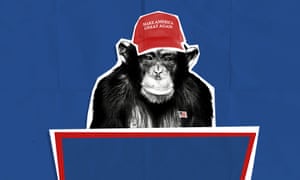
The curious case of Donald Trump… shows that human beings turn out to be a lot like chimps.
In the wild and in captivity, chimpanzee colonies organize themselves into tightly structured hierarchies. Power is vested in the biggest, strongest, and most outgoing males in the group, with the alpha male on top. The alpha leader dominates all others through tactics of threat, intimidation, bluffing, and outright aggression – and importantly, by forming short-term, pragmatic coalitions (let us call them “deals”) with other high-status males.
Chimpanzee politics can be intricate, but they always obey the rules of social dominance. Because chimps and humans evolved from a common ancestor going back 5-7m years, we humans know deep in our brains what social dominance is all about. Our expectation that social status can be seized through physical power and threat – that the strongest, biggest and boldest may indeed lord it over the rest of us – is very old, awesomely intuitive, and deeply ingrained.
Social psychologists today distinguish between the social dominance form of human leadership, on the one hand, and leadership through prestige on the other. Both are grounded in human evolution, but the prestige form is younger, tracing back a mere million years or so to the time when our hominid ancestors began to form culture. In the prestige paradigm, leaders attain their authority in the group by demonstrating culturally valued expertise – as, for example, in cooking, defending the tribe, healing, peacemaking, or (in the modern world) science, education, technology, the arts, business, law, medicine, communication, and so on.
For human beings today, dominance and prestige compete with each other as the two primal expressions of leadership. [Emphasis added.]
The “prestige” style is progressive and good. The “dominance” style is primitive and bad. More:
An especially effective dominance mechanism for the alpha chimp is the charging display. The top male essentially goes berserk and starts screaming, hooting, and gesticulating wildly as he charges toward other males nearby. Pandemonium ensues as rival males cower in fear and females grab their little ones and run for cover.
Once the chaos ends, there is a period of peace and order, wherein rival males pay homage to the alpha, visiting him, grooming him, expressing various forms of submission.
Trump’s incendiary tweets are the human equivalent of a charging display. Designed to intimidate his foes and rally his submissive base, these verbal outbursts reinforce the president’s dominance by reminding everybody of his wrath and his force.
Peddling up one of the rare hills of my native Holland, I was bracing
myself for the gruesome sight awaiting me at the Arnhem Zoo. In the
early morning, I had received a call telling me that my favorite male
chimpanzee, Luit, had been butchered by his own kind. Apes can inflict
incredible damage with their powerful canine teeth. Most of the time,
they are just trying to intimidate each other with what we call "bluff"
displays, but occasionally the bluff is backed up by action. I had left
the zoo the previous day worrying about Luit, but I was totally
unprepared for what I found.
Normally proud and not particularly affectionate to people, Luit now
wanted to be touched. He was sitting in a pool of blood, his head
leaning against the bars of the night cage. When I gently stroked him,
he let out the deepest sigh. Bonding at last, but at the saddest moment
of my career as a primatologist. It was immediately obvious that Luit's
condition was life threatening. He still moved about but lost enormous
amounts of blood. He had deep puncture holes all over his body and had
lost fingers and toes. We soon discovered that he was missing even more
vital parts.
I have come to think of this moment in which Luit looked to me for
comfort as an allegory of modern humanity: like violent apes, covered in
own our blood, we long for reassurance. Despite our tendency to maim
and kill, we want to hear that everything will be all right. At the
time, however, I was focused only on trying to save Luit's life. As soon
as the vet arrived, we tranquilized Luit and took him into surgery,
where we sewed literally hundreds of stitches. It was during this
desperate operation that we discovered Luit's testicles were gone. They
had disappeared from the scrotal sac even though the holes in the skin
seemed smaller than the testicles themselves, which the keepers had
found lying in the straw on the cage floor. "Squeezed out," the vet
concluded impassively.
Luit never came out of anesthesia. He had paid dearly for having stood
up to two other males, frustrating them by his steep ascent. Those two
had been plotting against him in order to take back the power they had
lost. The shocking way they did so opened my eyes to how deadly
seriously chimpanzees take their politics.
Two-against-one maneuvering is what lends chimpanzee power struggles
both their richness and their danger. Coalitions are key. No male can
rule by himself, at least not for long, because the group as a whole can
overthrow anybody. Chimpanzees are so clever about banding together
that a leader needs allies to fortify his position as well as the
greater community's acceptance. Staying on top is a balancing act
between forcefully asserting dominance, keeping supporters happy, and
avoiding mass revolt. If this sounds familiar, it's because human
politics works exactly the same.
Before Luit's death, the Arnhem colony was ruled jointly by Nikkie, a
young upstart, and Yeroen, and over-the-hill conniver. Barely adult at
seventeen, Nikkie was a brawny character with a dopey expression. He was
very determined, but not the sharpest knife in the drawer. He was
supported by Yeroen, who was physically not up to the task of being a
leader anymore, yet who wielded enormous influence behind the scenes.
Yeroen had a habit of watching disputes unfold from a distance, stepping
in only when emotions were flaring to calmly support one side or the
other, thus forcing everybody to pay attention to his decisions. Yeroen
shrewdly exploited the rivalries among younger and stronger males.
Without going into the complex history of this group, it was clear that
Yeroen hated Luit, who had wrested power from him years before. Luit had
defeated Yeroen in a struggle that had taken three hot summer months of
daily tensions involving the entire colony. The next year, Yeroen had
gotten even by helping Nikkie dethrone Luit. Ever since, Nikkie had been
the alpha male with Yeroen as his right-hand man. The two became
inseparable. Luit was unafraid of either one of them alone. In
one-on-one encounters in the night cages, Luit dominated every other
male in the colony, taking away their food or chasing them around. No
single one of them could possibly have kept him in his place.
This meant that Yeroen and Nikkie ruled as a team, and only as a team.
They did so for four long years. But their coalition eventually began to
unravel, and as is not uncommon among men, the divisive issue was sex.Being
the kingmaker, Yeroen had enjoyed extraordinary sexual privileges.
Nikkie would not let any other males get near the most attractive
females, but for Yeroen he had always made an exception. This was part
of the deal: Nikkie had the power, and Yeroen got a slice of the sexual
pie. This happy arrangement ended only when Nikkie tried to
renegotiate its terms. In the four years of his rule, he had grown
increasingly self-confident. Had he forgotten who had helped him get to
the top? When the young leader began to throw his weight around,
interfering with the sexual adventures not only of other males but also
of Yeroen himself, things got ugly.
Infighting within the
ruling coalition went on for months, until one day Yeroen and Nikkie
failed to reconcile after a spat. With Nikkie following him around,
screaming and begging for their customary embrace, the old fox finally
walked away without looking back. He'd had it. Luit filled the power
vacuum overnight. The most magnificent chimpanzee male I have known,
both in body and spirit, quickly grew in stature as the alpha male. Luit
was popular with females, a mighty arbiter of disputes, protector of
the downtrodden,and effective at disrupting bonding among rivals in
the divide-and-rule tactic typical of both chimp and man. As soon as
Luit saw other males together he would either join them or perform a
charging display to disband them.
Nikkie and Yeroen both looked awfully depressed about their
sudden loss of status. They seemed to have shrunk in size. But at times
they seemed ready to resurrect their old coalition. That this actually
happened in the night quarters, where Luit had no escape, was probably
no accident. The horrible scene the keepers the keepers discovered told
us that Nikkie and Yeroen had not only repaired their differences, but
had acted together in highly coordinated fashion. They themselves were
almost free of injuries. Nikkie did have a few superficial scratches and
bites, but Yeroen had none at all, suggesting that he had held Luit
down while letting the younger male inflict all the harm.
We will never knowexactly what transpired, and unfortunately no females had been present to stop the fight.
It is not unusual for them to collectively interrupt out-of-control
male altercations. On the night of the assault, however, the females had
been in separate night cages within the same building. They must have
followed the entire commotion, but were helpless to intervene.
The colony was eerily silent that morning while Luit sat
in his own blood. It was the first time in the zoo's history that none
of the apes ate their breakfast. After Luit was carried off and the rest
of the colony let outside - onto a two-acre island with grass and trees
- the first thing that happened was an unusually fierce attack on
Nikkie by a female named Puist. She was so persistently aggressive that
the young male, normally very impressive, fled up into a tree. On her
own, Puist kept him there for at least ten minutes by screaming and
charging every time he tried to come down. Puist had always been Luit's
main ally among the females. Her night quarters offered a view into the
males', and it seemed clear she was expressing her opinion about the
deadly assault.
And so our chimpanzees had demonstrated
all the elements of two-against-one politics, from the need for unity
to the fate of a ruler who becomes too cocky. Power is the prime mover
of the male chimpanzee. It's a constant obsession, offering great
benefits if obtained and intense bitterness if lost.
Political murder is no more rare in our own species: John F.
Kennedy, Martin Luther King, Salvador Allende, Yizhak Rabin, Gandhi.
The list goes on. Even the Netherlands -normally politically sedate (or
"civilized," as the Dutch would say)- was shocked a few years ago by the
assassination of Pim Fortuyn, a political candidate. Further back in
history, my country saw one of the most gruesome political murders of
all. Whipped into a frenzy by the adversaries of Johan de Witt, a man of
people got its hands on the statesman and his brother, Cornelius. They
finished both men of with swords and muskets, hung their bodies upside
down, and cut them open like pigs in a slaughterhouse. Hearts and
innards were removed, grilled over a fire, and eaten by a festive mob!
This ghastly event, which took place in 1672, resulted from profound
frustration at a a time when the country had lost a string of wars. The
murder was commemorated in poems and paintings, and the Historical
Museum of the Hague still exhibits a toe and the ripped-out tongue of
one of the victims.
For man or beast, death is the ultimate price of trying to reach the
top. There is a chimp named Goblin from Gombe National Park in Tanzania.
After many years as the group's bully, Goblin was set upon by a mass of
angry chimpanzees. First, he lost a fight against a challenger who was
supported by four younger males. As so often in the field, the actual
fight was barely visible since it occurred in the dense overgrowth. But
Goblin emerged screaming, and fled with injuries on his wrist, feet,
hands, and, worst of all, scrotum. His wounds were strikingly similar to
Luit's. Goblin nearly died as his scrotum became infected and started
to swell, and he developed a fever. Days afterward, he was moving slowly
resting often, and eating little. But he was tranquilized with a dart
by a veterinarian and given antibiotics. After a period of
convalescence, during which he stayed out of sight of his own community,
he tried to stage a comeback, directing intimidating charges at the new
alpha male. This was a grave misjudgement, because it provoked a
pursuit by the other males in the group. Seriously injured again, he was
once more saved by the field veterinarian. Eventually, Goblin was
accepted back into the community, but in a low-ranking position.
The fates that may befall those at the top are an inevitable part of
the power drive. Apart from the risk of injury or death, being in a
position of power is stressful. This can be demonstrated by measuring
cortisol, a stress hormone in the blood. It is no easy task to do so in
wild animals, but Robert Sapolsky has been darting male baboons on the
African plains for years. Among these highly competitive primates,
cortisol levels depend on how good an individual is at managing social
tensions. As in humans, this turns out to be a matter of personality.
Some dominant males have high stress levels simply because they cannot
tell the difference between a serious challenge by another male and
neutral behavior that they shouldn't worry about. They are jumpy and
paranoid. After all, if a rival walks by, it could be just because he
needs to go from A to B, not because he wants to be a nuisance. When the
hierarchy is in flux, misunderstandings accumulate, wrecking the nerves
of males near the top. Since stress compromises the immune system, it's
not unusual for high-ranking primates to develop the ulcers and heart
attacks also common in corporate CEOs.
The advantages of high rank must be pretty enormous, otherwise
evolution would never have installed such foolhardy ambitions. They are
ubiquitous in the animal kingdom, from frogs and rats to chickens and
elephants. High rank generally translates into food for females and
mates for males. I say "generally," because males also compete for food,
and females for mates, even though the latter is most restricted to
species, like ours, in which males help out with child rearing.
Everything in evolution boils down to reproductive success, which means
that the different orientations of males and females make perfect sense.
A male can increase his progeny by mating with many females while
keeping rivals away. For the female, such a strategy makes no sense:
mating with multiple males generally does not do her any good.
The female goes for quality rather than quantity. Most female animals
do not live with their mates, hence all they need to do is pick the
most vigorous and healthy sex partner. This way, their offspring will be
blessed with good genes. But females of species in which the mates stay
around are in a different situation, which makes them favor males who
are gentle, protective, and good providers. Females further enhance
reproduction by what they eat, especially if they are pregnant or
lactating, when caloric intake increases fivefold. Since dominant
females can claim the best food, they raise the healthiest offspring. In some species, like rhesus macaques, the hierarchy is so strict that a
dominant female will simply stop a subordinate walking by with bulging
cheek pouches. These pouches help the monkeys carry food to a safe spot.
The dominant will hold the head of the subordinate and open her mouth,
essentially picking her pocket. Her intrusion meets with no resistance
because for the subordinate it's either this or get bitten.
Do the benefits of being on top explain the dominance drive? Looking
at the outsized canine teeth of a male baboon or the bulk and muscle of a
male gorilla, one sees fighting machines evolved to defeat rivals in
pursuit of the one currency recognized by natural selection: offspring
produced. For males, this is an all-or-nothing game; rank determines who
will sow his seed far and wide and who will sow no seed at all.
Consequently, males are built to fight, with a tendency to probe rivals
for weak spots, and a certain blindness to danger. Risk-taking is a male
characteristic, as is the hiding of vulnerabilities. In the male
primate world, you don't want to look weak. So it's no wonder that in
modern society men go to the doctor less often than women and have
trouble revealing their emotions even with an entire support group
egging them on. The popular wisdom is that men have been socialized into
hiding emotions, but it seems more likely that these attitudes are the
product of being surrounded by others ready to seize any opportunity to
bring them down. Our ancestors must have noticed the slightest limp or
loss of stamina in others. A high-ranking male would do well to
camouflage impairments, a tendency that may have become ingrained. Among
chimpanzees it's not unusual for an injured leader to double the energy
he puts into his charging displays, thus creating the illusion of being
in perfect shape.
"Mens' tendency to hide their weaknesses has precedents in other animals. Among chimps...high-ranking males risk losing status, and open themselves up to attack, if they show any signs of weakness. So they don't. They do their best to conceal them."
A universal rule independent of gender equality: Men should not show weakness.
The competition for status and resources among men may be one of the evolutionary foundations of weakness being rejected more harshly in men.
Genetic traits that help males lay claim to fertile females will be
passed on. Animals don't think in terms of procreation, but they do act
in ways that help spread their genes. The human male has inherited the
same tendency. There are plenty of reminders of the connection between
power and sex.Sometimes, like during the Monica Lewinsky scandal,
this connection is exposed with great fanfare and hypocrisy, but most
people are realistic about the sex appeal of leaders and ignore their
philandering. That said, this applies to male leaders only. Since men
don't fancy powerful mates, high status fails to benefit women in the
sexual domain. A prominent French politician once compared power to pastry - she loved it, but she knew it wasn't good for her.
These differences between the sexes emerge early on. A Canadian study
invited boys and girls aged nine and ten to play games that measured
competitiveness. Girls were reluctant to take toys away from each other
unless it was the only way to win, but boys claimed toys regardless of
how this affected the game's outcome. Girls compared only if necessary,
but boys seemed to do so just for the sake of it.
Similarly, upon meeting for the first time, men check each other out
by picking something - anything - to fight over, often getting worked up
about a topic they normally don't care about. They adopt threatening
postures - legs apart and chests pushed out - make expansive gestures,
speak with booming voices, utter veiled insults, make risque jokes, and
so on. They desperately want to find out where they stand relative to
one another. They hope to impress the others sufficiently that the
outcome will be in their favor.
This is predictable event on the first day of an academic gathering when
egos from the far corners of the globe face each other in a seminar
room or, for that matter, at a bar. Unlike the women, who tend to stay
on the sidelines, the men get so involved in the ensuing intellectual
jostle that they sometimes turn red or white. What chimpanzees do
with charging displays - with their hair on end, drumming on anything
that amplifies sound, uprooting little trees as they go -- the human
male does in the more civilized manner of making mincemeat of someone
else's arguments or, more primitively, giving others no time to open
their mouths. Clarification of the hierarchy is a top priority.
Invariably, the next encounter among the same men will be calmer,
meaning that something has been settled, though it's hard to know what
exactly that is.
For males, power is the ultimate aphrodisiac, and an addictive one at
that. The violent reaction of Nikkie and Yeroen to their loss of power
fits the frustration-aggression hypothesis to the letter: the deeper the
bitterness, the greater the anger. Males jealously guard their power,
and lose all inhibition if anyone challenges it. And this hadn't
been the first time for Yeroen. The ferocity of the attack on Luit may
have been due to the fact that it was the second time he had come out on
top.
The first time Luit gained the upper hand - marking the end of Yeroen's
ancient regime - I was perplexed by the way the established leader
reacted. Normally a dignified character, Yeroen became unrecognizable.
In the midst of a confrontation, he would drop out of a tree like a
rotten apple, writhing on the ground, screaming pitifully, and waiting
to be comforted by the rest of the group. He acted much like a juvenile
ape being pushed away from his mother's teats. And like a juvenile who
during tantrums keeps an eye on mom for signs of softening, Yeroen
always noted who approached him. If the group around him was big and
powerful enough, and especially if it included the alpha female, he
would gain instant courage. With his supporters in tow, he would
rekindle the confrontation with his rival. Clearly, Yeroen's tantrums
were yet another example of deft manipulation. What fascinated me most,
however, were the parallels with infantile attachment, nicely captured
in expressions like "clinging to power" and "being weaned from power."
Knocking a male off his pedestal gets the same reaction as yanking the
security blanket away from a baby.
When Yeroen finally lost his top spot, he would often sit staring into
the distance after a fight, an empty expression on his face. He was
oblivious to the social activity around him and refused food for weeks.
We thought he was sick, but the veterinarian found nothing wrong. Yeroen
seemed a mere ghost of the impressive big shot he had been. I've never
forgotten this image of a beaten and dejected Yeroen. When power was
lost, the lights in him went out.
I've witnessed only one other such drastic transformation, this time in
my own species. A senior professor, a colleague of mine on a university
faculty with extraordinary prestige and ego, had failed to notice a
budding conspiracy. Some young faculty members disagreed with him on a
politically sensitive issue and successfully rallied a vote against him.
Until then, I don't think anyone had ever had the guts to go
head-to-head with him. Support for the alternative proposal had been
cultivated behind his back by some of his own proteges. Following the
fatal vote, which must have come out of the blue, given his expression
of disbelief, all color drained from the professor's face. Looking ten
years older, he had the same empty, ghostlike appearance Yeroen had
after he had lost his top spot. For the professor, this was about much
more than the issue at hand; it was about who ran the department. In the
weeks and months following the meeting, his entire demeanor changed as
he strode the corridors. Instead of saying "I am in charge," his body
language now said "Leave me alone."
Bob Woodward and Carl Bernstein's The Final Days describes Persident
Richard Nixon's breakdown after it became obvious that he would have to
resign: "Between sobs, Nixon was plaintive. How had a simple
burglary...done all this?...Nixon got down on his knees...[He] leaned
over and struck his fist on the carpet, crying, 'What have I done? What
has happened?" Henry Kissinger, his secretary of state, reportedly
comforted the dethroned leader like a child. He consoled him, literally
holding Nixon in his arms, reciting all of his great accomplishments
over and over until the president finally calmed down.
Given the obvious "will to power" (as Friedrich Nietzsche called it) of
the human race, the enormous energy put into expression, the early
emergence of hierarchies among children, and the childlike devastation
of grown men who tumble from the top, I'm puzzled by the taboo with
which our society surrounds this issue. Most psychology textbooks do
not even mention power and dominance, except in relation to abusive
relationships. Everyone seems in denial. In one study on the power
motive, corporate managers were asked about their relationship with
power. They did acknowledge the existence of a lust for power, but never
applied to it themselves. They rather enjoyed responsibility prestige,
and authority. The power grabbers were other men.
Political candidates are equally reluctant. They sell themselves as
public servants, only in it to fix the economy or improve education.
Have you ever heard a candidate admit he wants power? Obviously, the
word "servant" is doublespeak: does anyone believe that it's only for
our sake that they join the mudslinging of modern democracy? Do the
candidates themselves believe this? What an unusual sacrifice that would
be. It's refreshing to work with chimpanzees: they are the honest
politicians we all long for. When political philosopher Thomas Hobbes
postulated an in suppressible power drive, he was right on target for
both humans and apes. Observing how blatantly chimpanzees jockey for
position, one will look in vain for ulterior motives and expedient
promises.
I was not prepared for this when, as a young student, I began to follow
the dramas among the Arnhem chimpanzees from an observation window
overlooking their island. In those days, students were supposed to be
anti-establishment, and my shoulder-long hair proved it. We considered
power evil and ambition ridiculous. Yet my observation of the apes
forced me to open my mind to seeing power relations not as something bad
but as something ingrained. Perhaps inequality was not to be dismissed
as simply the product of capitalism. It seemed to go deeper than that.
Nowadays, this may seem banal, but in the 1970s human behavior was seen
as totally flexible; not natural but cultural. If we really wanted to,
people believed, we could rid ourselves of archaic tendencies like
sexual jealousy, gender roles, material ownership, and, yes, the desire
to dominate.
Unaware of this revolutionary call, my chimpanzees demonstrated the same
archaic tendencies, but without a trace of cognitive dissonance. They
were jealous, sexist, and possessive,plain and simple. I didn't know
then that I'd be working with them for the rest of my life or that I
would never again have the luxury of sitting on a wooden stool and
watching them for thousands of hours. It was the most revelatory time of
my life. I became so engrossed that I began trying to imagine what made
apes decide on this or that action. I started dreaming of them at night
and, most significant, I started seeing the people around me in a
different light.
...
"Chimpanzee Pimpin' Drivin' Hoes Into Bars(Monkey Bars)" - Showt Dogg
My observations helped me see human behavior in an evolutionary light.
By this, I mean not just the Darwinian light one hears so much about,
but also the apelike way we scratch our heads if conflicted, or the
dejected look we get if a friend pays too much attention to someone
else. At the same time, I began to question what I'd been taught about
animals: they just follow instinct; they have no inkling of the future,
everything they do is selfish. I couldn't square this with what I was
seeing. I lost the ability to generalize about "the chimpanzee" in the
same way that no one ever speaks about "the human." The more I watched,
the more my judgements began to resemble those we make about other
people, such as this person is kind and friendly, and that one is
self-centered. No two chimpanzees are the same.
It's impossible to follow what's going on in a chimp community without
distinguishing between the actors and trying to understand their goals. Chimpanzee politics, like human politics, is a matter of individual strategies clashing to see who comes out ahead.
The literature of biology proved of no help in understanding the social
maneuvering, due to its aversion to the language of motives. Biologists
don't talk about intentions and emotions. So I turned to Niccolo
Machiavelli. During quiet moments of observation, I read from a book
published four centuries earlier. The Prince put me in the right frame
of mind to interpret what I was seeing on the island, though I'm pretty
sure that the philosopher himself never envisioned this particular
application of his work.
Among chimpanzees, hierarchy permeates everything. When we bring two
females inside the building - as we often do for testing - and have them
work on the same task, one will be ready to go while the other hangs
back. The second female barely dares to take rewards and won't touch the
puzzle box, computer, or whatever else we're using in the experiment.
She may be just as eager as the other, but defers to her "superior."
There is no tension or hostility, and out in the group they may be the
best of friends. One female simply dominates the other.
In the Arnhem colony, the alpha female, Mama, did occasionally underline
her position with fierce attacks on other females, but she was
generally respected without contest. Mama's best friend, Kuif, shared
her power, but this was nothing like a male coalition. Females rise to
the top because everyone recognizes them as leaders, which means there
is little to fight over. Inasmuch as status is largely an issue of
personality and age, Mama did not need Kuif. Kuif shared in, but did not
contribute to, Mama's power.
Among the males, in contrast, power is always up for grabs. It's not
conferred on the basis of age or any other trait, but has to be fought
for and jealously defended in the face of contenders. If males form
coalitions, it's because they need each other. Status is determined by
who can beat whom, not just on an individual basis but in the group as a
whole. It does not do a male any good if he can physically defeat his
rival if each time he tries to do so the whole group jumps on top of
him. In order to rule, a male needs both physical strength and buddies
who will help him out when a fight gets too hot. When Nikkie was alpha,
Yereon's assistance was crucial. Not only did Nikkie need the old male's
help to keep Luit in check, but he was also unpopular with the females.
It was not unusual for females to band together against him. Yeroen
being highly respected, could stop such mass discontent by positioning
himself between Nikkie and the screaming females. Nikkie's dependence
makes it all the more surprising that he ended up biting the hand that
fed him.
But with complex strategies come miscalculations. This is why we
speak of political "skills": it's not so much who you are, but what you
do. We are exquisitely attuned to power, responding quickly to any new
configuration. If a businessman tries to get a contract with a large
corporation, he will be in meeting after meeting with all sorts of
people from which a picture emerges of rivalries, loyalties, and
jealousies within the corporation he is visiting, such as who wants
whose position, who feels excluded by whom, and who is on his way down
or out. This picture is at least as valuable as the organizational chart
of the company. We simply could not survive without our sensitivity to
power dynamics.
Power is all around us, continuously confirmed and contested, and
perceived with great accuracy. But social scientists, politicians, and
even laypeople treat it like a hot potato. We prefer to cover up
underlying motives. Anyone who, like Machiavelli, breaks the spell by
calling it like it is, risks his reputation. No one wants to be called
"Machiavellian," even though most of us are.
...
When tensions rise, male chimpanzees stay close together. This is why Yeroen, Luit, and Nikkie shared a cage on that fatal night. The caretakers and I wanted each male to sleep alone, but it's hard to control animals as strong as chimps. As soon as two of them entered a night cage together, the third absolutely wanted to join them. He simply could not afford to be left out. How could Luit prevent a hostile axis if he was not around to keep the other two from grooming each other? The evening before his death, we spent hours trying to separate the three males, but to no avail. It was as if they were glued together, sneaking as a team through open doors, holding on to each other's hips, so that no one was ever left behind. We resigned ourselves to leaving them together for the night.
Two-against-one dynamics are a familiar problem in human families with triplets, where one triplet is often left out of games by the other two. The lore among hunting peoples says that men should never set off in a party of three since only two of them may return alive (meaning that two will turn against the third). We easily grasp triadic configurations. In chess, a rook and a bishop can hold their own against a queen, and in real life we ask a friend to put in a good word for us so that we do not stand alone.
Male chimps are intimately familiar with this dynamic and seem to realize the importance of their own coalitions. Infighting among coalition partners is so threatening that they desperately try to reconcile, especially the who who stands to lose the most, which often times is the one at the top. Yeroen and Nikkie were always in a hurry to make up after a fight: they needed to preserve a united front. One moment they'd be running around screaming at each other, usually in competition over a female, and the next they'd fling their arms around each other and make up with a kiss. This signaled to everyone else that they intended to stay in power. The day they failed to reconcile was the day both of them dropped in rank.
The same phenomenon occurs between battling candidates in a political party. After one has emerged as the party's candidate, the loser rushes to endorse him. No one wants the opposition to think that the party is in tatters. They pat each other on the back, two former enemies now smiling at the cameras together. After George W. bush had won the bitterly contested 2000 Republican nomination, his rival, John McCain, with a forced smile, faced reporters who expressed doubt that he was ready to forgive and forget. McCain got a big laugh saying over and over "I endorse Governor Bush, I endorse Governor Bush, I endorse Governor Bush."
Coalition politics take place at the international level as well. I was once invited to a think tank in Washington D.C. Our group was an interesting mix of policy-makers, anthropologists, psychologists, Pentagon types, political scientists, and one primatologist (me!). It was shortly after the fall of the Berlin Wall. The historic event had meant a lot to me. When I lived in the Netherlands, the Soviet occupiers of East Germany could have been at my doorstep in two hours, something I was reminded of every time heavy NATO military vehicles rumbled down a nearby highway.
The underlying assumption at the meeting was that we were going to be living in a safer world now that one of the world's two largest military powers was fading into the past. Our task was to discuss what to expect: how would the new world order work out and what kinds of good things could the United States do with its newfound status as the sole superpower. I had problems with the underlying premise, however, since the demise of one power does not necessarily give the other free rein. This might be true in a simpler world, but Americans sometimes forget that their country is home to less than 4 percent of the planet's population. My evaluation of the international situation would have been easy to ignore, based as it was on animal behavior, had one of the political scientists not made the same points, but based on military history. Our message could be summarized in three deceptively simple words from coalition theory: strength is weakness.
This theory is nicely illustrated by Yeroen's choice of partner after he lost his position. For a brief while, Luit was alpha. Since Luit was physically the strongest male, he could handle most situations by himself. Furthermore, soon after his rise, the females one by one switched over to his side - most important, Mama. Mama was pregnant at the time, and it's natural that females under such circumstances do everything to stabilize the hierarchy. Despite his cushy position, Luit was keen on disrupting get-togethers among other males, especially between Yeroen and the only male who could pose a threat, Nikkie. Sometimes these scenes escalated into fighting. Noticing that both males wanted to be his buddy, Yeroen grew in importance by day.
At this point, Yeroen had two choices: He could attach himself to the most powerful player, Luit, and derive a few benefits in return - what kind of benefits would be up to Luit. Or, he could help Nikkie challenge Luit and in effect create a new alpha male who would owe his position to him. We have seen that Yeroen took the second route. This is consistent with the "strength is a weakness" paradox, which says that the most powerful player is often the least attractive political ally. Luit was too strong for his own good. Joining him, Yeroen added little. As the colony's superpower, Luit really did not need more that the male's neutrality. Throwing his weight behind Nikkie was a logical choice for Yeroen. He would be the puppet master, having far more leverage than he could ever have dreamt of having under Luit. His choice also translated into increased prestige and access to females. So if Luit demonstrated the "strength is weakness" principle, Yeroen illustrated the corresponding "weakness is strength" principle according to which minor players can position themselves at an intersection that offers great advantage.
The same paradoxes operate in the international political arena. Ever since Thucydides wrote about the Peloponnesian War more than two millennia ago, it has been known that nations seek allies against nations perceived as a common threat. Fear and resentment drive weaker parties into each other's arms, making them weigh in on the lighter side of the balance. The result is a power balance in which all nations hold influential positions. Sometimes a single country is the main "balancer," as Great Britain was in Europe before World War I. Having a strong navy and being virtually immune to invasion, Britain was in the perfect position to prevent any continental power from gaining the upper hand.
Counterintuitive outcomes are not unusual. Think about a parliamentary system in which a majority vote out of one hundred is needed and in which there are three parties, two with forty-nine seats each and one tiny party with only two seats. Which party do you think is the most powerful? Under such circumstances (which, in fact, existed in Germany during the 1980s), the party with two votes will be in the driver's seat. Coalitions are rarely larger than they need to be to win, hence the largest two parties have no desire to govern together. Both will court the smaller party, giving it disproportionate power.
Coalition theory also considers "minimally winning coalitions," in which players prefer to be part of a coalition that is large enough to be victorious yet small enough for them to make a difference within it. Inasmuch as siding with the strongest party dilutes payoffs, it's rarely the first choice. Even if in the foreseeable future the United States will be the most powerful player on the global stage, both economically and militarily, this by no means guarantees its inclusion in winning coalitions. On the contrary, resentment will build automatically, leading to counterbalancing coalitions among the remaining powers. It was coalition theory that I talked about at the think tank meeting, believing it was a widely accepted idea, but my comments were met with distinctly unhappy faces. The Pentagon clearly was not planning according to any "strength is weakness" scenario.
It did not take long, though, for precisely such a scenario to play out. One morning in the spring of 2003, I woke up to the unexpected sight in my newspaper of three smiling foreign ministers walking side by side toward the United Nations Security Council chambers. The ministers of France, Russia, and Germany had proclaimed their opposition to the planned United States led invasion of Iraq, noting that China, too, was on their side. There is no abundance of love between the French and Germans not between the Chinese and Russians,but these strange bedfellows had come together after the U.S. government had abandoned consensus-building, which until then had permitted it to act as the world's most powerful player without upsetting international alliances. Isolation was setting in. The end of U.S. diplomacy had called forth a counter alignment that ten years earlier would have been unimaginable.
Our Inner Ape: A Leading Primatologist Explains Why We Are Who We Are. Waal, p. 43-58, 72-77.
The curious case of Donald Trump, however, now shows that human beings turn out to be a lot like chimps.
In the wild and in captivity, chimpanzee colonies organize themselves into tightly structured hierarchies. Power is vested in the biggest, strongest, and most outgoing males in the group, with the alpha male on top. The alpha leader dominates all others through tactics of threat, intimidation, bluffing, and outright aggression – and importantly, by forming short-term, pragmatic coalitions (let us call them “deals”) with other high-status males.
Chimpanzee politics can be intricate, but they always obey the rules of social dominance. Because chimps and humans evolved from a common ancestor going back 5-7m years, we humans know deep in our brains what social dominance is all about. Our expectation that social status can be seized through physical power and threat – that the strongest, biggest and boldest may indeed lord it over the rest of us – is very old, awesomely intuitive, and deeply ingrained.
Social psychologists today distinguish between the social dominance form of human leadership, on the one hand, and leadership through prestige on the other. Both are grounded in human evolution, but the prestige form is younger, tracing back a mere million years or so to the time when our hominid ancestors began to form culture. In the prestige paradigm, leaders attain their authority in the group by demonstrating culturally valued expertise – as, for example, in cooking, defending the tribe, healing, peacemaking, or (in the modern world) science, education, technology, the arts, business, law, medicine, communication, and so on.
For human beings today, dominance and prestige compete with each other as the two primal expressions of leadership.
When it comes to US presidents, we expect to see a bit of both.
For Trump, however, it is dominance all the way through.
An especially effective dominance mechanism for the alpha chimp is the charging display. The top male essentially goes berserk and starts screaming, hooting, and gesticulating wildly as he charges toward other males nearby. Pandemonium ensues as rival males cower in fear and females grab their little ones and run for cover.
Once the chaos ends, there is a period of peace and order, wherein rival males pay homage to the alpha, visiting him, grooming him, expressing various forms of submission.
Trump’s incendiary tweets are the human equivalent of a charging display. Designed to intimidate his foes and rally his submissive base, these verbal outbursts reinforce the president’s dominance by reminding everybody of his wrath and his force. When the alpha chimp charges, you cannot help but take note – with your ears and with your eyes.
Look at Mr Trump. What do you see? He is physically big and dynamic. His face gives the impression of a volcano about to explode. And explode he does, with regularity. Trump is more overtly aggressive than any political figure in the United States today, so aggressive, so insulting, so egregiously denigrating that you thought he might not be bluffing when, for example, he threatened to “lock Hillary up”, or when he warned North Korea that it “will be met with fire and fury like the world has never seen”.
Throughout primate evolution, bluffing appears prominently on every syllabus ever written for dominance psychology 101 (including The Art of the Deal). It was a standard tactic for Yeroen. But is Trump bluffing? What if he isn’t?
With the cameras rolling, each cabinet official in turn proclaimed how honored or blessed he (or she) was to serve the primal leader. The vice-president, Mike Pence, began the submission fest with these words: “Thank you, Mr President, and this is the greatest privilege of my life, to serve as vice-president to a president who is keeping his word to the American people and assembling a team that is bringing real change, real prosperity, and real strength back to our nation.”
And on it went, around the room, one obsequious gesture after another. Similarly, chimps show a wide range of deference displays in the presence of the alpha, including grooming, stroking, bowing, and other variations on the theme of sucking up.
BOUNCERS Are NOBODIES. They're Typically Low Status, Low Income Males Who Are Unintelligent, Uneducated, Non-Athletic, And Unattractive. Why Do You Think They Get Into Bouncing? Because It Gives Them The Status, Power And Dominance That They've Never Had And Don't Have In The Real World. (Low Status NOBODIES Who've Never Had Power Are The People Most Likely To Misuse Their Power Once They Get It.(GETTIN' IT NIGGA!)) Hopefully The White Boy Sued The Animal Or At Least Reported Him To The Authorities (The Po-Lease). TEllE
Listen Intently At The 2:00 Minute Mark!
"Victory has a hundred fathers but defeat is an orphan," as the saying goes. Accepting responsibility for something that went wrong is not our strong point. In politics, we take the blame game for granted. Since no one wants it at his or her doorstep, blame tends to travel. This is the ugly way of resolving disputes: instead of reconciliation, celebration, and mediation,trouble arising at the top is dispatched to the bottom.
Every society has its scapegoats, but the most extreme cases I have known concerned newly established groups of macaques. These monkeys have strict hierarchies, and while the higher-ups were working out their rank positions, a process that tends to get nasty,nothing was easier for them than to turn en masse against a poor bottom-ranker. One female, named Black, got attacked so often that we called the corner she used to flee to "Black's corner." Black would crouch there while the rest of the group gathered around her, mostly grunting and threatening, but sometimes biting or pulling out fistfuls of hair.
In my experience of managing primates, there's no point in giving in to the temptation of removing the scapegoat: the next day another individual will take its place. There is an obvious need for a receptacle of tensions. But when Black gave birth to her first offspring everything changed, because the alpha male protected this infant. The rest of the group generalized their animosity to Black's family, hence they directed threats and grunts at this little monkey baby, too, but having high-level protection, he had nothing to fear and seemed rather puzzled by all the fuss. Black soon learned to keep her son close at times of trouble, because then no one would touch her either.
What makes scapegoating so effective is that it's a double-edge sword. First, it releases tension among the dominants. Attacking an innocent harmless bystander is obviously less risky than attacking each other. Second, it rallies the higher-ups around a common cause. While threatening the scapegoat, they bond with each other, sometimes mounting and embracing, indicating that they stand united. It's a total charade, of course: primates often pick enemies that hardly matter. In one monkey group, all the members would run to their water basin and threaten their own reflections. Unlike humans and apes, monkeys don't recognize their reflections as themselves, so they'd found an enemy group that conveniently didn't fight back. The Arnhem chimps had a different outlet. If tensions escalated to the breaking point, one of them would start barking at the lion and cheetah safari park next door. The big cats were perfect enemies. The entire colony would soon be wraah-barking at the top of its lungs at those awful beasts safely separated from them by a moat, a fence, and a strip of forest. Tensions would be forgotten.
A well-established group usually does not have a particular individual who is always chased into the corner. In fact, the absence of a whipping boy is a sure sign that things have settled down. But displacement of aggression, as it's known among specialists, does not necessarily end up at the bottom of the social ladder. Alpha threatens Beta, who immediately starts looking around for Gamma. Beta then threatens Gamma while glancing around at Alpha, because the ideal outcome is that Alpha takes Beta's side. Displacement aggression can trickle down four or five steps before it peters out. It's often of low intensity - the equivalent of name-calling or door-slamming - but still permits the higher-ups to let off steam. And everyone in the group knows what's going on: subordinates go into hiding at the first sign of tensions near the top.
The term "scapegoat" derives from the Old Testament, where it refers to one of two goats used in a ceremony of the Day of Atonement. The first goat was sacrificed, and the second was allowed to escape with its life (the "escape goat"). This goat received all inequities and transgressions of the people on its head before being sent out to a solitary land, which was literally the wilderness and symbolically a spiritual wilderness. This was the way people freed themselves from evil. Similarly, the New Testament describes Jesus as the "Lamb of God who takes away the sin of the world" (John 1:29)
For modern man, scapegoating refers to inappropriate demonization, vilification, accusation, and persecution. Humanity's most horrific scapegoating was the Holocaust, but letting off steam at the expense of others covers a far wider range of behavior, including witch-hunting in the Middle Ages, vandalism by the fans of losing sports teams, and spousal abuse after conflicts at work. And the mainstays of this behavior - the innocence of the victim and a violent release of tensions - are strikingly similar among humans and other animals. The quintessential example is pain-induced aggression in rats. Place two rats on an iron grid through which they are given an electric shock, and the moment they feel the pain they attack each other. Like people who hit their thumb with a hammer, the rats never hesitate to "fault" somebody else.
We surround this process with symbolism and pick victims based on things like skin color, religion, or a foreign accent. We also take care never to admit to the sham that scapegoating actually is. In this regard, we're more sophisticated than other animals. Butit's undeniable that scapegoating is one of the most basic, most powerful, least conscious psychological reflexes of the human species, one shared with so many other animals that it may well be hardwired.
The mythical Oedipus died a scapegoat during social upheaval in his city, Thebes. Blamed for an enduring drought, he was the perfect victim, given that he was an outsider raised in Corinth. The same applies to Marie Antoinette. Political instability combined with her Austrian heritage made her an ideal target. Today, Microsoft is a scapegoat for the lack of internet security; illegal immigrants are held responsible for rising unemployment; and the Central Intelligence Agency took the fall for the never-found weapons of mass destruction in Iraq.
The Iraq war itself is another good example. Like all Americans, I was shocked and stunned by the terrorist attack on New York. In addition to my initial horror and grief, anger soon became part of the mix. I could feel it all around me, and I felt it percolating within myself as well. I'm not sure this feeling was shared by people in other parts of the world: horror and grief, yes, but anger, perhaps not. This might explain why what happened next put the United States at such monumental odds with other nations. Overnight, the world had to contend with a furious wounded bear, startled out its slumber by someone who had stepped on its tail. As one popular song put it, a sucker punch had made the country light up like the Fourth of July.
After a swipe at Afghanistan, the angry bear kept looking for another, more substantial target, and there was Saddam Hussein, hated by everybody, most of all his own people, thumbing his nose at the world. No matter the lack of any proven connection to 9/11, the bombing of Baghdad was a great tension release for the American people greeted by cheerleading media and flag-waving in the streets. Immediately following this catharsis, though, doubts began to surface. Eighteen months later, polls indicated that the majority of Americans considered the war a mistake.
Reallocation of blame fails to address the situation that triggered it, but it works. It serves to calm frayed nerves and restore sanity. As Yogi Berra put it, "I never blame myself when I'm not hitting. I just blame the bat." It's a good way of keeping yourself out of the equation, but how it exactly works is little understood. Only one study has measured it in a most innovative way: not in people, but in baboons. Primatologists have come up with "guidelines" for what makes for a successful male baboon. The measure of success is the amount of glucocorticoid (a stress hormone that reflects how one is doing psychologically) in the blood. Low levels mean that one copes well with the ups and downs of social life, which for male baboons is full of status striving, slights, and challenges. It was found that displacement of aggression is an excellent personality trait for a baboon to have. As soon as a male has lost a confrontation, he takes it all out on a smaller guy. Males who tend to do so enjoy relatively stress-free lives. Rather than withdrawing and sulking after a defeat, they're quick to shift their problems to others.
I've heard women say that this is a male thing, that women tend to internalize blame, whereas men have no compunction about finding others at fault. Men prefer to give rather than get ulcers.It's depressing to learn that we share this tendency - which creates so many innocent victims - with rats, monkeys, and apes. It's a deeply ingrained tactic to keep stress at bay at the expense of fairness and justice.
Our Inner Ape: A Leading Primatologist Explains Why We Are Who We Are. Waal, p.167-171