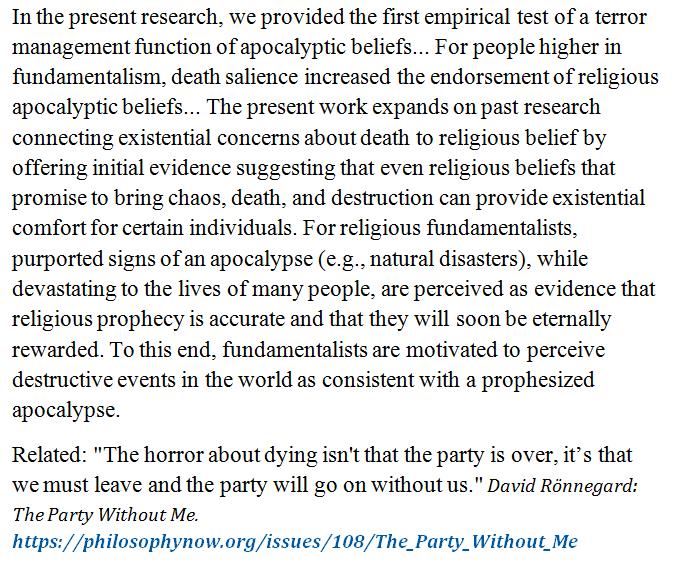
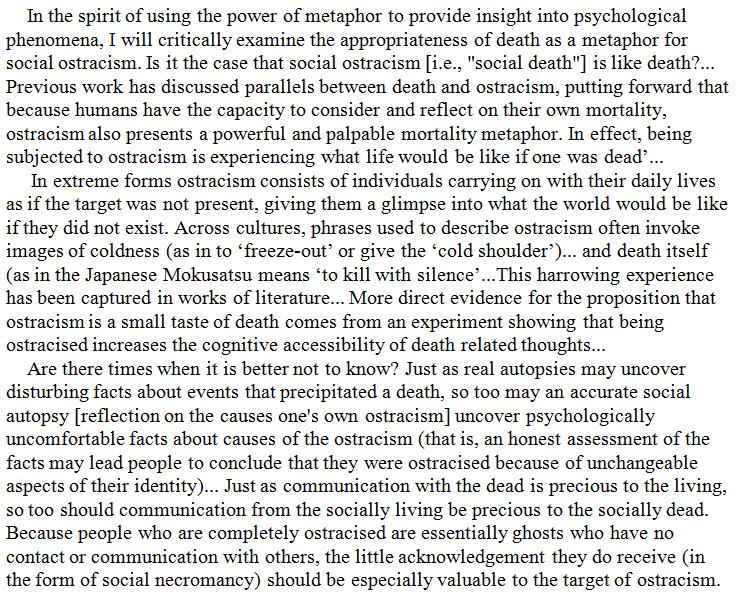
"NO RELIGION IS THE NEW RELIGION...SHE SAID SHE DON'T BELIEVE IN G0D!" - Peter Dagampat Ph.D.
Belief in punitive supernatural agencies is one universal feature of religion.Another
is that most religions impose costs of some kind on membership. Some
religions demand tithes, some require donations of time, others ban
certain foods or working on certain days. Why do religions impose such
costs? And why do people join very demanding religions, such as
Mormonism or Orthodox Judaism, when softer options like the Episcopal
church are available?
Religions impose costs on
members, it seems, in order to deter people who seek to enjoy a
religious community's benefits without contributing to its costs. Free
riders can be highly corrosive to a community's cohesion. "Winter
Shakers," who took food and shelter from Shakers but departed in the
spring, were a heavy burden. But systems to monitor people's level of
commitment and enthusiasm tend to destroy the property being measured. A
better solution is to make religion costly to join, whether by fees,
donation of time or requiring distinctive diet and dress.
Economists and anthropologists who have studied the question conclude that these costs serve several critical functions. By
raising the cost of entry, a religious community excludes free riders
and ensures that its members are committed. A high price of entry also
raises the level of trust among its members, because by obeying all the
required rules and taboos, congregants signal to one another that they
have bought into the religion's moral code and can be relied on to
behave accordingly. An extra benefit of distinctive dress or dietary
habits is that members find it harder to associate with nonmembers and
so devote more time to the community.
"If
strictness increases costs, why should anyone join a strict church?"
asked the economist Laurence Iannaccone. Many psychologists have sought
to analyze strict religious behavior as if it were some kind of mental
aberration. Applying the economic approach known as rational choice
theory to church attendance in the United States, Iannaccone arrived at a
quite different answer. "Strictness reduces free riding," he said.
"It screens out members who lack commitment and stimulates participation
among those who remain." Rational choice theory thus explains the
success of sects, cults, and conservative denominations without
resources to assumed abnormalities, irrationality, or misinformation."
There
is an optimal level of strictness, Iannaccone observes. Many sects are
too strict and fail. Others are not attractive to outsiders, and thrive
only if they maintain high fertility and accommodate sufficiently to
change. The Amish, an Anabaptist order with settlements in Ohio,
Pennsylvania and Indiana, are an example of the latter strategy. They
have high fertility and retention. They ban most new technology but
allow telephones in public places, though not in homes, and let cars be
hired but not owned.
For an injudicious adjustment of
strictness, Iannaccone offers the example of the Catholic church, which
relaxed many of its distinctive rules after the Second Vatican Council
of 1962 but adhered to hard-line positions on birth control and the
celibacy of priests. "The Catholic church may have managed to arrive at a
remarkable, 'worst of both worlds' position - discarding cherished
distinctiveness in the areas of liturgy, theology and lifestyle, while
at the same time maintaining the very demands that its members and
clergy are least willing to accept," Iannaccone writes.
The anthropologist William Irons came to much the same conclusion about the virtues of costliness. A religion, he noted, is "basically
a commitment to behave in a certain way without regard to
self-interest." The costly rituals enable members of a community "to
monitor one another's commitments to the community and its moral code,
thereby facilitating the formation of larger and better united groups."
A
high degree of commitment was vital to the survival of groups that were
locked into fierce competition with one another. Because religious
commitments are more powerful than any other kind,"evolution has
built into human beings a strong propensity to seek a religious
orientation toward life and to hold this orientation to be of the
highest value."Irons [Andy And Bruce Irons] wrote.
Biologists who study
animal signaling have noted that cheap signals can be imitated and thus
lose their value. Trustworthy signals are those that are very costly to
produce and cannot be counterfeited. Only very healthy peacocks can
afford to grow a magnificent tail, so peahens can rely on this signal in
choosing mates. When Thompson's gazelles spot a leopard, some will jump
up and down in a conspicuous movement known as stotting, instead of
just running away. The true signal of fitness advertises to the leopard
that it needn't waste its time and would do better to hunt some less
healthy gazelle.
Religious behavior to serves as a true signal because
religions are learned only in arduous initiation rites and demand a
heavy commitment of time. The signals are important to other members of
the community. They cannot watch an individual's movements all the time,
but they can assess his sincerity in the ritual.
The signals, it should be noted, are symbolic, and they convey their message far more effectively than could mere words.A
man may say "You can trust me!" but greatly more credible is his
participation in whatever rituals are required by the group's religion.
The
members of a Jewish sect in Israel known as the Haredim continue to
wear the thick black coats and fur hats of their eastern European
homeland. "By donning several layers of clothing and standing out in the
midday desert sun," writes the anthropologist Richard Sosis, "these men
are signaling to others, "Hey! Look, I'm a Haredi Jew. If you are
also a member of this group, you can trust me because why else would I
be dressed like this? Only a lunatic would spend their afternoon doing
this unless they believed in the teachings of Ultra-Orthodox Judaism and
were fully committed to its ideals and goals." Because of trust among group members, not only is the problem of free riders eliminated, but members benefit from mutual help. During his study of Haredi communities, Sosis notes, he often saw Haredi
travelers being offered free meals, lodging and rides by Haredi hosts
who did not know them. "On several occasions I witnessed cars being
loaned to complete strangers, and interviews revealed a surprising
number of interest-free loans offered and accepted between people who
had previously not known each other."
Trust and
cooperation of this strength are invaluable. It is easy to imagine that
cohesiveness of this kind could make a critical difference for small
groups constantly at war with one another. Irons, for one, believes that
this aspect of religion has been too little appreciated by skeptics
because of their focus on religious texts and beliefs rather than on
ritual. He writes, "The theory of religion as it applies to commitment
emphasizes the vital importance of religion to most human communities
and the fundamental [role] that religion plays in the lives of most
human beings.The theory also suggests that the core of religion is
not belief (which most scientists and intellectuals are prone to
criticize), but rather, for the most part, commitment to socially
constructive behavior."
Given the costliness of
religious behavior, and its salient role in determining a primitive
society's ability to deal with foes both internal and external, the
forces of natural selection seem very unlikely to have ignored it.
If religious behavior offered no benefit, groups that wasted time and
resources this way would have been eliminated by groups that did not
bear such a handicap in the struggle for survival.
The Faith Instinct: How Religion Evolved and Why it Endures. Wade, p. 58-61
I'll BREAK THIS DOWN LATER. BUT READ IT AND TRY TO APPLY THE
CONCEPT OF COSTLY SIGNALING TO MORMON MISSIONS, ISLAMIC HAJJ, AND OTHER
RELIGIOUS RITES OF PASSAGE OR RITUALS THAT PLACE DEMANDS AND COSTS OF
TIME, MONEY, AND ENERGY ON ITS MEMBERS TO TEST THEIR FIDELITY AND
COMMITMENT TO THE RELIGION.
"When a group's fundamental tenets are at stake, those who chant the loudest or clench their eyes the tightest in the face of conflicting evidence earn the most trust from their fellow group members."
I'm At CSULB (This Was In June Of This Year (2015)) Surrounded By A Group Of Muslim Girls In Hijabs And Veils. Why Do They Wear This Shit? I Told You Why On My $1 Blog. To Demonstrate Their Conformity To The Beliefs And Ideology Of Their Peer Group (Muslim Peers) As Well As Distinguish And Differentiate Themselves From The CSULB Infidels! By Wearing That Shit They're Saying, "We're Righteous, Upright Followers Of Allah, The One TRUE GOD, And Committed Adherers Of His Religion Unlike You Heathens."This Is How They Gain A Sense Of Identity And Purpose!
THE IRONY ABOUT THESE MUSLIM NUTS IS THAT THEY LIVE IN AMERICA, ATTEND AMERICAN SCHOOLS, WORK IN AMERICAN INDUSTRIES, BUT, FOR THE MOST PART, ARE ANTI-AMERICAN! HOW UN-AMERICAN!
In my New York debate on "Is Christianity the Problem?" with Christopher Hitchens - a lively affair, against a resourceful opponent - one of the most interesting questions came from a man from the island nation of Tonga.For centuries, the man said, Tonga suffered from terrible vendettas, tribal wars, and even cannibalism. Then the missionaries came with their doctrines of God, universal brotherhood, and the afterlife. Today, the man said, Tonga is a much more peaceful and happy place. Then turning to Hitchens he said, you have given us some interesting theories, but what do you have to offer us? Hitchens was momentarily speechless. What struck him and the audience was the sheer simplicity of the question. The man wasn't debating the fine points of doctrine; he just wanted to know, at the end of it all, which approach made things better for him and his people...
"TAKE ONE UH MINE AND IMMA TAKE 3 UH YOs" - MR. KANE
"An Eye For An Eye Nigga! S. B00G & WY Nigga!" - The Relativez Girl
Life After Death: The Evidence. D'Souza, p. 185-186
I'LL ANSWER THE QUESTION FOR MR. HITCHENS SINCE HE'S NO LONGER HERE TO ANSWER IT FOR HIMSELF. HE (MR. HITCHENS), ALONG WITH MOST SCIENTISTS AND ACADEMICIANS, GAVE THEM THE TRUTH. HE GAVE THEM THE SCIENTIFICALLY PROVEN FACTS ABOUT THE WORLD, LIFE, AND HUMAN NATURE. HE GAVE THEM THE REALISTIC PERSPECTIVE OF A WORLD DEVOID OF GOD CREATED BY A COMBINATION OF THE PHYSICAL PROPERTIES OF THE UNIVERSE, HAPPENSTANCE (RANDOM OCCURRENCES), AND EVOLUTION. HE GAVE THEM THE TRUTH, WHICH IS THE POLAR OPPOSITE OF THE FICTITIOUS, MYTHICAL BIBLICAL STORIES THAT CHRISTIANS GAVE THEM WHICH BEAR LITTLE RESEMBLANCE TO HISTORICAL AND EVOLUTIONARY REALITY AND AREN'T BACKED BY SCIENTIFIC FACT (THE BIBLE IS COMPOSED OF A NUMBER OF UNTRUTHS AND RELIGIOUS TENETS ARE A SET OF OUTDATED BELIEFS SUITED FOR AN ARCHAIC TIME AND AN ARCHAIC MIND. YOU CHRISTIANS, LIKE ALL RELIGIOUS PEOPLE, CONTINUE TO BELIEVE THIS NONSENSE BECAUSE YOU EVOLVED TO BELIEVE THIS NONSENSE. IT WAS ADAPTIVE TO BELIEVE THIS NONSENSE IN OUR EVOLUTIONARY PAST.)
IN OTHER WORDS, THE TONGAN MAN IS SAYING, "RATHER THAN GO THROUGH THE TROUBLE OF SEEKING THE TRUTH THROUGH SCIENCE I'LL JUST ACCEPT THESE CHRISTIAN BELIEFS AS FACT BECAUSE IF I SEEK THE TRUTH AND FIND THINGS THAT I DON'T LIKE MY WORLD AND PEACE OF MIND MAY BE DISTURBED (IT MAY COME TUMBLING DOWN). SO TO AVOID DISTURBING MY WORLD AND PEACE OF MIND AND TO MAKE LIFE EASIER, MORE TOLERABLE, AND MORE COMFORTABLE I'LL JUST BELIEVE WHAT THE CHRISTIAN FAITH PROFESSES (WHAT THESE CHRISTIANCRACKERS SAY) REGARDLESS OF WHETHER IT'S ACCURATE (REGARDLESS OF WHETHER IT'S THE TRUTH)." IN EFFECT, THE TONGAN MAN, LIKE MOST PEOPLE, IS SAYING THAT HE'S TOO LAZY TO FIND THE TRUTH AND, MORE IMPORTANTLY, WOULD RATHER NOT BE TOLD THE TRUTH (WOULD RATHER BE LIED TO) SO THAT HE CAN CONTINUE TO BE HAPPY AND LIVE IN PEACE. THAT IS, HE'D RATHER CONTINUE TO DECEIVE HIMSELF SO THAT HE CAN COPE WITH LIFE THAN BE EXPOSED TO THE TRUTH AND HAVE HIS WORLD TURNED UPSIDE DOWN. THIS IS WHY THOSE WHO ARE RELIGIOUS AND BELIEVE IN GOD ARE DELUSIONAL AND IN DENIAL. HOW CAN YOU CALL YOURSELF SANE WHEN THERE'S ALL THIS SCIENTIFIC DATA THAT EXPLAINS AND CONTRADICTS RELIGION AND DISPROVES THE EXISTENCE OF GOD. KNOW HOW YOU CAN? BECAUSE IT'S EASY. TAKING ANOTHER PERSONS PERSPECTIVE OR IDEOLOGY FOR GRANTED, ESPECIALLY IF IT MAKES LIFE MORE BEARABLE IS AN EASY THING TO DO. SEARCHING FOR THE TRUTH AND FINDING FACTS THAT CONTRADICT YOUR LONG HELD CONVICTIONS AND DON'T CONFORM WELL WITH YOUR LIFE, OUTLOOK, AND EVERYTHING YOU'VE BEEN TAUGHT TO BELIEVE IS THE HARD THING TO DO. (THE TONGAN MAN IS BASICALLY SAYING, "I'D RATHER FOOL MYSELF AND LIVE IN DENIAL SO THAT I CAN LIVE IN PEACE, THAN FACE THE FACTS AND LIVE IN REALITY". NOT KNOWING THAT THE FACTS PROVIDE A BETTER SOLUTION FOR PEACE AND HAPPINESS THAN DO FICTITIOUS, MORAL STORIES THAT BEAR LITTLE RESEMBLANCE TO REALITY AND CAN'T BE APPLIED TO REALITY.)
I'M GOING
TO MAKE THIS QUICK. THE FIRST FIVE PAGES HAVE TO DO WITH EMPATHY AND
THE STORY OF THE GOOD SAMARITAN (RELATE THIS TO WHAT I'VE WRITTEN ON
ANOTHER POST ABOUT PEOPLE AVOIDING BUMS). BENEATH THIS ARE PARAGRAPHS
CONCERNING RELIGION (WHY CERTAIN ATHEISTS ARE THE WAY THEY ARE, WHY
EMOTION DICTATES OUR REASON AND BELIEFS, AND HOW HUMANS EVOLVED TO BELIEVE IN
RELIGION BUT NOT SCIENCE).BUT BEFORE YOU GET TO ALL OF THAT READ THESE PAGES FROM DAVID EAGLEMAN'STHE BRAIN REGARDING THE HUMAN TENDENCY TO DEHUMANIZE THOSE WHO WE PERCEIVE AS BEING UNLIKE US AND BELONGING TO AN OUT-GROUP!
We Reserve Empathy For Those In Our In-Group! Those Who We Perceive As Being Unlike Us And From A Social Or Cultural Or Racial Group Unlike Ours Don't Deserve Our Empathy And Compassion. At Least, That's How We Unconsciously Reason And Justify Our Behavior Towards Outsiders.
On the court takes care of itself. Off the court is where character is built. No other program in the nation doing this at a high level. Sponsor feeding the homeless and advocate sponsorship for 10 deserving HS programs. Good luck keeping up#GiveBack#ExpectNothingInReturn
HE MAY BE MAKING HIS PLAYERS FEED THE HOMELESS, BUT IS HE MAKING HIS PLAYERS CHANGE THEIR MINDSET AND THE WAY THEY THINK ABOUT THE HOMELESS. IS HE MAKING HIS PLAYERS LOOK AT THE HOMELESS IN A MORE COMPASSIONATE AND HUMANISTIC LIGHT? IS HE MAKING HIS PLAYERS LOOK AT THE HOMELESS AS FELLOW HUMANS WHO DESERVE DIGNITY AND RESPECT? I DON'T THINK SO. SO ALL OF THIS "WORK" THAT HE AND HIS PLAYER DO FOR THE HOMELESS IS BENEFITING THEM (HE AND HIS PLAYERS) MORE THAN THE HOMELESS! IT'S BENEFITING HE AND HIS PLAYERS BY BOOSTING THEIR IMAGE, WHICH MAKES THEM MORE SEXUALLY AND SOCIALLY APPEALING! WHAT A FUCKIN' CONMAN THAT TREE TOP EDAMAMI GUY IS!
WHY DO
PEOPLE AVOID BUMS? WHY DO MOST PEOPLE TRY TO AVOID INTERACTING WITH BUMS
OR EVEN LOOKING AT THEM? BECAUSE HUMANS ARE INNATELY EMPATHETIC. WE CAN
LOOK AT SOMEONE'S FACIAL EXPRESSIONS OR BODY LANGUAGE OR EMOTIONAL
STATE OR THE ACTIVITIES THAT THEY'RE ENGAGING IN (THEY'RE SITUATION) AND
RELATE TO THEM. IF WHAT THEY'RE EXPERIENCING AND EMOTIONALLY DISPLAYING
IS POSITIVE (AND WE LIKE THEM) WE TYPICALLY FEEL GOOD FOR THEM AND
MAYBE EVEN WANT TO JOIN THEM IN THEIR HAPPINESS. BUT IF WHAT THEY'RE
EXPERIENCING IS NEGATIVE OR THE EMOTION THEY'RE DISPLAYING IS NEGATIVE
WE DON'T WANT TO HAVE ANYTHING TO DO WITH THEM. WE'LL TRY TO AVOID THEM
AND NOT EVEN LOOK IN THEIR DIRECTION. NOW WHY DO WE DO THIS? WHY WILL WE
TRY TO AVOID THE PERSON EXPERIENCING A NEGATIVE SITUATION OR EXHIBITING
A NEGATIVE EMOTION? BECAUSE WE'RE EMPATHETIC AND SINCE WE'RE
EMPATHETIC WE CAN IDENTIFY WITH A NEGATIVE SITUATION (HOMELESSNESS, FOR
INSTANCE) OR A NEGATIVE EMOTIONAL STATE. AND SINCE WE EVOLVED TO AVOID
THINGS OF A NEGATIVE NATURE WE TURN A BLIND EYE AND DEAF EAR TO NEGATIVE
MATTERS, SITUATIONS, OR EMOTIONS (WHAT THE UNFORTUNATE PERSON IS
EXPERIENCING). WHY DO WE DO THIS? BECAUSE WE DON'T WANT TO EXPERIENCE
THAT PERSON'S DIFFICULTIES AND DISTRESS. WE DON'T WANT TO BURDEN
OURSELVES WITH THEIR TROUBLES AND STRUGGLE. WE DON'T WANT THE PERFECT
LITTLE WORLD WE'VE CREATED FOR OURSELVES TO BE DISTURBED BY THE THOUGHT
OF WHAT THE UNFORTUNATE PERSON IS GOING THROUGH. WE LITERALLY DON'T WANT
TO SEE OR HEAR WHAT IS HAPPENING OR HAS HAPPENED TO THE UNFORTUNATE
PERSON BECAUSE DOING SO WILL BRING US DOWN, BRING US TO THEIR LEVEL, AND
DISTRESS US, DISTURB US, DAMAGE OUR PSYCHE, AND POSSIBLY EVEN DESTROY
OUR LIVES. SO WE AVOID THE BUM. (PETROS PAPADAKIS, I'M NOT REALLY
REFERRING TO NEGATIVE PEOPLE IN THE ABOVE PARAGRAPH. I'M REFERRING TO
PEOPLE WHO ARE GOING THROUGH SOME ADVERSITY. FOR INSTANCE, THINK OF THE
PEOPLE WHO BECOME GRAVELY ILL OR EXPERIENCE SOME FINANCIAL HARDSHIP
(LOSE EVERYTHING THEY HAD AND FALL IN SOCIAL STATUS, FOR INSTANCE).
THEIR FRIENDS AND FAMILY TYPICALLY DISASSOCIATE FROM THEM. THEY STOP
TALKING TO THEM, STOP VISITING THEM, AND TRY TO AVOID THEM AT ALL COSTS.
WHY? BECAUSE THEY LITERALLY DON'T WANT TO SEE THEIR FRIEND OR FAMILY
MEMBER IN THAT STATE. WHY? BECAUSE SEEING THEIR FRIEND OR FAMILY MEMBER
IN THAT STATE WILL HURT THEM PSYCHOLOGICALLY. IT'LL DISTRESS THEM,
DISTURB THEM, DESTROY THE POSITIVE IMAGE THAT THEY HAD OF THEM, AND
POSSIBLY REMIND THEM OF WHAT COULD HAPPEN TO THEM OR WHAT AWAITS THEM.
AND THEY DON'T WANT TO HAVE ANYTHING TO DO WITH THAT.)
One
quiet Sunday morning, I stroll down the driveway of my home in Stone
Mountain, Georgia, to pick up the newspaper. As I arrive at the bottom -
we live on a hill - a Cadillac drives up the street and stops right
before me. A big man in a suit steps out, sticking out his hand. A firm
handshake follows, during which I hear him proclaim in a booming, almost
happy voice, "I'm looking for lost souls!" Apart from perhaps being
overly trusting, I am rather slow and had no idea what he was talking
about. I turned around to look behind me, thinking that perhaps he had
lost his dog, then corrected myself and mumbled something like, "I'm not
very religious."
This was of course a lie, because I
am not religious at all. The man, a pastor, was taken aback, probably
more by my accent than by my answer. He must have realized that
converting a European to his brand of religion was going to be a
challenge, so he walked back to his car, but not without handing me a
business card in case I'd change my mind. A day that had begun so
promisingly now left me feeling like I might go straight to hell.
I
was raised Catholic. Not just a little bit Catholic, like my wife,
Catherine. When she was young, many Catholics in France already barely
went to church, except for the big three: baptism, marriage, and
funeral. And only the middle one was by choice. By contrast, in the
southern Netherlands - known as "below the rivers" - Catholicism was
important during my youth. It defined us, setting us apart from the
above-the-rivers Protestants. Every Sunday morning, we went to church in
our best clothes, we received catechism at school, we sang, prayed, and
confessed, and a vicar or bishop was present at every official occasion
to dispense holy water (which we children happily imitated at home with
a toilet brush). We were Catholic through and through.
But
I am not anymore. In my interactions with religious and non-religious
people alike, I now draw a sharp line, based not on what exactly they
believe but on their level of dogmatism. I consider dogmatism a far
greater threat than religion per se.I am particularly curious why
anyone would drop religion while retaining the blinkers sometimes
associated with it. Why are the "neo-atheists" of today so obsessed with
God's nonexistence that they go on media rampages, wear T-shirts
proclaiming their absence of belief, or call for a militant atheism?
What does atheism have to offer that's worth fighting for? As one
philosopher put it, being amilitant atheistis like "sleeping
furiously."
I
was too restless as a boy to sit through an entire mass. It was akin to
aversion training. I looked at it like a puppet show with a totally
predictable story line. The only aspect I really liked was the music. I
still love masses, passions, requiems, and cantatas and don't really
understand why Johann Sebastian Bach ever wrote his secular cantatas,
which are so obviously inferior. But other than developing an
appreciation of the majestic church music of Bach, Mozart, Haydn, and
others, for which I remain eternally grateful, I never felt any
attraction to religion and never talked to God or felt a special
relationship. After I left home for the university, at the age of
seventeen, I quickly lost any remnant of religiosity. No more church for
me. It was hardly a conscious decision, certainly not one I recall
agonizing over. I was surrounded by other ex-Catholics, but we rarely
addressed religious topics except to make fun of popes, priests,
processions, and the like. It was only when I moved to a northern city
that I noticed the tortuous relationship some people develop with
religion.
Much of postwar Dutch literature is written
by ex-Protestants bitter about their severe upbringing. "Whatever is not
commanded is forbidden" was the rule of the Reformed Church. Its
insistence on frugality, black dress code, continuous fight against
temptations of the flesh, frequent scripture readings at the family
table, and its punitive God - all contributed greatly to Dutch
literature. I have tried to read these books, but have never gotten very
far: too depressing! The church community kept a close eye on everyone
and was quick to accuse. I have heard shocking real-life accounts of
weddings at which the bride and groom left in tears after a sermon about
the punishment awaiting sinners. Even at funerals, fire and brimstone
might be directed at the deceased in his grave so that his widow and
everybody else knew exactly where he'd be going. Uplifting stuff.
In contrast, if the local priest visited our home, he would count on a cigar and a glass of jenever
(a sort of gin) - everyone knew that the clergy enjoyed the good life.
Religion did come with restrictions, especially reproductive ones
(contraception being wrong), but hell was mentioned far less than
heaven. Southerners pride themselves on their bon vivant attitude to
life, claiming that there's nothing wrong with a bit of enjoyment. From
the northern perspective, we must have looked positively immoral, with
beer, sex, dancing, and good food being part of life. This explains a
story I heard once from an Indian Hindu who married a Dutch Calvinist
woman from the north. Although the woman's parents didn't have the
faintest idea what a Hindu was, they were relieved that their new
son-in-law was at least not Catholic. For them, belief in multiple
deities was secondary to the heretic and sinful ways of their next-door
religion.
The southern attitude is recognizable in
Pieter Brueghel's and Bosch's paintings, some of which bring to mind
Carnival, the beginning of Lent. Carnival is big in Den Bosch, when the
city is known as Oeteldonk, and also celebrated in nearby
Catholic Germany, in cities like Cologne and Aachen, where Bosch's
family came from (his father's name, "van Aken," referred to the latter
city). Bosch must have been well versed in the zany Carnival atmosphere,
and its suspension of class distinctions behind anonymous masks. Just
like Mardi Gras in New Orleans, Carnival is deep down a giant party of
role reversal and social freedom. The Garden of Earthly Delights
achieves the same by depicting everyone in his or her birthday suit. I
am convinced that Bosch intended this as a sign of liberty rather than
the debauchery some have read into it.
Possibly, the
religion one leaves behind carries over into the sort of atheism one
embraces. If religion has little grip on one's life, apostasy is no big
deal and there will be few lingering effects. Hence the general apathy
of my generation of ex-Catholics, which grew up with criticism of the
Vatican by our parents' generation in a culture that diluted religious
dogma with an appreciation of life's pleasures. Culture matters, because
Catholics who grew up in papist enclaves above the river tell me that
their upbringing was as strict as that of the Reformed households around
them. Religion and culture interact to such a degree that a
Catholic from France is not really the same as one from the southern
Netherlands, who in turn is not the same as one from Mexico. Crawling on
bleeding knees up the steps of the cathedral to ask the Virgin of
Guadalupe for forgiveness is not something any of us would consider. I
have also heard American Catholics emphasize guilt in ways that I
absolutely can't relate to.It is therefore as much for cultural as
religious reasons that southern ex-Catholics look back with so much less
bitterness at their religious background than northern ex-Protestants.
Egbert
Ribberinkk and Dick Houtman, two Dutch sociologists, who classify
themselves, respectively, as "too much of a believer to be an atheist"
and "too much of a nonbeliever to be an atheist," distinguish two kinds
of atheists. Those in one group are uninterested in exploring their
outlook and even less in defending it. These atheists think that both
faith and its absence are private matters. They respect everyone's
choice, and feel no need to bother others with theirs. Those in the
other group are vehemently opposed to religion and resent its privileges
in society. These atheists don't think that disbelief should be kept
locked up in the closet. They speak of "coming out," a terminology
borrowed from the gay movement, as if their nonreligiousness was a
forbidden secret that they now want to share with the world. The
difference between the two kinds boils down to the privacy of their
outlook.
I like this analysis better than the usual
approach to secularization, which just counts how many people believe
and how many don't.It may one day help to test my thesis that
activist atheism reflects trauma. The stricter one's religious
background, the greater the need to go against it and to replace old
securities with new ones.
Religion looms as
large as an elephant in the United States, to the point that being
nonreligious is about the biggest handicap a politician running for
office can have, bigger than being gay, unmarried, thrice married, or
black. This is upsetting, of course, and explains why atheists have
become so vocal in demanding their place at the table. They prod the
elephant to see whether they can get it to make some room. But the
elephant also defines them, because what would be the point of atheism
in the absence of religion?
As if eager to provide
comic relief from this mismatched battle, American television
occasionally summarizes it in its own you-can't-make-this-stuff-up way.
The O'Reilly Factor on Fox News invited David Silverman,
president of the American Atheist Group, to discuss billboards
proclaiming religion a "scam." Throughout the interview, Silverman kept
up a congenial face, complaining that there was absolutely no reason to
be troubled, since all that his billboards do is tell the truth:
"Everybody knows religion is a scam!" Bill O'Reilly, a Catholic, expressed his disagreement and clarified why religion is not
a scam "Tide goes in, tide goes out. Never a miscommunication. You
can't explain that." This was the first time I had heard the tides being
used as proof of God. It looked like a comedy sketch with one smiling
actor telling believers that they are too stupid to see that religion is
a fraud, but that it would be silly for them to take offense, while the
other proposes the rise and fall of the oceans as evidence for a
supernatural power, as if gravity and planetary rotation can't handle
the job.
All I get out of such exchanges is the
confirmation that believers will say anything to defend their faith and
that some atheists have turned evangelical.Nothing new about the first, but atheists' zeal keeps surprising me. Why
"sleep furiously" unless there are inner demons to be kept at bay? In
the same way that firefighters are sometimes stealth arsonists and
homophobes closet homosexuals, do some atheists secretly long for the
certitude of religion?Take Christopher Hitchens, the late British
author of God Is Not Great. Hitchens was outraged by the dogmatism of
religion, yet he himself moved from Marxism (he was a Trotskyist) to
Greek Orthodox Christianity, then to American Neo-Conservatism, followed
by an "antitheist" stance that blamed all of the world's troubles on
religion. Hitchens thus swung from the left to the right, from
anti-Vietnam War to cheerleader of the Iraq War, and from pro to contra
God. He ended up favoring Dick Cheney over Mother Teresa.
Some
people crave dogma, yet have trouble deciding on its contents. They
become serial dogmatists. Hitchens added, "There are days when I miss my
old convictions as if they were an amputated limb," thus implying that
he had entered a new life stage marked by doubt and reflection. Yet, all
he seemed to have done was sprout a fresh dogmatic limb.
Dogmatists
have one advantage: they are poor listeners. This ensures sparkling
conversations when different kinds of them get together the way male
birds gather at "leks" to display splendid plumage for visiting females.
It almost makes one believe in the "argumentative theory," according to
which human reasoning didn't evolve for the sake of truth, but rather
to shine in discussion. Universities everywhere set up crowd-pleasing
debates between religious and antireligious intellectual "giants."
The Bonobo and the Atheist: In Search of Humanism Among the Primates. de Waal, p. 83-89.
My
first experience with proselytizing was almost too comical to be true.
At the time, I had a room on the fourth floor of a university dormitory,
in Groningen. On morning, I heard a knock on my door, and two young
American Mormons in jackets and ties stood in front of me. Curious to
hear about their faith, I invited them in. They proceeded to set up an
easel and a board on which they pasted felt figures and text labels to
explain the story of an ordinarily named American, who had seen the Lord
in a pillar of light. Later, he was led by an angel to holy texts on
golden plates.
All of this happened just over a century
ago. I listened to their incredible tale and was just about to ask how
this Joseph Smith convinced others of his special encounter, when we
were rudely interrupted. I often left a window open to let Tjan, my pet
jackdaw, fly in and out. He was free outside, but would come in before
dark to be fed and locked up for the night. While the two young men
patiently recounted God's appearance in a cave, Tjan sailed into the
room looking for a landing spot. He went for the highest point, which
was the head of one of the Mormons standing in front of his board. A
large black bird landing on him was the last thing he'd expected. I saw
the panic on his face and quickly tried to assure him that this was just
Tjan, a bird with a name, who wouldn't hurt anyone. I have never seen
two people pack up so quickly: they were gone in no time, out the door,
running for the elevator. While they collected their things, I heard
them talk of the "devil."
My having spoiled Tjan as a
baby with the fattest earthworms I could dig up made him extra large for
his species. He was such a curious and intelligent character, who'd fly
above me on strolls through the park. But of course he was black,
noisy, and crow-like, reminding the Mormons of a creature that might
steal their souls. As a result, they never got to answer my question,
nor did they have a chance to explain how Smith translated the golden
plates engraved with "reformed Egyptian" by gazing at "peep stones"
placed in the bottom of his hat. Smith was smart enough to empathize
with his skeptics: "If I had not experienced what I have, I couldn't
have believed it myself."
So, why did people believe
him? Smith met with a great deal of derision and hostility (he was
killed by a lynch mob at the age of thirty-eight), but the Church of
Jesus Christ of Latter-day Saints now counts 14 million followers. It is
obvious that believers are not looking for evidence, because the only
item that might have been helpful, the set of golden plates, had to be
returned to the angel. People simply believe because the y want to. This
applies to all religions. Faith is driven by attraction to certain
persons, stories, rituals, and values. It fulfills emotional needs, such
as the need for security and authority and the desire to belong.
Theology is secondary and evidence tertiary. I agree that what the
faithful are asked to believe can be rather preposterous, but atheists
surely won't succeed in talking people out of their faith by mocking the
veracity of their holy books or by comparing their God with the Flying
Spaghetti Monster. The specific contents of beliefs are hardly at issue if the overarching goal is a sense of social and moral communion. To borrow from a tithe by the novelist Amy Tan, to criticize faith is
like trying to save fish from drowning. There's no point in catching
believers out of the lake to tell them what is best for them while
putting them out on the bank, where they flop around until they expire.
They were in the lake for a reason.
Accepting that
faith is driven by values and desires makes at once for a great contrast
with science, but also exposes common ground, since science is less
fact-driven than is widely assumed. Don't get me wrong, science produces
great results. It has no competition when it comes to understanding
physical reality, but science is also often, like religion, based on
what we want to believe. Scientists are human, and humans are
driven by what psychologists call "confirmation biases" (we love
evidence that supports our view) and "disconfirmation biases" (we
disparage evidence that undermines our view).That scientists systematically resist new discoveries was already the topic of a 1961 article in the illustrious pages of Science,
which added the mischievous subheading "This source of resistance has
yet to be given the scrutiny accorded religious and ideological
sources."
...
My own story concerns
the discovery, in the mid-1970s, that chimpanzees make up after fights
by kissing and embracing their opponents. Reconciliation behavior has
now been demonstrated in many primates, but when one of my students
needed to defend a study of this behavior before a committee of
psychologists, she got an earful. We had naively assumed that these
psychologists, who knew only rats, would have no opinion about primates,
yet they were adamant that reconciliation in animals was out of the
question. It didn't fit their thinking, which excluded emotions, social
relationships, and everything else that makes animals interesting. I
tried to change their minds by inviting them to the zoo where I worked
so that they could see for themselves what chimpanzees do after fights.
To this proposal, however, they replied bafflingly, "What good would it
do to see the actual animals? It will be easier for us to stay objective
without this influence."
It is said that the
ancient king of Sardis complained that "men's ears are less credulous
than their eyes." Only here it was reversed: these scientists feared
that their eyes might tell them something they didn't want to hear. Like
the rest of humanity, scientists apply fight-or-flight responses to
data: they go for the familiar and avoid the unfamiliar. I have to think
of this each time I hear neo-atheists claim that their God denial makes
them smarter than believers and rational like scientists. They like to
present themselves as emotion free, "just the facts, ma'am" kind of
thinkers. In a column in USA Today, Jerry Coyne, a fellow
biologist and self-declared "gnu-atheist" (yes, "gnu" as in
"wildebeest," which is Dutch for "wild beast"), called faith and science
utterly incompatible "for precisely the same reason that irrationality
and rationality are." He then proceeded to draw little aureoles around
the heads of scientists:
Science
operates by using evidence and reason. Doubt is prized, authority
rejected. No finding is deemed "true" - a notion that's always
provisional - unless it's repeated and verified by others. We scientists
are always asking ourselves, "How can I find out whether I'm wrong?"
Oh, how I wish I had colleagues like Coyne! Having spent all my life among academics, I can tell you that hearing how wrong they are is about as high on their priority list as finding a cockroach in their coffee.
The typical scientist has made an interesting discovery early on in his
or her career, followed by a lifetime of making sure that everyone else
admires his or her contribution and that no one questions it. There is
no poorer company than an aging scientist who has failed to achieve
these objectives. Academics have petty jealousies, cling to their
views long after they have become obsolete, and are upset every time
something new comes along that they failed to anticipate. Original ideas
invite ridicule, or are rejected as ill informed. As neuroscience
pioneer Michael GazzaniGgacomplained in a recent interview,
There
is a profound inhibitory effect on new ideas by people and ideas that
"got there first," telling their story over and over while new
observations struggle up from the bottom. The old line that human
knowledge advances one funeral at a time seems to be so true!
This is more like the scientists I know. Authority outweighs evidence,
at least for as long as the authority lives. There is no lack of
historical examples, such as resistance to the wave theory of light, to
Pasteur's discovery discovery of fermentation, to continental drift, and
to Rontgen's announcement of X-rays, which was initially declared a
hoax.Resistance to change is also visible when science continues to cling to unsupported paradigms, such as Rorschach inkblot test, or keeps touting the selfishness of organisms despite contrary evidence. Scientists
praise the "plausibility" and "beauty" of theories, making value
judgements on the basis of how they think things work, or ought to work.
Science is in fact so value laden that Albert Einstein denied that all
we do is observe and measure, saying that what we think exists is a
produce almost as much of theory as of observation. When theories
change, observations follow suit.
If faith makes
people buy an entire package of myths and values without asking too many
questions, scientists are only slightly better. We also buy into a
certain outlook without critically weighing each and every underlying
assumption and often turn a deaf ear to evidence that doesn't fit. We
may even, like the psychologists on my student's committee, deliberately
turn down a chance to get enlightened. But even if scientists are
hardly more rational than believers, and even if the entire notion of
unsentimental rationality is based on a giant misunderstanding (we
cannot even think without emotions), there is one major difference
between science and religion. This difference resides not in the
individual practitioners but in their culture. Science is a collective
enterprise with rules of engagement that allow the whole to make
progress even if its parts drag their feet.
What
science does best is to incite competition among ideas. Science
instigates a sort of natural selection, so that only the most viable
ideas survive and reproduce...In comparison, religion is static. It does
change with a changing society, but rarely as a result of evidence.
This sets up a potential conflict with science...
The Bonobo and the Atheist: In Search of Humanism Among the Primates. de Waal, p. 95-100.
If
religion is so widespread, the next question is why it evolved.
Biologists always wonder about survival value. What sort of advantage
does religion offer? This question has been addressed by comparing early
Christians with the Roman population around them. When two plagues
swept through the empire, each one killing one-third of the population,
the Christians fared better than the Romans. The Christians brought food
and water to those too sick to care for themselves, attending to their
needs in the name of Christ, whereas the Romans fled from their dearest,
abandoning them even before they had expired in an attempt to avert
contagion. Even though Christians risked contamination, a study of
tombstone inscriptions revealed that they enjoyed a higher life
expectancy. ... Perhaps
the question can be answered on a smaller scale, as in a study of the
longevity of nineteenth-century communities in the United States.
Communities based on a secular ideology, such as collectivism,
disintegrated much faster than those based on religious principles. For
every year that communities lasted, religious ones were four times as
likely to survive than their secular counterparts. Sharing a religion
dramatically raises trust. We know the huge bonding effect of
coordinated practices, such as praying together and carrying out the
same rituals. This relates to the primate principle that acting together
improves relationships, ranging from monkeys' preferring human
experimenters who imitate them to varsity rowers' gaining physical
resistance (such as a higher pain threshold) from exercising as a team
rather than on their own. Joint action may stimulate endorphin release,
as has also been suggested for other bonding mechanisms, such as joint
laughter. These positive effects of synchronization help explain the
cohesiveness of religions and their effect on social stability. Durkheim
dubbed the benefits derived from belonging to a religion its "secular
utility." He was convinced that something as pervasive and ubiquitous as
religion must serve a purpose - not a higher purpose, but a social one.
The biologist David Sloan Wilson, who analyzed the data on early
Christians, agrees in that he sees religion as an adaptation that
permits human groups to function harmoniously: "Religions exist
primarily for people to achieve together what they cannot achieve
alone." Religious community building comes
naturally to us. In fact, given how commonly religion is pitted against
science, it is good to remember the tremendous advantage religion
enjoys. Science is an artificial, contrived achievement, whereas
religion comes as easily to us as walking or breathing. This has been
pointed out by many authors, from the American primatologist Barbara
King, who in Evolving God relates the drive to religion to our
desire to belong, to the French anthropologist Pascal Boyer, who views
religion as an intuitive capacity:
Scientific
research and theorizing has appeared only in very few human
societies...The results of scientific research may be well-known, but
the whole intellectual style that is required to achieve them is really
difficult to acquire. By contrast, religious representations have
appeared in all human groups that we know, they are easily acquired,
they are maintained effortlessly and they seem accessible to all members
of a group, regardless of intelligence or training. As Robert McCauley
points out,...religious representations are highly natural to human
beings, while science is quite clearly unnatural. That is, the former
goes with the grain of our evolved intuitions, while the latter requires
that we suspend, or even contradict most of our common ways of
thinking.
Contrast the ease with which
children adopt religion with the long and laborious road young people
travel to achieve a Ph.D. around the age of thirty. McCauley, a philosopher colleague of mine at Emory, told me that if
he had to choose which of the two would survive if society collapsed,
he'd put his money on religion rather than science: "Religion
overwhelmingly depends upon what I'm calling natural cognition, thinking
that is automatic, that is not conscious for the most part." McCauley
contrasts this with science, which is "conscious, usually in the form of
language. It's slow, it's deliberative."
Imagine,
we put a few dozen children on an island without adults. What would
happen? William Golding thought he knew, giving us savagery and murder
in Lord of the Flies. This may have been a great extrapolation
from life at English boarding schools, but there is no sherd of evidence
that this is what children left to their own devices will do. When
four-to five-year-old children are left alone in a room, they tend to
negotiate with each other by means of moral terminology such as "That's
not fair!" or "Why don't you give her some of your toys?" No one
knows what children would do if left alone for a much longer time, but
they would definitely form a dominance hierarchy. Young animals, whether
goslings or puppies, quickly battle it out to establish a pecking
order, and children do the same. I remember the pale faces of psychology
students steeped in academic egalitarianism, upset at seeing young
children beat up on each other on the first day of preschool. We are a
hierarchical primate, and, however much we try to camouflage it, it
comes out early in life.
The children on the island
might also enter the symbolic domain. They'd probably develop language
in the same way that Nicaraguan deaf children, in the 1980s, began
communicating in a simple sign language that outsiders couldn't follow.
Many other aspects would develop as well, such as culture. The children
would transmit habits and knowledge and show conformism in the tools
they made or how they greeted each other. They'd also have property
rights and tensions over ownership. Finally, they would undoubtedly
develop religion. We don't know what kind, but they would believe in
supernatural forces, perhaps personalized ones, like gods, and develop
rituals to appease them and bend them to their will. The
one thing the children would never develop is science. By all accounts,
science is only a few thousand years old, hence it appeared extremely
late in human history. It is a true accomplishment, a critically
important one, yet it would be naive to put it on the same level as
religion. The war between science and religion is, to put it in biblical
terms, one between David and Goliath. Religion has always been with us
and is unlikely to ever go away, since it is part of our social skin.
Science is rather like a coat that we have recently bought. We
always risk losing it or throwing it away. The antiscience forces in
society require constant vigilance, given how fragile science is
compared with religion. To contrast the two as if they are on equal
footing and in competition is a curious misrepresentation explainable
only by reducing science and religion to sources of knowledge about the
same phenomena. Only then could anyone argue that if one of the two is
right, the other must be wrong.
When it comes down to
knowledge of the physical world, the choice is obvious. I can't fathom
why in this day and age, with everyone walking around with laptops and
traveling through the air, we still need to defend science. Consider how
far biomedical science has come, and how much longer we live as a
result. Isn't it obvious that science is a superior way of finding out
how things work, where humans come from, or how the universe arose? I am
among scientists every day, and there is nothing more addictive than
the thrill of discovery. True, plenty of mysteries are left, but science
offers the only realistic hope of solving them.Those who present
religion as a source of this kind of knowledge, and stick to age-old
stories despite the avalanche of new information, deserve all the scorn
they invite.But I also consider this particular collision between
science and religion a mere sideshow. Religion is much more than belief.
The question is not so much whether religion is true or false, but how
it shapes our lives, and what might possibly take its place if we were
to get rid of it the way an Aztec priest rips the beating heart out of a
virgin. What could fill the gaping hole and take over the removed
organ's functions?
The Bonobo and the Atheist: In Search of Humanism Among the Primates. de Waal, p. 211-216.
"NO RELIGION IS THE NEW RELIGION...SHE SAID SHE DON'T BELIEVE IN G0D!" - Peter Dagampat Ph.D.
http://www.youtube.com/watch?v=QZw3lxyuhEU
The Same Goes For Religiousity. You Might Hear A Female Say "Wow,
He's A Really Religious Guy. His Parents Raised Him Well." But, In
Actuality, It Wasn't Entirely His Environment That Shaped His Religious
Commitment And Religious Faithfulness. Much Of It Had To Do With His
Genes. His Genes Predisposed Him To Be Highly Religious And These
Genes Then Interacted With His Environment To Create The Religious
Person He Came To Be.
I don't think that the terrible thing about dying is the expiration of the self. The terrible thing is that WE must leave - and the party goes on without us. Social comparison until the end.
https://www.youtube.com/watch?v=Kyagrj-OHAM 0:45 "There's No Reason To Feel Sorry When It Comes To Death! Cuz In G0D There Is No Death! Jesus Said Any Man Who Believes My Word...Shall NOT See Death!" - Sam
Imagine, for example, a prehistoric hunter making his way
home through unfamiliar woods. His mind wanders as he travels, and he is
only absently aware of ambient noises of the forest, but when a twig
snaps in the underbrush, his mind is instantly, involuntarily focused.
This intense mental alertness results from the sudden activation of the
amygdala, the ancient limbic watchdog that monitors all incoming sensory
information for signs of danger and opportunity. When the amygdala
detects the unaccounted-for auditory impulses caused by the sudden
noise, it rivets the hunter's mind upon it. Already, the autonomic
system has triggered an arousal response, bracing the body for action.
In the same split second the hunter first hears the suspicious sound,
the cognitive imperative is driving the causal operator to discover what
it might mean.
Discovering a cause is the first
priority of the causal operator, but as the hunter scans the underbrush,
no cause is apparent. Uncertainty at such an urgent moment is
intolerable to the causal operator, so it does what it is designed to do
in the absence of a specific cause: it proposes one. The proposal
arises out of activity in the hippocampus, the limbic structure where
past experiences are stored as memories. Rapidly, the mind scours these
memory banks, sorting and cross-referencing information as it searches
for any pertinent content - images, sounds, or larger chunks of
experience - that might shed light on the problem at hand.
The
computational task is staggering, but in an instant, all the brain's
memory files have been consulted, all irrelevant data has been ignored,
and the casual operator presents its best hunch by conjuring in the
hunter's mind the idea of a leopard lurking in the trees. For the
hunter, who had seen the tracks of a big cat earlier that day, and who
had once been chased by a leopard in woods very similar to these, there
was no need for further deliberation; the unseen predator was utterly
real, the danger was immediate, and his only option was to run.
Later,
in a calmer moment, the hunter might reconsider his reaction. After
all, he had no way of knowing for sure that the noise was made by a
leopard - it's just as likely that the twig was stepped on by a plump
wild pig, or by a harmless foraging deer. But the hunter didn't need to know the leopard was real, it was enough that he believed
it. The causal operator is designed to promote survival, not
necessarily to find the truth, and if there really had been a leopard in
the bushes, it was the hunter's ability to think about the potential for danger, as opposed to an antelope that can only react, that would save his life.
But
why would he believe so surely in something he didn't know absolutely
to be true? We think there was more to the hunter's reaction than simple
common sense. We believe he accepted the realness of the unseen leopard
because neurological forces allowed him no other choice.
The
hunter's process of believing that began as amygdalar function focused
the mind's cognitive operations upon the mystery of the noise in the
bushes. The causal operator, or, more specifically, the brain structures
that support the causal operator, responded by proposing the presence
of a leopard. Simultaneously, the binary operator interprets the problem
as a conflict of opposites. In a specific sense, this conflict is
between the concepts of leopard and not-leopard, but on a deeper and
more general level it is a fundamental conflict of life versus death.
In
either case, these urgent conflicts must be effectively resolved. The
analytical, verbally inclined left brain immediately attacked the
problem by making certain logical connections: The hunter realized he
was in leopard country, and remembered having seen leopard tracks a few
miles back. It was logical to believe that a leopard might have been
lurking in the trees.
At the same time, the hunter
knew that the tracks he'd seen were at least several days old. He also
knew that leopards do not customarily hunt at that time of the day. This
led to the logical possibility that something other than a leopard - a
deer or a pig, for example - was the source of the startling sound. The
hunter now faced a logical dilemma: Fleeing might have cost him an easy
kill, but hesitation might have cost him his life.
While
the verbal, analytical left brain struggled with this problem,
the intuitive, holistic right brain was taking a different approach.
Thinking with images and emotions, rather than language and logic, the
right brain analyzed how the situation felt. The right brain visualized
the easy kill, and the reaction was highly positive. But those positive
feelings were heavily outweighed by the vivid visualization of being
eaten by a leopard. As the right brain dwelt upon this grisly
possibility, a memory sprang to mind of a time when the hunter was
chased by a man-eating cat in the woods very similar to these. The right
brain remembered the terror and instantly made its decision: There's a
leopard in the trees.
This emotional apprehension
immediately colored the decision making process of the left brain. The
logical idea of the leopard was now charged with emotional substance,
and as the intuitive faculties of the right brain came into unified
agreement with the logical powers of the left, the ideas in his head
gained depth and authority. He not only thought there was a leopard in
the bushes, he felt it in his bones.
Now the opposites
of leopard versus not-leopard, and of life versus death, had been
powerfully and neurologically resolved. A cause had been determined.
Ideas had become emotionally charged convictions; a logical possibility
had become a visceral belief.
In a sense, the hunter
had created a simplistic myth - the myth of the leopard in the bushes.
It began, as all myths do, with urgent, unanswerable questions. In this
case: What is that noise, and what does it mean? The importance of
finding answers compelled the mind, through the drive of the cognitive
imperative, to bring the brain's analytical powers to bear. The causal
operator found a plausible explanation for the noise. The binary
operator framed the problem in terms of opposites. And finally, the
holistic agreement of the left and right sides of the brain led to a
whole brain unification that turned logical ideas into emotionally felt
beliefs. These beliefs resolved all uncertainties and gave the hunter a
coherent scenario in which he could react effectively.
Like
all effective myths, the story of the leopard in the trees may or may
not have been literally true. Yet this simple scenario explains the
unexplainable in a way that allowed the hunter to take effective and
possibly life-saving action. His belief enhanced his chances of
survival, and that is precisely the goal of the cognitive drive.
This
process is automatic: uncertainty causes anxiety, and anxiety must be
resolved. Sometimes resolutions are obvious and causes are easy to spot.
When they are not, the cognitive imperative compels us to find
plausible resolutions in the form of a story, like the story of the
leopard in the trees. These stories are especially important when the
mind confronts our existential fears. We suffer. We die. We feel small
and vulnerable in a a dangerous and confusing world. There is no simple
way to resolve these enormous uncertainties. In such situations, the
explanatory stories that the mind creates take the shape of religious
myth.
It would be impossible to trace the endless web
of cultural and psychological factors that led to the genesis of a
single specific myth, and it would be foolhardy to suggest that anyone
could explain for certain how any specific religious myth developed. But
if we frame our discussion carefully, we can certainly examine the
biological origins of the urge to make myth. We can even speculate upon
the neurological origins of a single myth concept. Consider, for
example, the following scenario:
In
a close-knit prehistoric clan, one of the tribe has died. His body lies
on a bearskin. Others approach and touch him gently. They sense
immediately that the man who used to be exists no more. What was once a
warm and vital person has suddenly become a cold and lifeless thing.
The
clan's chieftain, an introspective man, slumps beside the campfire and
broods upon the lifeless form that was once his comrade. What is it that
is missing? he wonders. How was it lost and where has it gone? As he
watches the crackling fire his stomach tightens with sadness and
anxiety. His mind's need for cause will not rest until it finds
resolution, but the longer he dwells upon the unnerving puzzle of life
and death, the deeper he sinks into existential dread.
In
neurobiological terms, the grieving chief is in the grip of the same
arousal responses that seized the startled hunter. It began in the
chieftain's brain when the amygdala noticed frustration in the thought
processes of the logical left hemisphere - the effect of the chief's
intense, prolonged brooding. Interpreting this frustration as a sign of
distress, the amygdala triggered a limbic fear response, and sent off
neural signals that activated the arousal system. Now, as the chief
continues to ruminate upon his grief and fear, that arousal response
intensifies. His pulse quickens, his breath grows shallow and rapid, and
his forehead becomes beaded in sweat.
The
chief stares vacantly at the fire, turning his troubles around and
around in his head. Soon the fire has burned down to embers, and as the
last flames sputter and die, an intuition strikes him: The fire was once
bright and alive, but now it's gone, and soon there will be nothing but
lifeless grey ashes. As the last wisps of smoke rise to the heavens he
turns to the body of his fallen friend. It occurs to him that his
comrade's life and spirit have vanished completely as the flames. Before
he can consciously phrase the thought, he is struck by the image of the
very essence of his friend escaping to heavens, like smoke, the rising
spirit of the fire.
This conviction begins as
nothing more than an idea, just one more possibility offered up by the
intellectual pondering of the brain's left side. At the same time, the
brain's right side is proposing holistic, intuitive, nonverbal solutions
to the problem. As the intellectual idea of the ascension of the
spirits enters the chief's consciousness, it becomes "matched" with one
of these emotional right-brain solutions. Suddenly, the agreement of
both sides of the brain causes a neurobiological resonance that sends
positive neural discharges racing through the limbic system, to
stimulate pleasure centers in the hyopthalamus. Because the hypothalamus
regulates the autonomic nervous system, these strong pleasure impulses
trigger a response from the quiescent system, which the chief
experiences as a powerful surge of calmness and peace.
All
this happens in the wink of an eye, too fast for the arousal response
that triggered the chief's anxiety to subside. For a remarkable moment,
both the quiescent and arousal systems are simultaneously active,
immersing the chief in a blend of fear and rapture, a state of intensely
pleasurable agitation that some neurologists call the Eureka Response,
which the chief experiences as a rush of ecstasy and awe.
In
this transforming flash of insight, the chief is suddenly freed from
his grief and despair; in a deeper sense, he feels that he has been
freed from the bonds of death.
The insight strikes him
with the force of revelation. The experience feels vividly, palpably
real. In that moment, the opposites of life and death are no longer
locked in conflict; they have been mythically resolved. Now he sees
clearly the absolute truth of things - that the spirits of the dead live
on.
He feels that he has discovered a primal truth. It
is more than an idea, it is a belief he has experienced in the deepest
reaches of his mind. Like the story of the leopard in the bushes, the
chief's intuition about the ultimate destiny of the soul may or may not
be true. What matters is the notion that it is based on something deeper
than imagination or wishful thinking. We believe that all lasting myths
gain their power through neurologically endorsed flashes of insight,
like the one that struck the chief. These insights might take many
forms, and can be triggered by many different ideas. For example, the
chieftain might have seen fog rising up a mountain slope in the
moonlight, and concluded that like the eerie mist, the spirits of the
dead go off to dwell in the holy hills. Any idea might trigger a myth if
it can truly unify logic and intuition, and lead to a state of
left-brain/right-brain agreement. In this state of whole-brain harmony,
neurological uncertainties are powerfully alleviated as existential
opposites are reconciled and the problem of cause is resolved. To the
anxious mind, the resonant whole-brain agreement feels like a glimpse of
ultimate truth. The mind seems to live this truth, not merely
comprehend it, and it is this quality of visceral experience that turns
ideas into myths.
That personal myth becomes a communal
myth when it is shared with others who find meaning and power in the
resolutions it provides. There is no guarantee that this will happen.
The chief's clan mates, for example, will not accept his insights
unless, as they listen to him share his story, they experience within
themselves the same neurological ring of truth that seized the chief
during his moment of penetrating vision. Their reactions, in hearing the
story, will not necessarily be as intense as the chief's, but if they
feel even a small degree of neurologically experienced emotion, the
chief's passionate testimony will gain credence. They will believe him
not because they think he is right, but because they feel it. The chief
may become considered a seer, and a system of mythology may rise from
his beliefs.
Why God Won't Go Away: Brain Science and The Biology of Belief. Newberg, D'Aquili, Rause, p. 67-73.
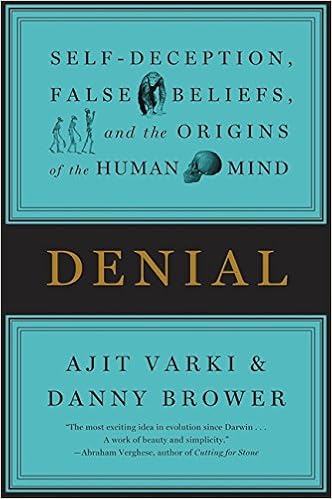
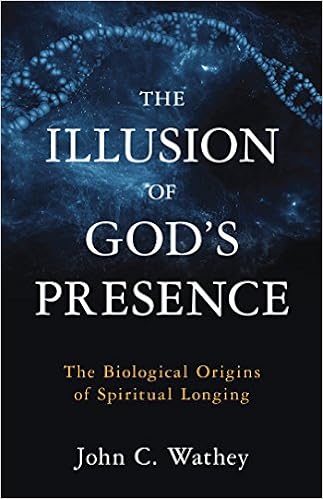
Which Is Based On The Hypothesis That Belief In G0D And The Afterlife Occurred Once Homo Sapiens Evolved The Capacity For Denial (Denying Reality)! Read Both Books To See If What I'm Saying Is Accurate!
"HE IS I AND I AM HIM, SLIMWIT THE TILTEDBRIM!" - NIGGA DOGGY DOGG!
At
the heart of all the mystic's descriptions, however, is the compelling
conviction that they have risen above material existence, and have
spiritually united with the absolute. The primordial longing for this
absolute union, and the transcendent experiences to which it might lead,
are the common threads that run through the mystical traditions of East
and West, of ancient centuries, and of the present. And while the
mystics of different times and traditions have used many techniques to
attain this lofty union, from the pious self-denial of medieval
Christian saints to the ritual sexuality of some tantric Buddhists, the
mystical states they describe sound very much the same. For
example, here is the Sufi master Hallaj Husain ibn Mansur, a resident of
medieval Iraq, describing the intimate intermingling of the mystic and
his Lord:
I am He Whom I love, and He whom I love is I:
We are two spirits dwelling in one body.
If thou seest me, thou seest Him,
And if thou seest Him, thou seest us both.
The
medieval Catholic sage Meister Eckhart, writing from the cooler climes
of Germany, had similar words to say on the very same subject:
How
then am I to love the Godhead? Thou shalt not love him as he is: not as
a God, not as a spirit, not as a Person, not as an image, but as sheer,
pure One. And into this One we are to sink from nothing to nothing, so
help us God.
The theme of unity echoes in the Taoist wisdom of Lao-tzu...
Ordinary men hate solitude
But the Master makes use of it,
embracing his aloneness, realizing
he is one with the whole universe
...Christian
mystics relied upon intense contemplative prayer, fasting, silence, and
various forms of mortification to free their minds from mundane matters
and focus more intently upon God. These disciplines emerged
independently, but all are based on a common insight; The first step in
attaining mystical union is to quiet the conscious mind and free the
spirit from the limiting passions and delusions of the ego.
"The separate self dissolves in the sea of pure consciousness, infinite, and immortal," says Hindu scripture.
"Separateness arises from identifying the Self with the body, which is
made up of the elements; when this physical identification dissolves,
there can be no more separate self. This is what I want to tell you,
beloved."
...In her book A History of God,
religion scholar Karen Armstrong explains that the goal of Greek
mysticism was to gain "a freedom from distraction and multiplicity, and
the loss of ego - an experience that is clearly akin to that produced by
contemplatives in nontheistic religions like Buddhism. By
systematically weaning their minds away from their 'passions' - such as
pride, greed, sadness, or anger which tied them to the ego - hesychiasts
would transcend themselves and become deified like Jesus on Mt. Tabo,
transfigured by the divine 'energies.'"
Armstrong finds similar ideas among the Islamic mystics, called Sufis, who developed the concept of 'fana, or
annihilation, which was brought about by a combination of fasting,
sleepless vigils, chanting, and contemplation, all intended to induce
altered states. These behaviors often resulted in actions that seemed
bizarre and uncontrolled, which, according to Armstrong, earned those
mystics who practiced such techniques the nickname of the "drunken"
Sufis. The first drunken Sufi was Abu Yizad Bistami who lived in the
ninth century, and whose introspective disciplines, Armstrong says,
carried him beyond any personalized conceptions of God.
"As
he approached the core of his identity," she writes, "he felt that
nothing stood between God and himself; indeed, everything that he
understood as 'self' seemed to have melted away:
I
gazed upon [Allah] with the eye of truth and said to Him: "Who is
this?" He said, "This is neither I nor other than I. There is no God but
I." Then he changed me out of my identity into His Selfhood...Then I
communed with him with the tongue of his Face saying: "How fares it with
me with Thee?" He said, "I am through Thee, there is no god but Thou."
Bistami
had united with God, Armstrong says, had become a part of God, beyond
his self. In Armstrong's words, "This was no external deity 'out there,'
aline to mankind: God was discovered to be mysteriously identified with
the inmost self. The systematic destruction of the ego led to a sense
of absorption in a larger ineffable reality."
"THERE IS NO OTHER THAN ME. A PROPHET, A MAC MESSIAH! TURN WATER TO HENNESSEY!" - MAC ALLAH
In
their follow-up study Johnstone and colleagues found that, as before,
patients with damage to their right parietal lobe (as measured by their
ability to judge the orientation of lines and ability to identify the
fingers on their left hand) were more spiritual. In particular, they
tended to score higher on measures of forgiveness (so they were less
‘self-oriented’) as well on measures of spiritual transcendence (tending
to agree with statements like “I feel the presence of a higher power”).
In contrast, patients with damage to their frontal lobe (measured using a kind of‘connect the letters and numbers’ puzzle) tended to beless likelyto engage in private religious practices and go to church. There was also some evidence that they tended to be less spiritual.
Johnstone
et al suspect that the link between the right parietal lobe and
spirituality comes about because damage to this part of the brain makes
it harder to locate yourself in 3D space. So there is a tendency to feel
that you are somehow merged or blurred in with your environment – hence
the sensations of spiritual transcendence.
They
don’t speculate on the link between better frontal lobe function and
religious activities per se (focussing instead on the spirituality link)
but I find this result intriguing. The frontal lobe is involved in
classic ‘figuring stuff out’ actions, as well as social functioning. So
it seems likely that good frontal lobe function could be important to
this aspect of religiosity.
https://www.youtube.com/watch?v=hxDSOh66oWk 9:23 The BRAIN Has Evolved Neural Wiring That CreateS The
Sensations, Thoughts, And Beliefs That, For Centuries, WERE Attributed
To GOD's Presence Or GOD's Connection With You. So When You're Deep In
Prayer Or Singing A Hymn In Church With The Rest Of The Congregation And
You Feel That Closeness To GOD (That Transcendence) The Neurons In The
GOD Region Of Your
Brain Are Just Firing! (Those Parts Of Your Brain That Are Responsible
For Belief In God, The Feeling Of The Presence Of God, Religious Out Of
Body Experiences, Etc. Are Triggered By Neurochemicals, Electrical
Signals, Etc. In The Brain Resulting In The Heightened Mental State Of
Arousal That You Experience! In Other Words, The Concept Of God And The
Sense That God Is With You Or You're With God, Are All A Product Of The
Genetic And Biological Functioning Of The Brain!)
During
brain scans of those involved in various types of meditation and
prayer, Newberg noticed increased activity in the limbic system, which
regulates emotion. He also noted decreased activity in the parietal
lobe, the part of the brain responsible for orienting oneself in space
and time.
“When
this happens, you lose your sense of self,” he says. “You have a notion
of a great interconnectedness of things. It could be a sense where the
self dissolves into nothingness, or dissolves into God or the universe.”
Such “mystical”, self-blurring experiences are central to almost all religions – from theunio mysticaexperienced
by Carmelite nuns during prayer, when they claim their soul has mingled
with the godhead, to Buddhists striving for unity with the universe
through focusing on sacred objects. But if Newberg and his colleagues
are correct, such experiences are not proof of being touched by a
supreme being, but mere blips in brain chemistry.
“It
seems that the brain is built in such a way that allows us as human
beings to have transcendent experiences extremely easily, furthering our
belief in a greater power,” Newberg says. This would explain why some
type of religion exists in every culture, arguably making spirituality
one of the defining characteristics of our species.
They
found that people of different religious persuasions and beliefs, as
well as atheists, all tended to use the same electrical circuits in the
brain to solve a perceived moral conundrum – and the same circuits were
used when religiously-inclined people dealt with issues related to God.
The
study found that several areas of the brain are involved in religious
belief, one within the frontal lobes of the cortex – which are unique to
humans – and another in the more evolutionary-ancient regions deeper
inside the brain, which humans share with apes and other primates,
Professor Grafman said.
"There
is nothing unique about religious belief in these brain structures.
Religion doesn't have a 'God spot' as such, instead it's embedded in a
whole range of other belief systems in the brain that we use everyday,"
Professor Grafman said.
The
search for the God spot has in the past led scientists to many
different regions of the brain. An early contender was the brain's
temporal lobe, a large section of the brain that sits over each ear,
because temporal-lobe epileptics suffering seizures in these regions
frequently report having intense religious experiences. One of the
principal exponents of this idea was Vilayanur Ramachandran, from the
University of California, San Diego, who asked several of his patients
with temporal-lobe epilepsy to listen to a mixture of religious, sexual
and neutral words while measuring their levels of arousal and emotional
reactions. Religious words elicited an unusually high response in these
patients.
This
work was followed by a study where scientists tried to stimulate the
temporal lobes with a rotating magnetic field produced by a "God
helmet". Michael Persinger, from Laurentian University in Ontario, found
that he could artificially create the experience of religious feelings –
the helmet's wearer reports being in the presence of a spirit or having
a profound feeling of cosmic bliss.
The universality of religious behavior suggests that, as with language, it is mediated by specialized structures in the brain.
Language is known to be supported by neural circuitry in certain
regions of the brain because, if these regions are damaged even
minutely, specific defects appear in a patient's linguistic abilities.
No such dedicated regions have yet been identified with certainty for
the neural circuitry that may underlie religious behavior. Excessive
religiosity is a well-know symptom of temporal lobe epilepsy and could
reflect the activation of neural circuits associated with religious
behavior. But there is no agreement on this point, and the search for
such circuitry in people who don't suffer from epilepsy is "suggestive
but not conclusive," according to the neurologist Steven Schachter. It
could be that religious behavior itself does not require a dedicated
brain region large enough to be detectable by present methods. The fact that religious behavior is universal
strongly suggests that it is an adaptation, meaning a trait shaped by
natural selection. If it is an adaptation,
it must have a genetic basis, such as a suite of genes that are
activated during development and wire up the neural circuits needed to
induce the behavior. Identification of such genes would be the best possible proof that religious behavior has an evolutionary basis. The
lack of any progress in this direction so far is not particularly
surprising: the genes that underlie complex diseases have started to be
identified only recently and funds to support such expensive efforts are
not available for studying nonmedical complex traits.
An
indirect approach to the genetic basis of religious behavior is through
psychological studies of adopted children and of twins. Such studies
pick up traits that vary in the population, such as height, and estimate
how much of the variation is due to environmental factors and how much
to genetics. But the studies cannot pick up the
presence of genes that do not vary; genes for learning language, for
example, are apparently so essential that there is almost no variation
in the population, since everyone can learn language. If religious
behavior is equally necessary for survival, then the genes that underlie
it will be the same in everyone, and no variation will be detectable.
Religious behavior itself is hard to quantify, but studies of religiosity - the intensity with which the capacity for religious behavior is implemented - have shown that it is moderately heritable, meaning that genes contributed somewhat, along with environmental factors, to the extent of the trait's variation in the population. "Religious
attitudes and practices are moderately influenced by genetic factors," a
large recent study concludes. Another survey finds that "the
heritability of religiousness increases from adolescence to adulthood,"
presumably because the influence of environmental factors decreases in
adulthood (when you leave home you go to church if you want to, not
because your parents say so). The aspects of religiosity that
psychologists measure include factors like frequency of church
attendance and the importance assigned to religious values. Their studies show that there are genetic influences at work on the intensity of religious behavior, but
do not yet reach to the heart of the issue, that of probing the neural
circuitry for learning and practicing the religion of one's community.
In
the absence of direct evidence about the genes underlying religious
behavior, its evolutionary basis can be assessed only indirectly. The
effect of cultural learning in religion is clear enough, as shown by the
rich variety of religions around the world. It's
the strong commonalities beneath the variation that are the
fingerprints of an innate learning mechanism. The common features seem
very unlikely to have persisted in all societies for the 2,000
generations that have elapsed during the 50,000 years since the
ancestral human population dispersed from its African homeland, unless
they have a genetic basis. This is particularly true given the complexity of religious behavior, and its rootedness in the emotional levels of the brain.
To
no less an observer than Darwin himself it seemed that religion was
like an instinctive behavior, one that the mind is genetically primed to
learn as indelibly as the fear of heights or the horror of incests. His two great books on evolution, Origin of Species and Descent of Man,
have nothing directly to say about religion but in his autobiography,
written in his old age, he was more explicit about this controversial
topic. He wrote, "Nor must we overlook the probability of the constant
inculcation in a belief in God on the minds of children producing so
strong and perhaps an inherited effect on their brains not yet fully
developed, that it would be as difficult for
them to throw off their belief in God, as for a monkey to throw off its
instinctive fear and hatred of a snake. ...
The neural circuitry that predisposed hunters and gatherers to learn the
religion of their community remained the basis of religious behavior.
The Faith Instinct. Wade, p. 43-45, 133.





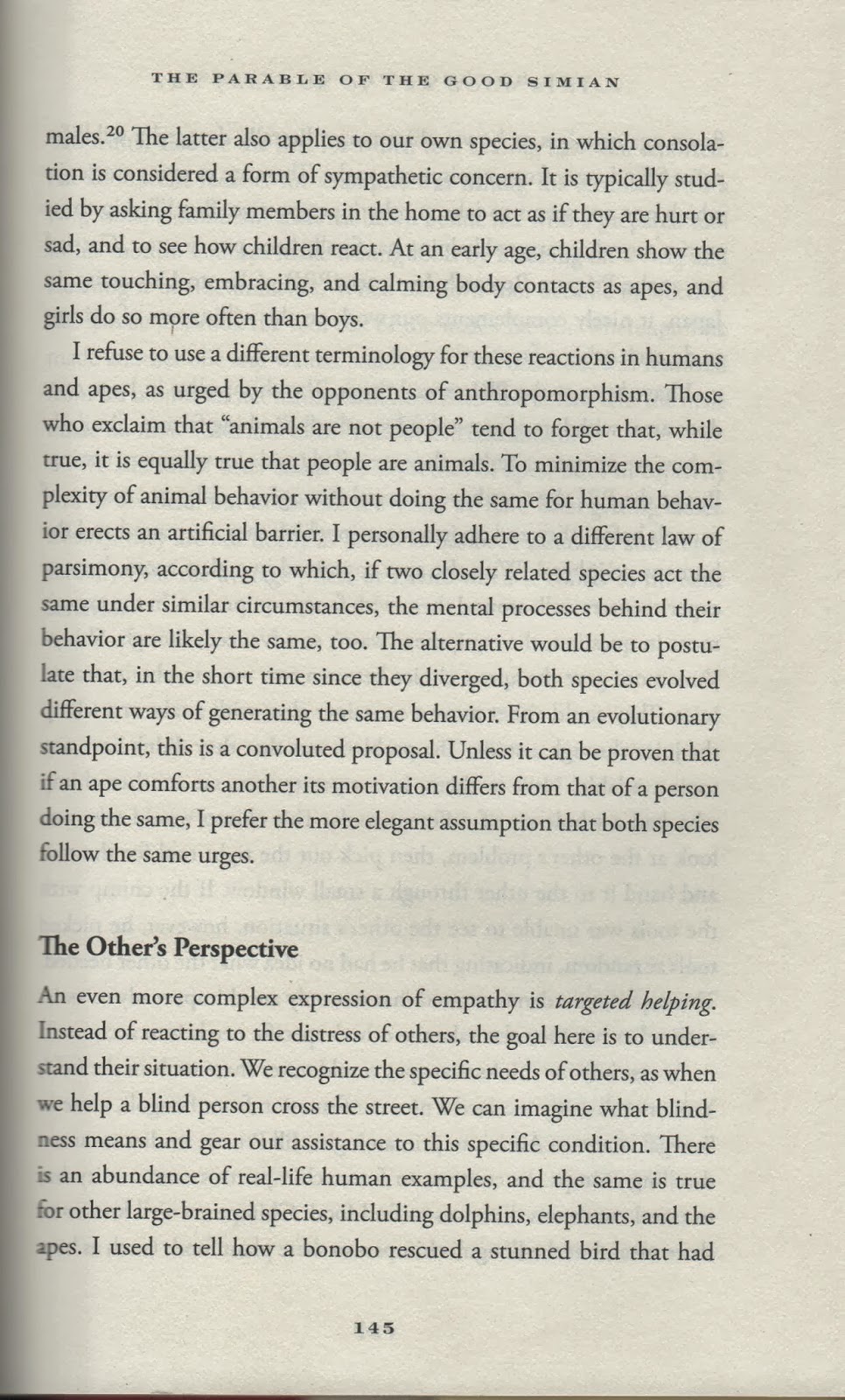



 Rolf Degen